Alva Noë argues that neuroscience can't help us understand why we love certain works of art:
An account of how the brain constrains our ability to perceive has no greater claim to being an account of our ability to perceive art than it has to being an account of how we perceive sports, or how we perceive the man across from us on the subway. … Some of us might wonder whether the relevant question is how we perceive works of art, anyway. What we ought to be asking is: Why do we value some works as art? Why do they move us? Why does art matter? And here again, the closest neural scientists or psychologists come to saying anything about this kind of aesthetic evaluation is to say something about preference. But the class of things we like, or that we prefer as compared to other things, is much wider than the class of things we value as art.
Noah Hutton disagrees:
Why do I value Monet’s Impression Sunrise? For many reasons. Some art historical– its significance to the school of impressionism, its departures and influences. Some personal and indescribable– waves of feeling, a sudden mood. And some reasons, despite Noë’s overbearing negativity, stemming from recent offerings of perceptual neuroscience.
… [Margaret Livingstone’s Vision and Art] led me to some new questions I hadn’t really considered before in studying art history: Maybe some artists have intuitively, quite unconsciously, tapped into universal features of our neurobiology to induce widespread appreciation of their artistic output? Maybe it follows, then, that it could be interesting and useful to study these universal aspects of our biology of perception?
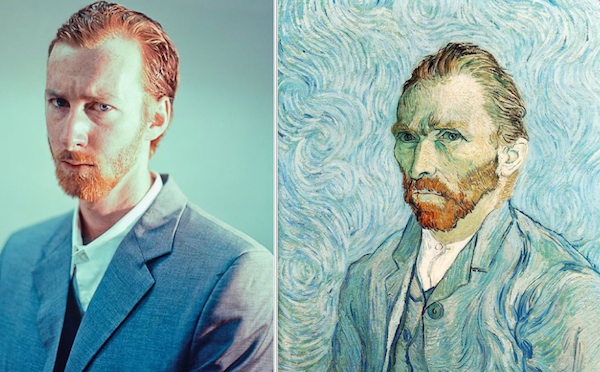
(Image: "Self Portrait 1889" by Vincent van Gogh and a remake by Seth Johnson from Booooooom!, a Vancouver-based art blog that asked photographers to remake classic works of art.)
 The Dish