In a new book Jean-Louis Cohen argues that changes in architecture and design were a major legacy of WWII. Josh Rothman summarizes:
During the war, military manufacturers needed huge, windowless buildings large enough to hide aircraft manufacturing; today, the same sorts of structures are used for "big box" stores and factories everywhere. During the war, buildings often had to be prefabricated; today, prefab houses and sheds are in nearly every American town. Inspired by the Jeep — an off-road vehicle first built for the war, in 1941 — postwar auto designers moved away from the heavily-ornamented, luxury aesthetic of the prewar automobile, and started designing simpler, more utilitarian-looking cars. "Domestic interiors," Cohen writes, "were influenced by the compact spaces created in vehicles, airplanes, and ships."
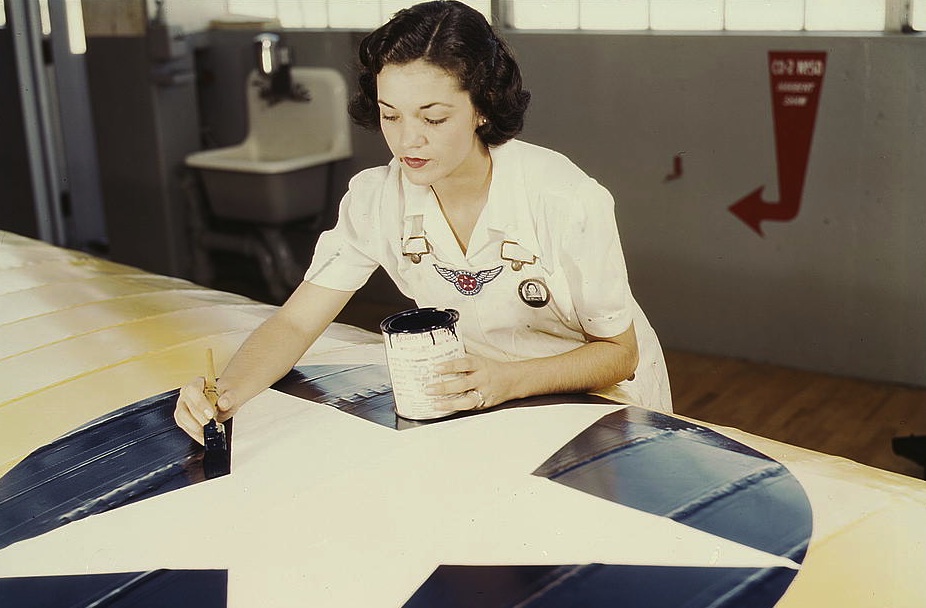
(Photo: Mrs. Irma Lee McElroy, a former office worker, paints the American insignia on airplane wings in August of 1942. By the Library of Congress.)
 The Dish