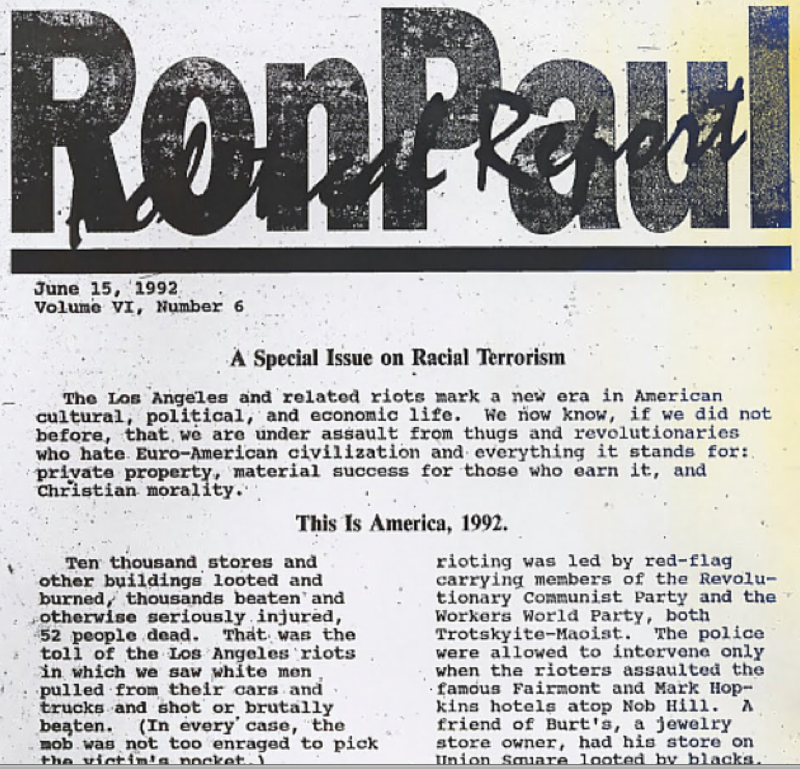
Ed Morrissey fears that Paul would be a disaster in the general election and mostly focuses on Paul's racist newletters in order to make his case:
What do Republicans who are considering Paul as the nominee think will happen if he wins a spot on the Republican ticket? The Obama campaign will have a field day running these [newsletters] in advertisements and painting their opposition as entirely consisting of old racists, even if Paul starts issuing vague regrets for his newsletters and instructs people to read them in full context. The last two weeks have seen Republicans debate what Mitt Romney was thinking when he said he had “progressive views” in 2002 or when Gingrich was lauding FDR as one of the greatest presidents of all time even longer ago than that. Aren’t these statements a few orders of magnitude more disturbing?
Jeffrey Lord piles on. Chait calls Paul a "huge racist":
The slight complicating factor is that Paul’s newsletter was unsigned, so even though it purported to express his views, he can plausibly deny having authored any single passage personally. But the general themes of white racial paranoia are so completely pervasive that the notion that they don’t represent Paul’s own thinking is completely implausible. It is possible that another contributor could have snuck in a line here or there that did not reflect Paul’s thinking, but they couldn’t have set the consistent ideological line for his newsletter. Paul may be a dissident from the main thrust of Republican policy-making but this is not because he’s more tolerant or more sensible than the leaders of the GOP. It’s because he’s crazier.
Dave Weigel points to his old reporting on the subject. In short: "Paul said he had no idea who wrote the letters, which wasn't very credible, but my sense was that he really didn't harbor the sorts of thoughts that appeared in the letter." Why Paul hasn't been attacked over his newsletters this campaign:
Paul's very strong in Iowa and strong in New Hampshire. But after those states vote, the race moves to South Carolina and Florida. The first state has always been one of Paul's weakest. The second state is simply too large for Paul's fans to overwhelm the vote like they can in Iowa caucuses or in the relatively small New Hampshire primary. They're mostly closed primaries, with no ways for liberal anti-war Democrats to boost Paul. So Republicans don't think Paul will grow beyond his new, fairly large subsection of the GOP. Paul only becomes a problem to them if the race continues to the caucus states that he performed very well in last time, where he's had extra time and money to organize.
Image of a Ron Paul newsletter from here. Jamie Kirchick exposed such material in the last presidential cycle. My response at the time here.
 The Dish