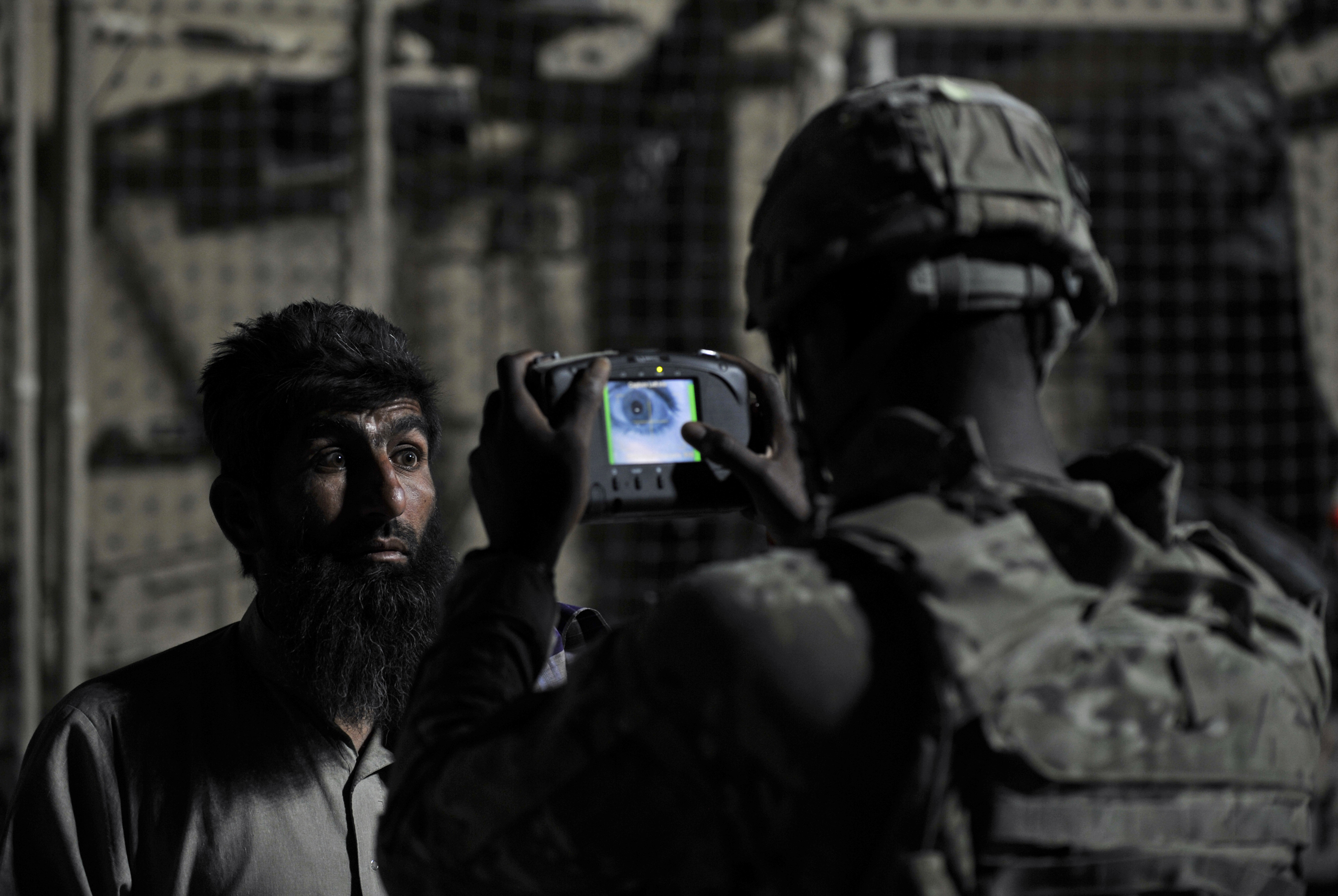
Each year developing countries lose millions when people pose as police, teachers, and bureaucrats in order to collect cash payments or pensions. Biometric data, like iris scans or fingerprints, offers a novel solution:
After Liberia’s 14-year civil war, Princeton’s Jonathan Friedman reported recently, the successful switch to biometric IDs for paying civil service employees saved the government $4 million annually. Malawi is saving $2 million a month, it announced in May, after abandoning cash salary payments. In Afghanistan, USAID announced its hopes to convert 400,000 personnel payments into mobile payments after a pilot program found that 10 percent of payments were going to nonexistent policemen.
Earlier coverage of India's plan to scan the irises of 1.2 billion people here.
(Photo: SPC Tolbert Brandon from the US army HHB 3-7 Field Artillery Regiment 3rd Bct 25th ID scans the eyes of an Afghan man with Automated Biometric Identification System (ABIS) during a mission in Turkham Nangarhar on September 28, 2011. By Tauseef Mustafa/AFP/Getty Images)
 The Dish