Exum fumes over Obama's decision to allow Ali Abdullah Saleh to get medical care in New York:
That sound you subsequently heard this evening was America's Yemen experts (all three of them!) banging their heads on their desks in frustration. What kind of message does it send to the people of Yemen and the greater region when the United States allows an abusive autocrat to take refuge in a New York hospital while his people demonstrate in support of democracy in the face of bullets from his security forces? Just whose side is the United States on in the Arab Spring? If Bashar al-Asad gets pancreatic cancer, should we expect for him to be treated at Johns Hopkins?
How, you might ask, did this golf foxtrot come to pass? An aforementioned strength of this administration — its ruthless and successful campaign to decimate al-Qaeda and its affiliates — is also a weakness in that it overshadows everything else and causes the administration to see entire regions of the globe through a [counterterrorism]-shaped soda straw.
Paul Pillar nods. Daniel Serwer situates the mistake as part of a broader failure in Yemen policy:
The conditions that enable Al Qaeda to thrive in Yemen are not going away so long as Saleh and his family maintain their autocratic rule. It may be tactically convenient to get Saleh to the U.S., but it is strategically stupid for the United States to remain in his pocket, snookered into supporting his sons as the only bulwark against Al Qaeda in the Arabian Peninsula. The problems that make Yemen home to Al Qaeda in the Arabian Peninsula go far beyond terrorism: sectarian and secessionist rebellions are raging north and south, water and oil are running out, qat is king, poverty is endemic and abuse of the population is reaching epic proportions.
Any serious counter-terrorism effort in Yemen should include this bigger picture, as John Brennan knows. But I fear it does not. If Saleh comes to the U.S. it will be a symptom of a much bigger problem with U.S. policy in Yemen.
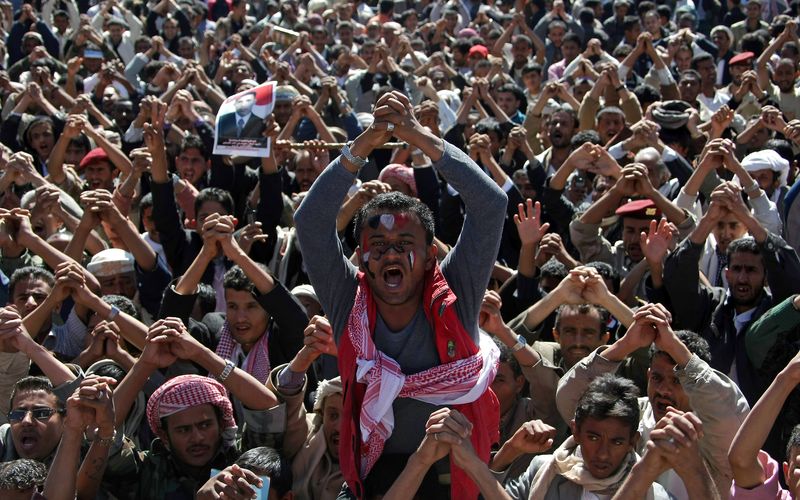
(Photo: Yemeni anti-government protesters raise their hands while shouting slogans during a demonstration calling for the trial of outgoing Yemeni president Ali Abdullah Saleh in Sanaa on December 27, 2011. By Mohammed Huwais/AFP/Getty Images.)
 The Dish