George F Will gives the conservative critique of Newt Gingrich. He pivots to Huntsman. In a sane world, so would the entire party.
Month: December 2011
The Art Of Icons

Steve Silberman revisits the work of Susan Kare, the artist tasked with creating fonts and a friendly interface for Apple:
[S]he mined ideas from everywhere: Asian art history, the geeky gadgets and toys that festooned her teammates’ cubicles, and the glyphs that Depression-era hobos chalked on walls to point the way to a sympathetic household. The symbol on every Apple command key to this day — a stylized castle seen from above — was commonly used in Swedish campgrounds to denote an interesting sightseeing destination. …
I asked Kare if she had any feeling at the time that the work she was doing at Apple 30 years ago would be so pervasively influential. "You can set out to make a painting, but you can’t set out to make a great painting," she told me. "If you look at that blank canvas and say, ‘Now I’m going to create a masterpiece’ — that’s just foolhardy. You just have to make the best painting you can, and if you’re lucky, people will get the message."
Silberman showcases some of Kare's original notebook drawings, which are featured in her self-published book Susan Kare Icons.
Texts From Bennett Update
The party poopers at TSG claim it's a total hoax. Well, not total:
Asked by TSG if his son had a 17-year-old cousin named Bennett, Sheldon’s father, also named David, laughed and said, “That’s what he says.”
The elder Sheldon went on to note that his son has a friend who is prone to "Yogi Berraisms" and that he uses some of these malaprops for the “Bennett” blog. The friend’s name, he said, “has been changed to protect the innocent.”
“Mac writes them,” Sheldon said, “and puts it in the form of texts.”
Someone needs to hire that dude as a comedy writer. Dish fave texts from Bennett here.
The Nuanced Moral Sensibilities Of Babies
Ed Yong is blown away by a new study:
When we make moral judgments, we do so subtly and selectively. We recognise that explicitly antisocial acts can seem appropriate in the right circumstances. We know that the enemy of our enemy can be our friend. Now, Kiley Hamlin from the University of British Columbia has shown that this capacity for finer social appraisals dates back to infancy – we develop it somewhere between our fifth and eighth months of life. … Uta Frith, who studies child psychology at UCL, says … "To me this says that toddlers already have more or less adult moral understanding. Isn’t this amazing? I don’t know in what way adults would react in the same situation in a more sophisticated way."
The View From Your Window Contest

You have until noon on Tuesday to guess it. City and/or state first, then country. Please put the location in the subject heading, along with any description within the email. If no one guesses the exact location, proximity counts. Be sure to email entries to VFYWcontest@gmail.com. Winner gets a free The View From Your Window book. Have at it.
Why Pay For Channels You Don’t Watch? Ctd
A reader writes:
Former telecom industry attorney here. Alyssa Rosenberg may have her finger on the pulse of what the growing young consumer base wants (and for what it's worth, I completely agree), but the economics of a switch to more flexible channel delivery – combined with FCC policy priorities – really make a la carte (or any version thereof) unrealistic.
The theoretical benefits to consumers are undercut by the economics for programmers. Currently, the big networks – ESPN, CNN, Discovery, the Scripps Network Interactive lifestyle channels (Food, HGTV, etc.) – have strong enough viewer shares that they can force cable companies to pay them for their wares, giving them an additional revenue stream to fund the programming you love. Here's the catch: that only works if every subscriber pays that fee, not just the ones who watch it, and while almost everyone watches at least one of those channels, the portion watching each one isn't nearly as high as you'd think.
The fees these networks charge are very secretive (even the trade rags only publish guesses), but right now, ESPN is rumored to charge around $8/subscriber (the highest by leaps and bounds; CNN and the others float somewhere around $1-$2 a sub based on scuttlebutt). If forced to go a la carte and only collect the fee for each subscriber who affirmatively chose that station, these programmers will raise their per subscriber fees to whatever level necessary to maintain the revenue stream without batting an eyelash. The result? You'd end up paying about the same amount each month, but for fewer channels. You've essentially exchanged the benefit of channel surfing for unexpected programming for the benefit of not needing to wade through channels you don't watch when scanning the channel guide. That's not really much of an improvement in consumer welfare.
The other issue, as she starts to note, is that a move to any more flexible system (even not strict a la carte) will cause "a bunch of networks [to] die in the process." The problem is that the majority of those that will be killed are stations owned by, or with programming oriented toward, women, minorities, and foreign language audiences. (To be clear, when I say "women-oriented programming", I'm talking Lifetime and We, networks whose audiences are almost solely women within specific age demographics, versus, say, Bravo, which draws from both sexes and a wider age range – ladies, no disrespect!) The business model for those stations, given their more limited natural audience base, is simple: give your programming to cable/satellite operators for free, and use the universal distribution to raise your ad rates while hoping that the additional exposure gains you more casual viewers. The FCC encourages this with policies that support the carriage of such stations, and cable companies often use their carriage of such stations as a sort of "good actor" shield when accused of more nefarious behavior.
Under a la carte, however, those stations lose all their casual viewers, who – when asked to affirmatively opt into channels, all of which the cable company will charge them SOMETHING for (as the price of convenience for not sending you everything) – will not check their boxes. That means fewer viewers, lower ad revenues, and near certain failure for most. Advocates for these channels have made darn sure the FCC sees these numbers. Politics being as they so often are, no FCC commissioner wants to be the person advocating a la carte when they know they will get tremendous brush back from the NAACP and other groups – especially, as described above, when the benefits to consumers are tenuous and limited.
Ask Me Anything: Favorite Novel?
Romney’s Plan To Destroy Newt
Josh Marshall is underwhelmed by it:
According to Mitt advisors, one of their key hits against Gingrich will be that he’s a flip-flopper. And this won’t just hurt Newt, apparently, it will also serve to inoculate Romney from charges that he’s a flip-flopper.
Did you hear that? Pushing the flip-flopper issue against Gingrich will help Romney? There are plenty of ways to hit Newt and by any reasonable measure he’s a very vulnerable candidate. But for Mitt Romney to push the idea that Newt’s a flip-flopper seems wildly nuts — one of those over-clever ideas that political operatives are spinning out to reporters all the time but usually wise-up before actually trying.
Googlemapping The Cartels
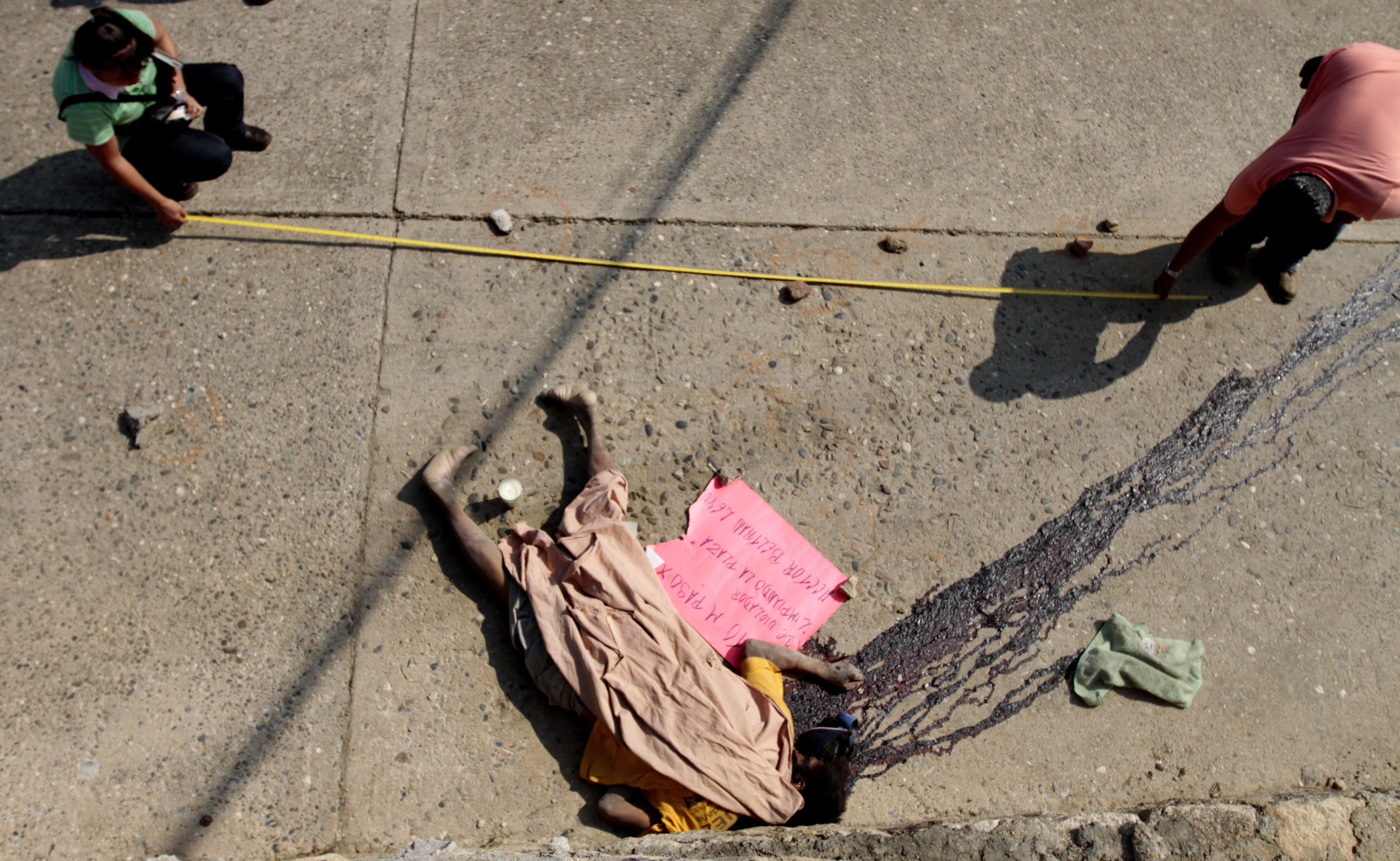
Ray Fisman explains how, using Google Maps and an algorithm, MIT's Melissa Dell might predict the next frontlines in Mexico's drug war:
According to Dell, the cartels have behaved like textbook economic actors, shifting their trafficking routes in predictable ways to circumvent towns where the government has cracked down and raiding towns where competing cartels have been weakened by government efforts. Drug confiscations in the communities where Dell predicts traffickers will relocate to following a crackdown increase by about 20 percent in the months following close PAN [President Calderón’s party] victories. It’s a reminder that crime fighting is a bit like Whac-A-Mole—smothering traffickers’ activities in one locale merely causes them to shift their operations elsewhere.
(Photo: Investigators examine a crime scene where the corpse of a man with a notice attributing the crime to a drug cartel lies in the touristic port city of Acapulco, on November 10, 2011. By Pedro Pardo/AFP/Getty Images.)
The Right To Privacy In The Digital Era
In his new book, Constitution 3.0: Freedom and Technological Change, Jeffrey Rosen measures how endangered that right may become. He imagines a scenario where websites like Google and Facebook could "someday potentially post video from live surveillance cameras online — and then archive those videos in a database," which combined with facial recognition software, means police could easily identify most citizens. As unlikely a scenario as it is, according to Rosen, it's also not prohibited in the Constitution:
Facebook is a private actor, the Constitution and the Fourth Amendment only prohibits unreasonable searches and seizures committed by government actors. … I think that helps crystallize the fact that at the moment, lawyers at Facebook and Google and Microsoft have more power over the future of privacy and free expression than any king or president or Supreme Court justice. And we can't rely simply on judges enforcing the existing Constitution to protect the values that the Framers took for granted.
 The Dish