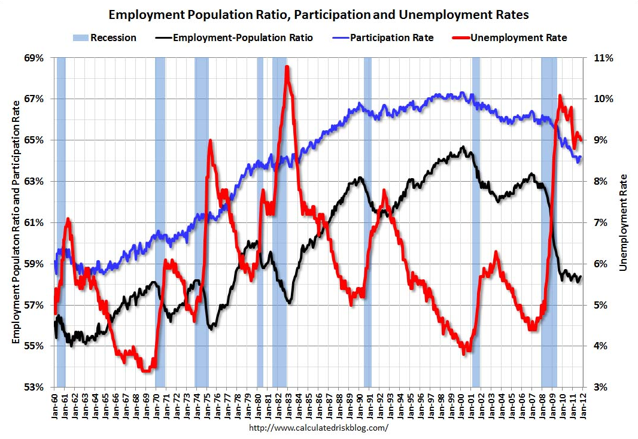
A reader notes something in the graph from Calculated Risk below. The data for the employment-population ratio, unemployment rate, and participation rate for this month are uncannily similar to the mix that Reagan faced in his third year in office. The difference, of course, is that the current economic context is far worse globally than in 1983 and the chance of a very rapid improvement close to zero. But if the narrative of recovery accelerates in the coming year, a big if, the parallels will once again be striking.
Month: December 2011
Our Cold War Defense Budget
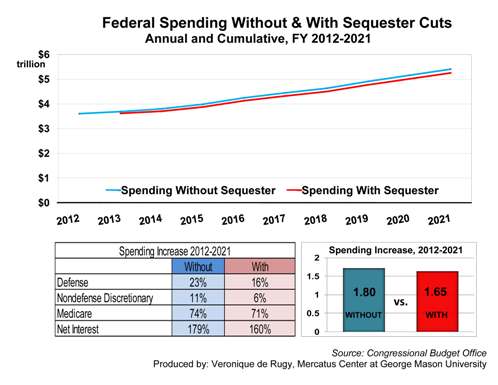
Is very much intact. Spare R.M. at DiA on the doomsday hysteria:
[T]he defence budget was slated to increase some 23% between 2012 and 2021. Now, according to Veronique de Rugy, the Pentagon will have to make do with a 16% boost. … Or to put it another way, as Lawrence Korb does, the "sequestration will return defense spending in real terms to its FY 2007 level, the next to last year of the Bush administration, when no one was complaining about devastating levels of spending." At a time when money is tight, that would seem reasonable, no? According to Winslow Wheeler, of the Center for Defense Information, the FY2007 level of funding would be higher, in real terms, than average annual military spending during the cold war.
What we desperately need is what Gingrich would call a total, profound re-evaluation of our real defense – as opposed to offense – needs. The Pentagon should be spending far less than it did during the Cold War. And given the enormous political resistance to the profound entitlement reform we need, the Pentagon may have to bear the brunt of retrenchment.
What’s The Difference Between Romney And A Robot?
We can relate to a robot. A reader writes:
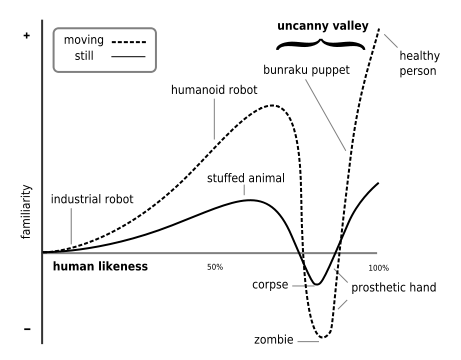
Your description of Mitt today – "Romney looks so studiedly presidential he's coming out the other side as un-presidential." – reminds me of the uncanny valley, which is a principle of robotics and by extension computer graphics that asserts that when human replicas look and act almost, but not perfectly, like actual human beings, it causes a response of revulsion among human observers.
Perhaps there's a presidential uncanny valley, and Mitt's smack at the bottom of it.
From Wiki:
The uncanny valley may "be symptomatic of entities that elicit a model of a human other but do not measure up to it." If an entity looks sufficiently nonhuman, its human characteristics will be noticeable, generating empathy. However, if the entity looks almost human, it will elicit our model of a human other and its detailed normative expectations. The nonhuman characteristics will be noticeable, giving the human viewer a sense of strangeness. In other words, a robot stuck inside the uncanny valley is no longer being judged by the standards of a robot doing a passable job at pretending to be human, but is instead being judged by the standards of a human doing a terrible job at acting like a normal person. This has been linked to perceptual uncertainty and the theory of predictive coding.
From the above chart, by Masahiro Mori, Romney looks as if he is probing zombie territory. I think zombies have a more solid identity myself.
Ask Me Anything: Favorite Holiday?
Newt On Food Stamps
Lies, more lies and a few racially-tinged fantasies, for good measure.
Arianna Huffington: Why Newt Must Run!
A stroll down memory lane. Money quote:
Gingrich may be a lightning rod, but he also embodies the revolution like no one else. He is its most articulate, self-confident, and unapologetic voice, and he burns with conviction that America can and will be a better place because of it. And if he's sufficiently freed up from the punishing legislative schedule of the last few months, he can rediscover the youthful realization that drove him to dedicate his life to politics in the first place: that at certain critical moments in history, effective leadership is all that stands between a civilization and its collapse.
Yes, that was 1995.
8.6% Unemployment
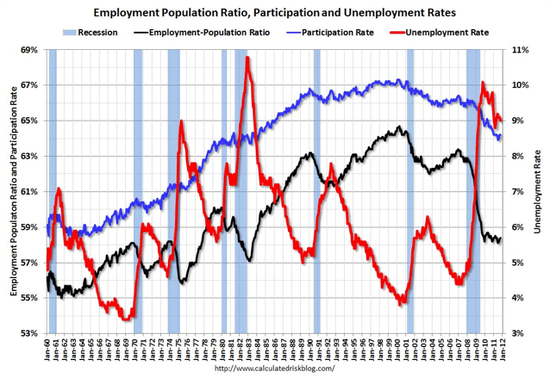
The unemployment rate fell by more than expected. The above chart from Calculated Risk helps explain how this happened:
The Labor Force Participation Rate was declined to 64.0% in November (blue line). This is the percentage of the working age population in the labor force. The participation rate is well below the 66% to 67% rate that was normal over the last 20 years, although some of the decline is due to the aging population.
Brad Plumer digs deeper:
[S]ome economists have argued that the labor force participation rate has been steadily shrinking over time due to structural changes in the economy. It’s not just the horrible job market that’s responsible. The Congressional Budget Office, for instance, expects the participation rate to keep dropping in the years to come, even after the economy recovers. Why is that? For one, the baby boomers will all start retiring. But the share of women who chose to work has also fallen to its lowest level in nearly 20 years. And, at the same time, the percentage of young people who are looking for work has dropped by quite a bit.
Felix Salmon focuses on the Employment-Population ratio (the black line above):
[W]hile numbers matter in election campaigns, it’s people who vote. And they vote based on their own personal experiences, rather than on macroeconomic statistics. And the fact is that if you’re a person in America, the likelihood that you have a job was unchanged this month: the employment-to-population ratio ticked up just one tenth of one percentage point.
Pejman Yousefzadeh makes related points:
[O]nce we get past the surprise of having the unemployment rate fall below 9%–and it is a measure of just how bad the jobs situation is that a fall below 9% counts as a “surprise”–we are still left with a nasty jobs picture. And that means–among other things–a nasty political picture for President Obama, as he heads into the 2012 election cycle.
Doug Mataconis disagrees:
[T]he political importance of the topline unemployment number dropping shouldn’t be underestimated. Notwithstanding the fact that job growth remains anemic, there’s a psychological difference between saying “9% unemployment” and “8% unemployment,” not a big one to be sure, but a difference nonetheless.
Sarah Kliff finds some reason to cheer:
Politico’s Ben White posts this helpful chart, from Hamilton Place Strategies, that shows how much jobs numbers have been tweaked. All told, the Bureau of Labor Statistics have added 231,000 more jobs to their initial estimates just over the past three months:
Greg Ip is also relatively upbeat:
Today's report is no anomaly; it comes on the heels of a run of good data that suggests the American economy so far is defying the recessionary tug from Europe. … What's behind this? I think the best explanation is that a decent recovery would have begun a year ago but for a run of bad luck: the Japanese earthquake and tsunami, the run up in oil prices following the Arab Spring, and the political brinkmanshp in America over the debt ceiling and in Europe over its sovereign-debt crisis.
Jared Bernstein is more negative:
[T]here’s still a great deal of slack in the job market. Average weekly hours worked didn’t budge and hourly wages ticked down slightly—over the past year, hourly earnings, before inflation, are up 1.8%, well behind inflation. In other words, we’re a long way away from providing job seekers and workers with the job and wage increases they need to get ahead. Outside of the public sector, we’re at least moving in the right direction, but very slowly.
More charts on today's jobs report here. I'm impressed by the revisions upward in recent months. It's a change when the revisions end up under-estimating employment, rather than over-estimating this. All in all, I suspect there are some better moods at the White House this morning.
Mitt vs Newt: Has The GOP Already Lost?
Charles Krauthammer has about as honest a column as can be expected from a Republican partisan at this point in time. It's not pretty, even though the economic fundamentals should make this an election tilted strongly toward the opposition. Money quote:
Two ideologically problematic finalists: One is a man of center-right temperament who has of late adopted a conservative agenda. The other is a man more conservative by nature but possessed of an unbounded need for grand display that has already led him to unconservative places even he is at a loss to explain, and that as president would leave him in constant search of the out-of-box experience — the confoundedly brilliant Nixon-to-China flipperoo regarding his fancy of the day, be it health care, taxes, energy, foreign policy, whatever.
Scott Johnson vents:
Just when the logic of a Romney candidacy was about to impress itself on me, Romney consented to an interview with Bret Baier on Fox News this week. Like Nixon in 1968, Romney has chosen to avoid these kinds of appearances. I think you can see why in this interview. It is an unimpressive performance. Baier conducts himself in a perfectly professional manner. When challenged with predictable questions by Baier, Romney is by turns discombobulated and even petulant (great line: “We’re going to have to be better informed about my views on issues”) before he recovers his footing toward the end of the interview.
The interview was not a disaster in any objective sense. It was not Palin-Couric. Romney knows his shit. But what came through in the interview, as it pulled apart Romney's chameleon-like record, was that this really is a man without a core. As I have said before, he makes plastic look real. He looks and sounds like some actor who can play the part of president in a Hollywood thriller, but isn't a major role. While Reagan inhabited the role of president, Romney just isn't a good enough actor. You watch that interview and think: how can I trust anything this gelled-hair, crinkly-eyed hologram says?
This is not really ideological. It's personal. And that matters in a presidential candidate. Romney looks so studiedly presidential he's coming out the other side as un-presidential. And on the personal front, Gingrich is even worse. How could such a man unite the country in a major economic or national security crisis? Would you want him or no-drama-Obama in that moment?
I have to say at this point, I'm beginning to wonder if the GOP hasn't already thrown this election. That isn't to say it cannot be won; of course it can (and might even by a hefty margin if we enter another downward spiral). But if Obama is re-elected, and the sequestration defense cuts are enforced and the Bush tax cuts expire, and the ACA becomes irreversible … how will the GOP's strategy over the last three years look like in retrospect?
Newt’s Appeal
A reader writes:
I spent Thanksgiving with my family of formerly-sensible moderates and conservatives. Every one of them has morphed into a Gingrich fan. As much as the commentariat likes to talk about electability, the just-regular-folks I spent the holidays with talked only about how Newt would "hammer" the President during debates. "Can you imagine," my sister said, her eyes as lit-up as a child's on Christmas morning. "When Obama starts that smartest-guy-in-the-room shit, Newt'll shut him up." No one talked about policy or even politics. This is a mob storming the Bastille, cheering the guillotine, and Gingrich is their most likely Robespierre.
Is that feeling widespread enough to get a loon like Gingrich elected? I hope not, and don't think so. But it's enough to get him nominated, and anyone who doubts that needs to get out more. There's a big slice of the electorate that has lost all perspective. The only thing they're interested in is the visceral joy of watching someone destroy and humiliate "that damned Obama." They're convinced that Gingrich is just the guy to administer the rough justice they crave, and whether he's electable or would even be good for the country simply doesn't enter into their thinking.
Yglesias Award Nominee
"Gingrich is a man who possesses undeniable political talents. In my judgment, he’s a much more impressive figure without the apocalyptic rhetoric. But it tells you something about Gingrich that it’s hard to imagine him without it," – Pete Wehner, who expects Newt to throw more rhetorical bombs in the next month.
 The Dish