Why Did Pot Become Illegal?

Michael Krawitz reviews the historical record:

According to Dale Gieringer the very first anti marijuana law was passed in California in 1913. Dr. Gieringer reports that testimony that led up to the ban included this statement from a California pharmacy official: “Within the last year we in California have been getting a large influx of Hindoos and they have in turn started quite a demand for cannabis indica; they are a very undesirable lot and the habit is growing in California very fast…”

Anti-immigrant sentiment may have started the ball rolling, but it wasn’t long until marijuana was seen as a useful weapon to put the genie of African American civil rights back into its bottle. The well-established industry that provided cannabis as medicine was sufficient to keep cannabis out of the first federal drug prohibition law, the 1914 Harrison Act, but the industry apparently had no fight left in it when, after alcohol Prohibition, federal authorities turned their attention toward cannabis

The Saddest Book Ever Written

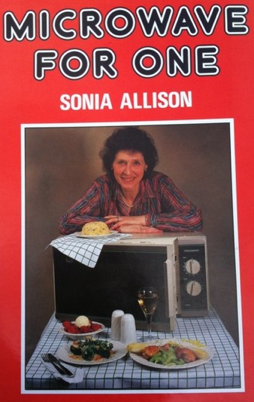
Gabe Habash nominates Microwave for One:

The book is by Sonia Allison, who has quite a few publications under her belt. But she’s6a00d83451c45669e20154379e835d970c best known for her masterpiece of tragedy, a book whose title and cover is so rife with sadness that one almost has the urge to brush the invisible tears from Ms. Allison’s face as she leans over her microwave and her food spread. Very little is known about the contents of the book, except for the few that have been lucky enough to chance upon a copy. Let’s turn to these Amazon customer reviews for some insight. …

Buy this book, or don’t, I don’t care anymore” by Michael Pemulis:

It used to be that I got home from work and the only thing I’d want to put in my mouth was the cold barrel of my grandfather’s shotgun. Then I discovered Sonia Allison’s Chicken Tetrazzini, and now there are two things.

Does Perry Have A Medical Excuse For Mediocrity?

Byran Burrough studies Perry's downfall: 

The most intriguing explanation for Perry’s collapse has been quietly circulating in Austin for weeks. This theory suggests that the governor is suffering from the after­effects of his low-back surgery in July, six weeks before he announced his candidacy; his surgeon, a friend who operates a Houston "medical day spa" specializing in liposuction and laser hair removal, fused two of Perry’s vertebrae and then injected the governor—for the first time in the surgeon’s career—with two teaspoonfuls of stem cells that had previously been cultured from fatty tissue taken from Perry’s hip. 

"Ever since, and you saw this at the very first debate, he just seemed to be very uncomfortable, you know, twisting his torso," observes the dean of Texas political writers, Paul Burka of Texas Monthly. "I think he’s got back pain and may be taking medication for it. He is not on his game. He stopped wearing [his trademark black cowboy] boots and started wearing orthopedic shoes and a back brace. Of course, the campaign denies there is any problem. But he doesn’t seem to have any energy. He just does not look like the same man to me. It’s shocking."

A Photoshop Alert System

Photoshop_Before_After

A Dartmouth project devised one:

The Dartmouth students and their professor developed a tool and system (described on Mashable) to create a "Photoshop rating" for any given image, so that a heavily edited image would get a five, while something untouched would be a zero. Can you imagine a world in which every advertising image or magazine fashion shoot carried, in effect, a warning level, with a "five" standing for the concept "no one really looks like this?" 

More before-and-after photos here.

Why Pay For Channels You Don’t Watch?

Alyssa Rosenberg ponders the future of cable television:

I remain pretty convinced that even if it takes a very long time to unbundle cable, and even if a bunch of networks die in the process, a move towards a more flexible (if not entirely a la carte) multi-platform system is inevitable. The idea that choice is paying for precisely what you want, rather than getting an enormous number of things — some of which you want and some of which you’d gladly see die in a fire — for your money seems pretty well-entrenched in the music industry now, and has always been the case for books. If I were HBO, I’d be pondering a subscription option for HBO GO only: I’m pretty sure I’d pay the $9-odd dollars I pay for my HBO package now for HBO GO only if I didn’t have cable.

Today In Syria: Sanctions And YouTube

Turkey has joined the US-Europe-Arab League sanctions effort. The Economist thinks the pressure is causing Assad to buckle:

“Until two weeks ago we didn’t have any contacts with a bank in either country,” says a financier. Early in the uprising, the IMF predicted that Syria’s economy would shrink by 2% this year. But local analysts think sanctions may push that figure into double digits. Inflation is steadily rising. Insurance companies are loth to cover business. Ordinary Syrians will suffer first as the cost of food soars and queues for fuel for heating and cars snake round buildings. But dissidents welcome the sanctions. The hardship they inflict is a lot less severe than the regime’s bullets and batons—and may in the long run be more powerful.

Jack Goldstone concurs. Bülent Kene? zooms in on the specifics of the Turkish measures. The opposition is keeping up the pressure through calls for a general strike. As the United Nations declares the death toll to have exceeded 4,000, Martin Gurri argues that the dissemination of videos and images of the uprising are the key tool of the opposition:

[T]he choices of Syria’s rulers are circumscribed by the knowledge that their victims will accuse them from beyond the grave.  It is one thing to commit mass murder behind a drawn curtain, as done without negative consequences by Bashar Assad’s father in the city of Hama.  It is quite another to do so in front of an audience – to become the guilty party in a crime witnessed by the world.  From a strictly geopolitical perspective, it invites foreign intervention on humanitarian grounds, on the Libyan model.  This is the regime’s predicament:  the more it kills to survive, the greater the host of gruesome images which will perturb the conscience of the Arab and global publics.

In line with these sentiments, the Dish will continue to air videos like this one, wherein several wounded men are beaten by pro-regime thugs:

What appears to be a significant funeral crowd gathered in Hama yesterday:

Finally, this video shows an impromptu mobile funeral home today in Bab Sba'a (a Homs neighborhood) bravely carrying the body of one of Assad's victims off the street amidst the sound of gunshots:

Has Obama Transformed US Foreign Policy?

David Rothkopf makes the case:

We are not only winding down our wars in the Middle East and shifting our focus to Asia, not just moving away from massive conventional ground wars against terrorist but mastering more surgical drone, intelligence and special forces-driven tactics, not just closing the book on exceptionalist, unilateralist policies and moving to toward multilateralist, rules-based approaches, not just setting aside reckless defense spending and moving toward living within our means, not just ditching the binary "you're with us or you're against us" rhetoric for policies open to more complex realities (as with China, our rival and key partner), but we have also made a pronounced move toward recognizing that the foundations of U.S. national security are also economic and so too are some of our most potent tools.

His colleague David Bosco is skeptical:

There are bits of truth to what Rothkopf says, of course, but there's an awful lot of puffery–and some outright contradiction. Take for example the juxtaposed claims that Obama has abandoned  a unilateralist and exceptionalist policy and "mastered more surgical drone, intelligence and special forces-driven tactics." There's a problem here. The vaunted shift toward a targeted killing policy in Pakistan, Afghanistan, Yemen and elsewhere is not being done multilaterally. Quite the contrary. The Obama administration has had little time for the complaints of UN human rights officials, for example, about its targeted killing program. It does not seek Security Council approval for cross-border strikes, including the one that killed Osama bin Laden, even though international law arguably requires that. Very much like previous administrations, the Obama administration talks up multilateral instruments when convenient and mostly ignores them when they're inconvenient.  

Romney’s Best Shot At The Nomination

Requires Newt's implosion:

According to PPP, Gingrich voters in Florida and Montana are now listing Romney as their second choice. … if Gingrich wilts in the weeks ahead — and given his personal and political baggage and his self-destructive tendencies, this is a very real possibility — Romney may finally be in line to reap a windfall. His broad personal popularity suggests that there is a point at which Republican voters will be willing to say, “Good enough” — and we may be one Newt meltdown away from it.

Meanwhile, the Huntsman campaign is refining the Obama message this fall: