
Upper Wright Valley, Antarctica, 4.15 pm
Upper Wright Valley, Antarctica, 4.15 pm
It's now a chasm. Nationally, the latest poll from the conservative voter skewed pollster gives Gingrich a 21 point national lead over Romney. No one has ever had that big a Rasmussen lead in the pre-primary season so far. The poll of all polls shows Gingrich in a 6.2 percent lead. I wonder, after the disastrous Fox interview, if Romney's candidacy hasn't suddenly found itself running on empty.
Dreher weighs in on the popular IQ and race thread:
Sullivan understands that just because the Nazis made bad use of this stuff doesn’t make it untrue, or unimportant. I get that. But I keep coming back to a point that seems to be the one TNC is making: of what use is this field of study, anyway? Where do we propose to go with it? Andrew’s view is that it’s worth knowing for the reason all truth is worth knowing, and pursuing. In an abstract world, that makes sense. But we don’t live in a world of pure disinterestedness. If I were a geneticist, I doubt I would want to work in this field, only because the experience of the 20th century, especially the Holocaust, makes me deeply mistrustful of what human beings will do with the scientific knowledge that this race is intellectually inferior to that race, and we can prove it genetically.
The only possible good I can see coming out of it is to knock down affirmative action programs as unjust — but you don’t need genetics to do that. The possible evils coming out of it? Legion.
TNC's final thoughts on the subject, which are difficult to excerpt and should be read in full, are here. They deserve a final response from me.
Let me first suggest he is conflating two separate issues. The question of whether the taboo against research on intelligence between racial groups has hampered research into intelligence in general does not rely on any position about the validity of the racial research. It's an empirical claim. My first stab was an over-reach. Sometimes that happens when you respond as a blogger to a story. But I've walked back that empirical claim (run, I might add, on a hyper-lefty site), and run several posts explaining why, and fail to see how that claim in particular is offensive. What is offensive to some is my refusal to assume that research into racial differences in IQ is inherently racist. Sorry, but I don't. I regard it as an empirical question, as I do for many human differences.
But Ta-Nehisi points to a deeper question and it is one I have wrestled with. How do I live with the knowledge that writing about such things as merely empirical matters, when they are freighted with profound historical evil, will deeply hurt many, and could help legitimize hateful abusers of information? What responsibility does a writer have for the consequences, good and bad, of good-faith pieces he writes? Is merely citing the massive amount of data showing clearly different racial distribution for IQ an offensive, cruel and racist provocation? Is raising this subject worth anything anyway?
This is not the only time I have encountered this moral problem as a writer. Was I wrong to take reparative therapy seriously as an argument and accord some respect to its claims as to the origin of homosexuality, as I did in Love Undetectable? Was I aggravating sexism by writing my essay on testosterone for the NYT Magazine? Am I encouraging anti-Semitism by writing what I think is the truth about the influence of the pro-Israel lobby in hobbling US interests in the Middle East? Did I encourage unsafe sex by writing "When Plagues End," in 1996, or undercut funding for AIDS research by revealing the breakthrough in treatment? Have I exacerbated the polarization I decry by calling those who approved or imposed "enhanced interrogation techniques" war criminals? Is "Christianist" too offensive a term even if it can be defended as a legitimate way to contrast it with live-and-let-live Christianity?
My core position is that a writer's core loyalty must be to the truth as best as he can discern it.
That's especially true in considered essays or books. On blogs, where sudden real time judgment can lead you to occasional overstatements or errors, it is important to ensure that corrections, adjustments or clarifications follow, and that dissent is open. (In publishing an extract from The Bell Curve in TNR, I also insisted in the same issue on publishing 19 separate dissents.) The point is the truth. I believe that part of the role of the public writer is not to self-censor for fear of social or cultural stigma. And that's one reason I took to the blogosphere before many others: because it was a place where I felt the limits on total freedom of speech were the least powerful. It was a place where taboos were weakest.
In my mind, I regard my work as a writer as existing in a different mode than my everyday living. I am writing not with respect to any individual but for the general public – which I envision stripped of its particular racial, gender, religious or whatever identities. If the truth hurts, so be it. In my role as a truth-seeker – and it is a role not my being – compassion and empathy are irrelevant.
Except they aren't.
The abstraction of the disinterested writer in pursuit of truth is an abstraction. And as a human being, I do not live in an abstract world. That I have wounded someone – like Ta-Nehisi – whom I revere as a writer and care about as a human being distresses me greatly. The friends I've lost from my recent Israel posts also grieve me. The friends I lost during the AIDS crisis – when I wrote things that violated the gay p.c. consensus – hurt me even more deeply. And to tell you the truth, I wonder whether my Christian faith is, in fact, compatible with the work I do. My compulsion to get to the bottom of highly contentious issues and my fixation on subjects where others smartly conclude the costs outweigh the gains ensure that I will continue to hurt people's feelings.
At one level, I wonder if this gift of freedom is not poisoned by my attraction to controversy rather than truth. I mean: questioning a woman's own pregnancy is an act of profound hurt. My defense in that case is that the person in question was a potential president and therefore merits more scrutiny than others. Nonetheless, it must have been deeply hurtful to Palin's family and herself even to raise the subject if there was nothing to it. In my conscience, I concluded that what drove me was my simple inability to believe the story on the surface, and that a possible president of the US who might have done such a thing was inconceivable. Similarly, I never believed that gender is entirely a social construction. Or that homosexual orientation is entirely genetic. My curiosity gets the better of me often.
I just know that it is hard for me to be a writer any other way. It seems to be in my nature – a querulous, insistent curiosity that sometimes relishes the hostility it often provokes. What I remain committed to is a constant re-evaluation of these arguments and complete openness to new data. But the hurt remains.
One justification is that the truth counts, and that even if we are able to ignore it for a while, it won't become less true. What I fear about liberal democracy is that if it rests itself on untrue notions of substantive human equality – both individually and in groups – it will one day fail. Covering up resilient inequality merely kicks this can down the road. And at the rate neuroscience is going, the empirical research – using far more powerful techniques than IQ testing – could up-end a lot of assumptions. Liberal democracy is better defended if it rests on formal civic moral equality, and not substantive, skills-based human equality. So, for example, it's a great argument for gay equality that homosexuality is 100 percent genetic. But I have never used that argument because the evidence isn't there for it. I think one should be careful about resting arguments on wobbly truth-claims.
One resolution to this conflict is to quit the public arena for areas of life where general truths are not so central; to find another way to make a living, and live it without the danger of hurting so many feelings. Throughout my life, I have considered doing this, for spiritual, moral and religious reasons. I fear there are too many times when I hurt more than heal, even though I don't intend to hurt. I fear that insisting on finding out reality at the expense of charity and empathy is not something a Christian should do lightly, if at all.
And so I ask TNC for forgiveness; not as a writer, where good faith and honesty alone matter; but as a friend and human being, where empathy counts.
I felt something shift in the last debate. And the resort to Gingrich has to be something of a final insult. There's got to be a limit to the humiliation of a front-runner like this. Ezra Klein still thinks Romney is the most likely nominee, but Ezra isn't blind:
Romney is having enough trouble adding supporters that he’s clearly vulnerable to a run of bad luck or bad news coming at the wrong time. And thus far, the primary has been so focused on a medium in which he shines — debates —that his flaws in interviews, his vulnerability to ads portraying him as a flip-flopper, and his weaknesses as a retail politician haven’t really been tested.
Josh Marshall has similar thoughts:
We probably need to wait until mid-December to know whether Newt’s surge is real or just another boom and bust. But it seems different; it feels different. … so far, Newt just seems more durable than the others. And suddenly Mitt looks a lot less inevitable.
Jonathan Chait piles on:
It is not that Republicans won’t vote for Romney. It’s that Romney does not capture their fundamental attitude toward Obama. He can adopt the positions of the base, but he can’t seem to ape their feeling of fear and outrage toward the current president. Gingrich may lack money and organization, but he has a real opportunity, and Romney surely knows it.
Oddly, I find Romney's dismissal of Obama to be among the most extreme. But the extremism – the apology claptrap, the "no foreign policy" canard, the "he made the recession worse" line etc. – somehow also seems inauthentic. Or, rather, it's as if he knows he has a problem and is over-reaching to solve it, rather than actually, you know, say what he thinks. Jonathan Bernstein, on the other hand, is betting Romney will prevail:
Does the Newt Gingrich polling surge mean that Mitt Romney is finished, or at least in serious trouble? No — in fact, Romney remains a heavy favorite in the race, regardless of what the current headlines lifted from those surveys might say.
The interview referred to in the above video is here. Romney apparently complained afterwards that questions in the interview were "uncalled for." The portion on immigration covered here.
Ryan Avent watches in horror as the European unemployment rate ticks up:
Jobless rates in Greece and Spain are already at eye-watering levels. Among young people, those under 25, rates of joblessness across the whole of southern Europe are startling. In Greece, 45% of young people were unemployed as of August, which is the last month for which data are available. In Spain, the rate is 49%, up sharply from a year ago. In Italy, youth unemployment is 29%; in Portugal, it is 30%. Even in France, 24% of young people are without employment.
Within a few months, southern Europe may be home to more young people without jobs than with them.

Marc Lynch asks American officials to stay calm:
[T]he U.S. has done very well thus far to not panic in the face of likely Muslim Brotherhood success in the [Egyptian] election, just as it has in Tunisia and Morocco. It will be harder and harder to maintain that poise over the next few weeks, as Egyptian liberals, Israel, and many in the U.S. begin to freak out. But it's important that it keep its cool, accepting the results of a free and fair election while also voicing its own clear expectations about the importance of the Islamist forces demonstrating their commitment to democratic rules, cooperation and tolerance.
I might add that those Christianists who are alarmed by democratically elected Islamists committed to democratic rules are in a vulnerable position. And the emergence of democratic Islamists in the Arab world, as well as in Turkey and Indonesia, helps explain my insistence on the term Christianism. It doesn't mean Christianists are anti-democratic or violent – let alone terrorists. It simply means that Christianists, like Islamists, want their democracy to reflect Christian values and priorities, as they understand them.
We have the equivalent of a democratic Islamist party in the US. It's called the GOP.
(Photo: An Egyptian flag is placed next to the flag of the Freedom and Justice Party at the party headquarters in Cairo on November 30, 2011. The FJP, a front for the Muslim Brotherhood, a moderate Islamist group persecuted and banned during the 30-year rule of president Hosni Mubarak, said they were leading in the preliminary results of the opening phase of Egypt's first post-revolution election after two days of peaceful polling that won international plaudits. By Odd Andersen/AFP/Getty Images)
The logic is unassailable:
In a sign that some in the GOP are beginning to panic a little about Gingrich's emergence as the frontrunner, NRO's Jim Geraghty compiles a long list of thought-crimes. A commenter notes:
Gingrich is a chameleon. He is all things to everyone; sage, liberal, 80s conservative. He was run out of DC due to moral and ethical corruption and spent the last 10 years as a paid off liberal. He is a cog in the wheel of big government and exactly what we do not need to save the country.
A de facto lobbyist for Freddie Mac who is the only Speaker ever disciplined for an ethics violation, opposed to the Iraq "surge", once strongly in favor of an individual healthcare mandate and cap-and-trade climate change legislation, is now promising to lead the Tea Party Republicans. Well, it could be interesting.
“Sovereign is he who controls the state of exception,” – Carl Schmitt.
"Dynamism, I believe, will some day be recognized as the most destructive and 'radical' revolution of modern times. It strikes at the root. Its modern rival, Marxism, retains at least the traditional respect for reason. The basis of the western world is the disciplining of life's energies and instincts by the supremacy of rational and ethical Law. Here our Christianity combines and conserves the legalistic heritage of the Jews and of the Greco-Roman Empire. In contrast, dynamism glories in the revolt of expansive Life-force against Law's 'dead shackles.' Transferred from individual to nation, such dynamism becomes lynch law: the 'healthy' and natural mob instincts of what Nazis call 'the Volk' and Reds call 'the masses,'" – Peter Viereck.
"What’s wrong with indefinite detention is not a matter of the logistics of national security or military resources. What’s wrong with indefinite detention is that it is an eradication of a fundamental right upon which American democracy has stood from its founding days — namely, the right not to be incarcerated without evidence, the right not to be summarily "disappeared" on the say-so of one person or agency, the right not to be denied justice.
If the President himself is not willing to embrace as sacred the right to due process for Americans, if he is not willing to risk everything to protect that fundamental constitutional guarantee, if he really believes you can compromise on this basic value, then why should we be surprised that the nation itself is floundering?" – Karen Greenberg, New York Daily News.
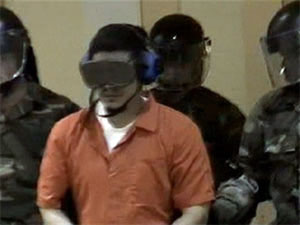
The president has mercifully agreed to veto the bill that would allow the US military to seize and detain without any due process anyone, including American citizens, who are suspected of terrorism, even in the US itself. A future Republican president might throw torture in with this toxic brew.
The veto is a relief. But the US Senate has thrown its weight behind gutting the core, most basic freedom upon which all others follow: habeas corpus. It has endorsed the notion that the government can do whatever it likes to any citizen it merely suspects of being involved of terrorism. It is a hole through which the entire framework of the constitution could disappear. One more terror attack, and we would have authorized soldiers to break into citizens' homes at will, round up any citizens the government deems suspicious, and deny them any recourse.
Let us assume that this power is exercized judiciously by the government – an assumption none of this country's Founders would have tolerated for a second. What happens when someone – a future Cheney or Addington – seized with the righteousness of their cause, abuses that power? I find it staggering that the current GOP, with all its suspicion of overweening government, nonetheless backs total trust of that government in these crucial constitutional areas.
A healthcare mandate is an outrage; gutting habeas corpus is just fine. Go figure.
(Photo: US citizen Jose Padilla, detained without charge and tortured by the US government for four years. He was then tried and convicted on a fraction of the allegations made against him. The current bill would remove from a future US his right to a trial entirely.)
Don Taylor answers my question.
 The Dish