Tebow’s Success, Ctd

A reader writes:

I know the Dish doesn't live and breathe NFL football, but in case you missed it … the wheels fell off the Tebowtrain two days ago, when the Broncos lost to the Bills 40-14. Time to stop talking up his "success". His stats vs the mediocre Bills, when Denver's playoff hopes are in the balance, were lousy. Thirteen completions on 30 attempts with only 185 passing yards. Four interceptions and only one touchdown. Even his running was a paltry 34 yards on 10 scrambles. 

He's a terrible quarterback (although he'd be a great tight end and, for what it's worth, he seems to be a good, sincere person – and that's coming from an atheist). But other teams now have game tape of him in action and can prepare their defenses accordingly. A new QB in the league can often get away with "miracles" when no one knows what to expect from them – especially if they possess great running skills like Tebow. But the party is over.

Another writes:

When Junod writes, "[Christianity] does not merely promise paradise down the line, but also in the here-and-now. Through the writings of Saul of Tarsus, it promises nothing less than temporal transformation — believe in this, and you will become an entirely different person"… half the statement is evidence of amnesia. 

Anyone who has read the marytrologies knows that Christianity does not promise 'temporal' transformation in the here-and-now but SPIRITUAL transformation.  As you probably know Christianity absolutely requires baptism, but even the ancients – especially they – saw a loophole: last-moment converts, such as the 40 Martyrs of Sebaste who were 'baptised in their own blood' or 'baptised in fire'.  The martyrologies are filled with transformations that do NOT include physical rescue.

Another also took issue with that passage from Junod:

To the extent Christianity can make that claim at all – and given a theology that posits a fallen terrestrial world inhabited by definitionally flawed beings, it doesn't – every religion can make that claim.  All religion contains the element of a personal transformation that comes from faith.  A sinner's salvation may offer transcendence, but Christ assures us that it's not in this world – it's in the next.  We remain sinners and flawed beings.  If Junod is arguing otherwise, he's using a text with which I'm unfamiliar.

More to the point, other religions, Hinduism and Buddhism, are explicit in this "largest claim."  They offer moksha and nirvana, not an afterlife of union with God, but enlightenment in human life.  In fact, these religions don't even conceive of an afterlife as such – you want to get off the treadmill, not stay on it. Christianity has much to celebrate about its unique theology; Junod has misidentified it.

The Genetics Of Playing Pro

Razib Khan explains why star athletes' offspring sometimes surpass their parents. He uses Kobe Bryant as an example:

[H]ere’s the important point: [Kobe Bryant's] odds of being this height are much higher with the parents he has than with any random parents. Using a perfect normal distribution (this is somewhat distorted by “fat-tailing”) the odds of an individual being Kobe’s height are around 1 in 1,500. But with his parents the odds that he’d be his height are closer to 1 out of 5. In other words, Kobe’s parentage increased the odds of his being 6 feet 6 inches by a factor of 300! The odds were still against him, but the die was loaded in his direction in a relative sense. By analogy, in the near future we’ll see many more children of professional athletes become professional athletes both due to nature and nurture. But, we’ll continue to see that most of the children of professional athletes will not have the requisite talent to become professional athletes.

“The Philosophy Of Food”

26313635_cc964ff96d_b

The University of North Texas has recently launched a new comprehensive site on the topic. From David Kaplan's introduction:

Food is vexing.  It is not even clear what it is.  It belongs simultaneously to the worlds of economics, ecology, and culture.  It involves vegetables, chemists, and wholesalers; livestock, refrigerators, and cooks; fertilizer, fish, and grocers. The subject quickly becomes tied up in countless empirical and practical matters that frustrate attempts to think about its essential properties.  It is very difficult to disentangle food from its web of production, distribution, and consumption.  Or when it is considered in its various use and meaning contexts, it is too often stripped of its unique food qualities and instead seen as, for example, any contextualized object, social good, or part of nature.  It is much easier to treat food as a mere case study of applied ethics than to analyze it as something that poses unique philosophical challenges.  

But things are starting to change. 

(Photo via Flickr user TowerGirl)

Bird Linguistics

Urban birds have changed their pitch to combat city noise:

[Steve] Nowicki studies animal communication and says young songbirds learn from older ones, so after a while differences in style emerge. "We know that birds can be attentive to very subtle differences in their songs in the context of choosing whom to mate with," he says.

So if birds from the city can't flirt with birds from the country anymore, "those birds are actually going to be less likely to mate with each other," he says. "I mean, literally they're going to stop being able to speak the same language."

The Daily Wrap

Today on the Dish, we launched the annual Dish Awards poll (keep voting early and often), which led to the tightest Malkin race evah and a showdown between Andrew vs. Jennifer Rubin in the Von Hoffman race. Jim Henley explained why Ron Paul couldn't produce the newsletters' authors, Nate Silver argued that Paul needed the race to be tight to have an impact on the GOP, and Jonathan Bernstein thought that the new delegate distribution rules weren't really going to help the good doctor – though his son might stand a better chance in 2020.

The Economist tracked the global work ethic while Yglesias worried about America's overlarge houses. Readers sounded off on that awesome Navy kiss and the Christmas gifts thread, Tebow's successes (while they lasted) bolstered a sort of American Christianity, and Teach For America caught some flak. Scientists couldn't figure out why nipples got hard, obsessed over correlations, and explained why people walk the way they do. Though Martin Luther demonstrated things could go viral before the internet, riots have gotten way more efficient in the age of cell phones.

Calvin and Hobbes fans got a belated Christmas gift (seen above), celebrities rode the subway, and KnowYourMeme ran through 2011's best. MHB here, VYFW here, and FOTD here.

– Z.B.

Why Won’t Ron Paul Name The Newsletter’s Author?

Jim Henley's theory:

If the Paul campaign says, “Actually, those newsletters were written by Lew Rockwell,” then suddenly Lew Rockwell is the story. How on earth does making Lew Rockwell more visible help Ron Paul? Right now Paul has to answer, lamely, for the content of the variously named volumes of the Send Ron Paul Your Money! newsletter series. Formally connect them to Rockwell and Paul also has to answer for the contents of every issue of the Rothbard-Rockwell Report, much of the content of mises.org and Rockwell’s own zigs and zags across the years of his LRC column.

Shikha Dalmia thinks Paul should give a speech along the lines of Obama's Reverend Wright speech:

Paul’s choice … is to try and proactively shape the events that will surely follow—or get into a defensive crouch as they unfold, attacking the attackers, playing the victim. If he does the former, he might at least be able to save the movement he has created if not himself. If the latter, he risks taking it down with him.

Jennifer Rubin Or Me: Who Was More Wrong?

The current Von Hoffmann vote count: Sullivan 413, Rubin 417.  Help break the tie:

The Daily Dish Awards Glossary

Click here to vote for the 2011 Malkin Award!

Click here to vote for the 2011 Moore Award!

Click here to vote for the 2011 Yglesias Award!

Click here to vote for the 2011 Chart Of The Year!

Click here to vote for the 2011 Face Of The Year!

Click here to vote for the 2011 Hathos Alert!

Click here to vote for the 2011 Mental Health Break Of The Year!

Correlations Aren’t The Answer

Screen shot 2011-12-19 at 1.28.39 PM

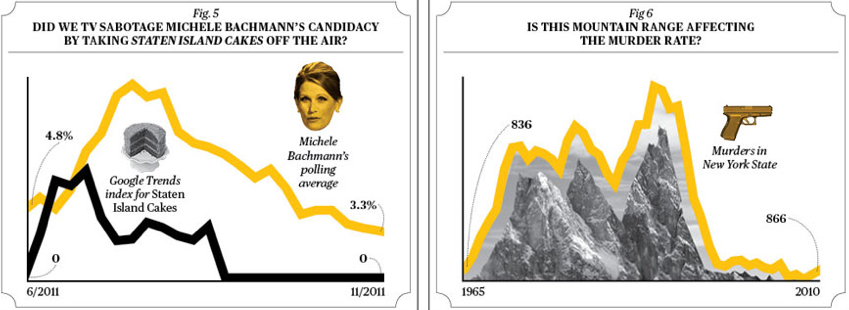
Jonah Lehrer describes why our "reliance on correlations has entered an age of diminishing returns":

First, all of the easy causes have been found, which means that scientists are now forced to search for ever-subtler correlations, mining that mountain of facts for the tiniest of associations. Is that a new cause? Or just a statistical mistake? The line is getting finer; science is getting harder. Second—and this is the biggy—searching for correlations is a terrible way of dealing with the primary subject of much modern research: those complex networks at the center of life. While correlations help us track the relationship between independent measurements, such as the link between smoking and cancer, they are much less effective at making sense of systems in which the variables cannot be isolated. Such situations require that we understand every interaction before we can reliably understand any of them. 

(A detail from a chart reminding us that correlation doesn't prove causation.)

Face Of The Day

136107686

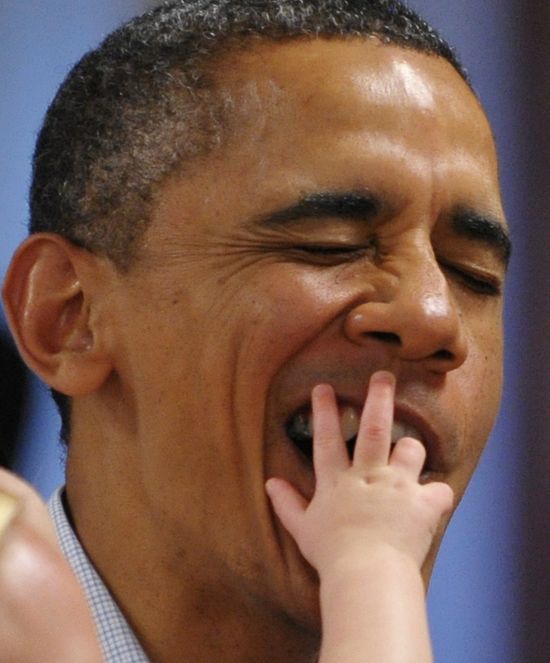
Cooper Wall Wagner, 8 months, reaches out to touch US President Barack Obama as he poses for a photo with Cooper's parents, Cpt Greg Wagner and Meredith Wagner, as Obama and First Lady Michelle Obama greet military personnel and their families at Marine Base Hawaii at Kaneohe Bay on Christmas Day, December 25, 2011. Obama greeted base personnel while vacationing at a rental home nearby. By Mandel Ngan/AFP/Getty Images.