America Has Too Few Houses?

That's Yglesias's belief:

[W]e're now objectively undersupplied with housing relative to the size of our population. Since pre-recession America had the biggest houses in the known universe, we're finding it perfectly possible to physically accommodate all these extra people by having twentysomethings live with their parents, siblings doubling up, etc. But what's basically happened is that joblessness, high debts, and lack of income have caused net household creation to crater even as the population keeps growing. Joe Weisenthal's chart of the day makes this point very effectively …

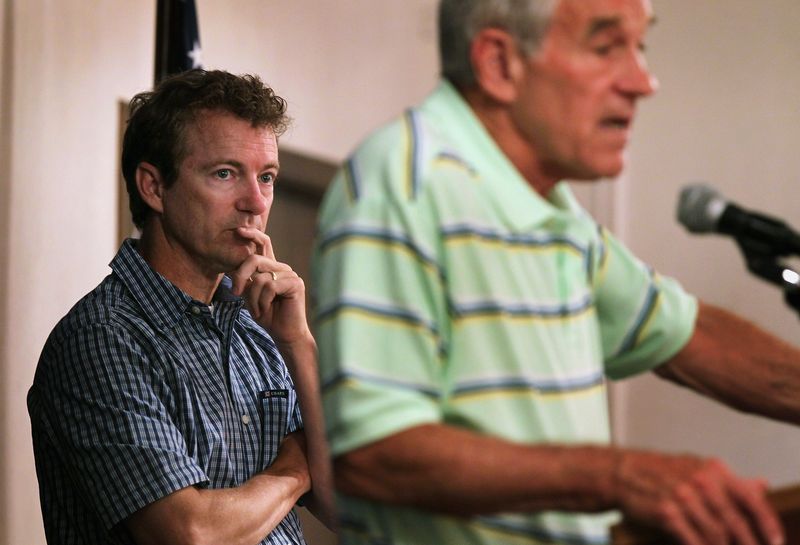
President (Rand) Paul?

GT_RONRANDPAUL_111223

Fabio Rojas games out what happens for the son if the father wins Iowa but loses the nomination:

[A] semi-successful Paul 2012 run means that there is now a whole network of party activists who love the Paul brand and know the ropes. They’re ready to go if Kentucky Senator Rand Paul – Ron’s son – wants to run. He’s also a fairly pure libertarian in many ways and could easily pick up that wing of the party. If the social conservatives burn out in 2012 and 2016, by running against Democrats during the peak of the business cycle, then the GOP may be ready to let Rand Paul run in 2020 and he might win. The real legacy of Paul’s 2012 primary run may be laying the groundwork for Rand Paul presidency.

(Photo: U.S. Senator Rand Paul listens to his father Texas Congressman and Republican presidential hopeful Ron Paul speak at a campaign stop August 10, 2011 in Cedar Rapids, Iowa. By Scott Olson/Getty Images.)

How Martin Luther Racked Up The Pageviews

Revealed:

Luther’s sympathisers recommended it to their friends. Booksellers promoted it and itinerant colporteurs hawked it. Travelling merchants, traders and preachers would then carry copies to other towns, and if they sparked sufficient interest, local printers would quickly produce their own editions, in batches of 1,000 or so, in the hope of cashing in on the buzz. A popular pamphlet would thus spread quickly without its author’s involvement.

Why Do Nipples Get Hard?

The jury is still out. Other odd nipple facts:

Pinnipeds (including seals, sea lions, and walruses) have retractable nipples that remain tucked when pups aren’t feeding on them. Adult male rats don’t have nipples, and male horses don’t have teats. The nipples of a female dog shrivel after they get spayed. The platypus and the echidna don’t have nipples at all, but rather secrete milk through the pores in their skin.

Tebow’s Success

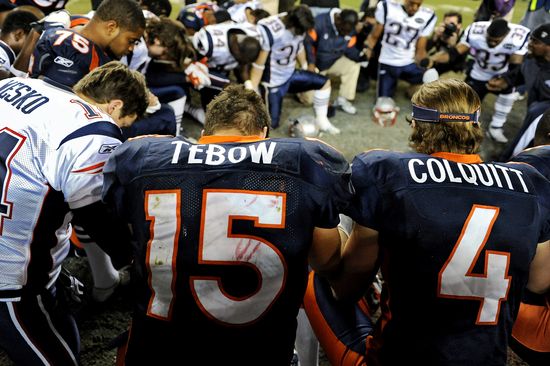
GT_TEBOWPRAY_111220

Tom Junod believes it goes hand-in-hand with Christianity's success:

You see, of all the major religions, Christianity makes the largest claim; it does not merely promise paradise down the line, but also in the here-and-now. Through the writings of Saul of Tarsus, it promises nothing less than temporal transformation — believe in this, and you will become an entirely different person. You will be made made clean, made whole, and above all, made new; Saul the persecutor will become St. Paul, the persecuted.

It's easy to see why such a faith would become the de facto gospel of the New World, and even why it might remain so in the face of science, reason and plain common sense. By making a claim of efficacy, Christianity makes a claim that is either demonstrable, or not. This is why it is so congenial to capitalism, conspicuous consumption, the gospel of success, and America's self-help ethos; and this is why it is so important to the country that Tim Tebow be transformed from a raw and developing talent with some permanent liabilities to, well, a winner. 

Chris Jones questions the conventional wisdom of Tebow as underdog. Earlier Dish coverage of the cultural phenomenon here, here and here.

(Photo: Quarterback Tim Tebow #15 of the Denver Broncos prays with teammates and players from the New England Patriots after an NFL game at Sports Authority Field at Mile High on December 18, 2011 in Denver, Colorado. The New England Patriots won, 41-23. By Patrick Smith/Getty Images)
Will New Rules Shake Up The GOP Race?

Jonathan Bernstein reviews the new GOP nominating rules. He claims they won't make much of a difference:

[I]n most cases, the delegate allocation rules just don’t matter; the winning candidate in most cycles has wrapped it up early and would dominate the eventual delegate count regardless of how delegates were determined. That’s just as likely to happen this time as ever. If two very strong candidates emerge with the resources to fight it out to the end, then the delegate rules might, but probably won’t, affect who wins. And it’s still going to be about as hard as it ever was for a candidate (such as, potentially, Ron Paul) who takes a steady 15 percent or 20 percent in every state to build up enough delegates to seriously threaten to deadlock the convention; just as they did for Republicans in the past, delegate allocation rules will work against that sort of candidate. 

A Digital Mob

Bill Wasik explores how technology has changed rioting:

In the pre-cell-phone era—as Cliff Stott observed in Marseilles—overall numbers didn’t matter one bit if you could not keep physically connected. In Among the Thugs, Bill Buford’s first-person account of soccer hooliganism, he describes the remarkable discipline that even these drunken, anarchic yobs had to maintain to carry out violence against opposing fans: “Everyone is jogging in formation, tightly compressed, silent.” Step out of the phalanx to grab a pint or take a piss and you might never find your fellows again; in the meantime, the opposing mob might find you alone. Today, by contrast, a crowd’s power is amplified by the fact that its members can never really get separated. A crowd that’s always connected can never really be dispersed. It’s always still out there.

The Science Of Walking

From emergency exits to crowd control, modeling pedestrian behavior matters:

Imagine that you are French. You are walking along a busy pavement in Paris and another pedestrian is approaching from the opposite direction. A collision will occur unless you each move out of the other’s way. Which way do you step?

The answer is almost certainly to the right. Replay the same scene in many parts of Asia, however, and you would probably move to the left. It is not obvious why. There is no instruction to head in a specific direction (South Korea, where there is a campaign to get people to walk on the right, is an exception). There is no simple correlation with the side of the road on which people drive: Londoners funnel to the right on pavements, for example. 

Instead, says Mehdi Moussaid of the Max Planck Institute in Berlin, this is a behaviour brought about by probabilities.

(Video: Tokyo/Glow HD from Nathan Johnston)