God As A Newborn

117053142

A radical idea from Benedict XVI's Christmas homily:

The Resurrection presupposes the Incarnation.

For God’s Son to take the form of a child, a truly human child, made a profound impression on the heart of the Saint of Assisi, transforming faith into love. “The kindness and love of God our Savior for mankind were revealed” this phrase of Saint Paul now acquired an entirely new depth. In the child born in the stable at Bethlehem, we can as it were touch and caress God.

And so the liturgical year acquired a second focus in a feast that is above all a feast of the heart. This has nothing to do with sentimentality. It is right here, in this new experience of the reality of Jesus’ humanity that the great mystery of faith is revealed.

Francis loved the child Jesus, because for him it was in this childish estate that God’s humility shone forth. God became poor. His Son was born in the poverty of the stable. In the child Jesus, God made himself dependent, in need of human love, he put himself in the position of asking for human love, our love.

(Photo: A sick newborn, May 9, 2009 in Helmand Province, Afghanistan. In the North of Kabul, the Charahi Qambar camp shelters refugees from Helmand province, where the International Security Assistance Force operates. By Reza/Getty Images.)

Walker Percy Interviews Himself

9821_-_Milano_-_Sant'Ambrogio_-_Sarcofago_di_Stilicone_-_Foto_Giovanni_Dall'Orto_25-Apr-2007

A reflection on faith on the day we commemmorate the birth of Jesus:

Q: What kind of Catholic are you?

A. Bad.

Q: Are you a dogmatic Catholic or an open-minded Catholic?

A: I don’t know what that means . . . . Do you mean do I believe the dogma that the Catholic Church proposes for belief?

Q: Yes.

A: Yes.

Q: How is such a belief possible in this day and age?

A: What else is there?

Q: What do you mean, what else is there? There is humanism, atheism, agnosticism, Marxism, behaviorism, materialism, Buddhism, Muhammadanism, Sufism, astrology, occultism, theosophy.

A: That’s what I mean.

Q: I don’t understand. Would you exclude, for example, scientific humanism as a rational and honorable alternative?

A: Yes.

Q: Why?

A: It’s not good enough.

Q: Why not?

A: This life is too much trouble, far too strange, to arrive at the end of it and then to be asked what you make of it and have to answer “Scientific humanism.” That won’t do. A poor show. Life is a mystery, love is a delight. Therefore I take it as axiomatic that one should settle for nothing less than the infinite mystery and the infinite delight, i.e., God. In fact I demand it. I refuse to settle for anything less.

I don’t see why anyone should settle for less than Jacob, who actually grabbed aholt of God and would not let go until God identified himself and blessed him.

Q: Grabbed aholt?

A: A Louisiana expression.

Q: But isn’t the Catholic Church in a mess these days, badly split, its liturgy barbarized, vocations declining?

A: Sure. That’s a sign of its divine origins, that it survives these periodic disasters.

Q: You don’t act or talk like a Christian. Aren’t they supposed to love one another and do good works?

A: Yes.

Q: You don’t seem to have much use for your fellowman or do many good works.

A: That’s true. I haven’t done a good work in years.

Q: In fact, if I may be frank, you strike me as being rather negative in your attitude, cold-blooded, aloof, derisive, self-indulgent, more fond of the beautiful things of this world than of God.

A: That’s true.

Q: You even seem to take certain satisfaction in the disasters of the twentieth-century and to savor the imminence of world catastrophe rather than world peace, which all religions seek.

A: That’s true.

Q: You don’t seem to have much use for your fellow Christians, to say nothing of Ku Kluxers, ACLU’ers, northerners, southerners, fem-libbers, anti-fem-libbers, homosexuals, anti-homosexuals, Republicans, Democrats, hippies, anti-hippies, senior citizens.

A: That’s true – though taken as individuals they turn out to be more or less like oneself, i.e., sinners, and we get along fine.

Q: Even Ku Kluxers?

A: Sure.

Q: How do you account for your belief?

A: I can only account for it as a gift from God.

Q: Why would God make you such a gift when there are others who seem more deserving, that is, serve their fellowman?

A: I don’t know. God does strange things. . . .

Q: But shouldn’t one’s faith bear some relation to the truth, facts?

A: Yes. That’s what attracted me, Christianity’s rather insolent claim to be true, with the implication that other religions are more or less false.

Q: You believe that?

A: Of course.

(Photo: Detail from the side facing the apse of the so-called "Sarcofago di Stilicone" ("Stilicho's sarcophagus"), an Ancient Roman christian sarcophagus dating from the 4th century. It is preserved beneath the pulpit of Sant'Ambrogio basilica in Milan, Italy. Picture by Giovanni Dall'Orto, April 25 2007.)

Can Jews Celebrate Christmas?

Pace Cartman, Paul Golin believes so:

There are well over a million intermarried Jews in the United States and likely more intermarried than single-faith households. There are more Americans under the age of 20 with one Jewish parent than there are with two. … The overwhelming majority of Jews pick and choose which Jewish laws they find meaningful and which they reject. Keeping kosher all the time? Rejected by 85 percent of American Jewry. Believing homosexuality is an abomination? Thankfully, rejected by a growing majority. When we start telling each other that our own individual red lines are the universally accepted “Jewish” red lines—and if you cross them, you’re a bad Jew—our community descends into recriminations.

Jonathan Freedland describes his Jewish fascination with the story of Jesus here. On a related note, Liel Leibovitz finds fault with Festivus, originated by Seinfeld, while Rachel Shukert defends it.

The Cost Of A Christmas Classic

Costxmas

Every year economists from PNC bank calculate what "The 12 Days of Christmas" would actually cost, including the expense of 12 drummers drumming, 11 pipers pipers piping, etc. Derek Thompson does the math on this year's record tally of $101,119.84:

First, Americans haven't received any swan relief recently, and the price of the birds has doubled again. Second, PNC uses a local Philadelphia dance company to estimate the price of "nine ladies dancing," and that index has grown by nearly 50 percent this decade (and more than 300 percent overall in the last 30 years!). In fact, this highlights perhaps the biggest real-world lesson of the survey, which is that over the last 28 years, the price of services has increased much faster than the price of goods. 

Can The Universe Ever Be Explained?

Alan Lightman explores the theory of the multiverse:

If the multiverse idea is correct, then the historic mission of physics to explain all the properties of our universe in terms of fundamental principles—to explain why the properties of our universe must necessarily be what they are—is futile, a beautiful philosophical dream that simply isn’t true. Our universe is what it is because we are here. The situation could be likened to a school of intelligent fish who one day began wondering why their world is completely filled with water. Many of the fish, the theorists, hope to prove that the entire cosmos necessarily has to be filled with water. For years, they put their minds to the task but can never quite seem to prove their assertion. Then, a wizened group of fish postulates that maybe they are fooling themselves. Maybe there are, they suggest, many other worlds, some of them completely dry, and everything in between.

When Altruism Goes Wrong

Barbara Oakley examines extreme altruism:

Pathological altruism is associated with disorders and conditions such as anorexia, the amorphous traits of codependency, animal hoarding, depression, excessive and misplaced guilt, and self-righteousness.  It is also seen in suicide bombing—the one common trait of suicide bombers is their sense of altruism for those who share their ideology. 

Pathologies of altruism can even underlie genocide.  A Rwandan Hutu, for example, didn’t wake up in the morning and think “Gee, I’m feeling totally evil today—I’m going to go out and kill Tutsis.” No—instead, he thought—“I’ve got to protect my family and people against those cockroaches, the Tutsis.” In other words, it was feelings of altruism, as well as hatred, that impelled many Hutus to kill.

Generosity Around The Globe

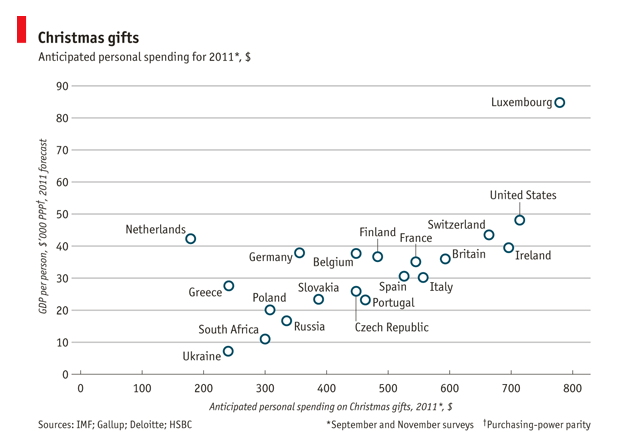
Christmasspending
Freakonomics parses the Economist's chart above: 

Despite their considerable wealth, the Dutch have clearly maintained their minimalist austerity chic. Not the case in Luxembourg, which has the highest GDP per capita in the EU, and the third highest in the world.  … Despite considerably less per capita wealth, we [Americans] appear to be spending only about $70 less per person than the Luxembourgers.