Morality Without God

Louise M. Antony contemplates it:

Suppose that you do something morally terrible, something for which you cannot make amends, something, perhaps, for which no human being could ever be expected to forgive you.  I imagine that the promise made by many religions, that God will forgive you if you are truly sorry, is a thought would that bring enormous comfort and relief.  You cannot have that if you are an atheist.  In consequence, you must live your life, and make your choices with the knowledge that every choice you make contributes, in one way or another, to the only value your life can have.

Some people think that if atheism were true, human choices would be insignificant.  I think just the opposite — they would become surpassingly important.

Those Who Get No Gifts

Stacia L. Brown remembers them:

Christmas hasn’t been a favorite holiday of mine since I was a child. It feels claustrophobic and excessive and so, so impossibly gaudy and red. But the pocket of time between 25th to the 1st has always been hallowed for me. I treat it with seriousness and give myself wholly to reflection: on the Nativity; on the subsequent Massacre of the Innocents; on those who go hungry; on the children who have to square their shoulders, lift their chins, puff their chests, and let their eyes become stones, when they awake on Christmas morn to the same bleak cots in a shelter, to the same loss or absence that claimed a parent near some Christmas past; to the same dearth of gifts or of cheer.

Joy does not always come easily to the world these days. And despite our best efforts to tinsel over everything that ails us and others, there are many who cannot forget their struggles through caroling or office holiday parties or heavily spiked punch and nog.

Santa Is Watching You

Scott F. Aikin and Robert B. Talisse make the case against Santa Claus:

The trouble with Santa’s surveillance is that it affects our motives.  When we know that we are being watched by an omniscient judge looking to mete out rewards and punishments, we find ourselves with strong reasons to act for the sake of getting the reward and avoiding the punishment.  But in order for our actions to have moral worth, they must be motivated by moralreasons, rather than narrowly self-interested ones.   In short, under Santa’s watchful eye, our motivations become clouded, and so does the morality of our actions.

A Secular Advent Calendar

Hubble

Alan Taylor explains the inspiration for the Hubble Space Telescope Advent calendar:

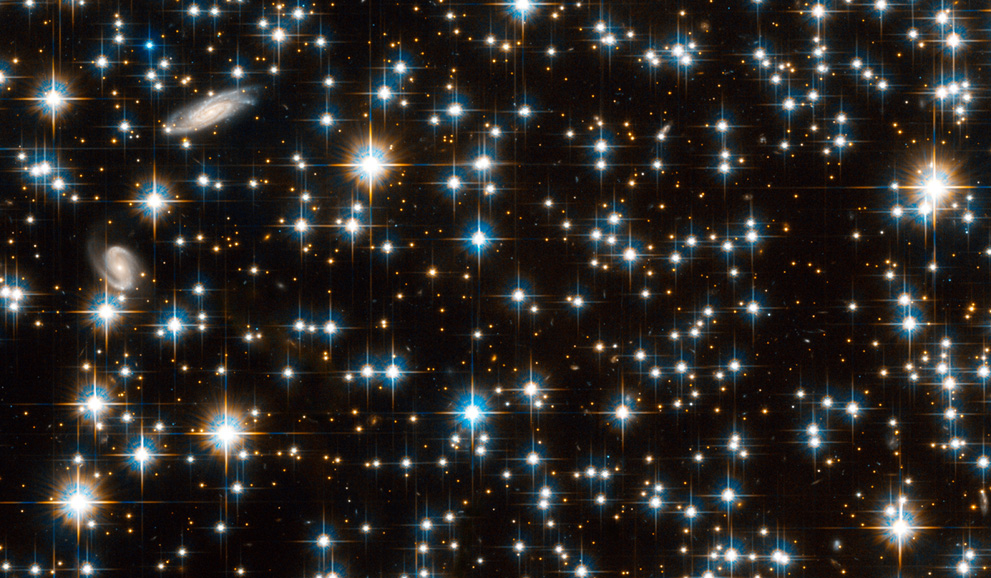
I’m not strictly what you would call a spiritual person, but I have had a couple of experiences in my life that I would call spiritual, which I believe helps me in my attempts to understand a variety of human experiences. In my view, the heart of much of that is a deep sense of awe, an experience where one feels that one is only glimpsing a tiny portion of something truly magnificent and powerful — and that somehow we are all connected to it. You could use the same description to fit Hubble images – the incomprehensible beauty, power, scale and mystery — and we are all connected to it, within sight of it, part of it all. 

The Angry Birds version is good enough for me.

(Photo: "The view of the Hubble Advanced Camera for Surveys is filled by stars, part of NGC 6791, an old open star cluster in the Lyra constellation. The bright stars are roughly 13,300 light years distant. Two background galaxies, far beyond our own Milky Way, can be seen at upper left." By NASAESA, and L. Bedin)

Heavy Breathing Housewives

Maura Hehir downplays the news that desperate moms are resorting to phone sex to make money while at home with the kids:

So after watching Elisabeth Hasselbeck's hard-hitting investigative report on this issue, I learned that because of the economy, the number of moms with young children becoming phone-sex operators has increased 400% in the last eighteen months. Except Hasselbeck never explicitly says how many that is: a bold, italicized "400" looks a lot scarier gliding across the TV screen than saying there are something like fifty phone-sex-operator moms now as opposed to ten.

J. Bryan Lowder wonders whether who actually still pays for phone sex in the era of internet porn:

[A]fter having spent some time looking through operator recruitment materials, I can report that phone sex is no longer based on a model of call centers and those infamous 1-900-numbers. Instead, the current model is much more entrepreneurial: while most actresses work for companies that facilitate payment processing and the necessary telephonic infrastructure, the women themselves are responsible for maintaining websites, blogging, self-promotion and, in some cases, even “trolling” online chat rooms for potential clients. In that sense, phone sex in 2011 is basically just an extension of other sorts of semi-interactive online porn.

A Poem For Saturday

The end of "Messiah (Christmas Portions)" by Mark Doty:

Aren't we enlarged 
by the scale of what we're able
to desire? Everything,
the choir insists,

might flame;
inside these wrappings
burns another, brighter life,
quickened, now,

by song: hear how
it cascades, in overlapping,
lapidary waves of praise? Still time.
Still time to change.

The full poem here.

(Video: skip to about :50 in for a choir star.)

Are Christmas Trees Bad For The Environment?

Not as bad as a fake tree:

[A]n artificial tree is made of polyvinyl chloride (PVC), can never be recycled, and eventually ends up in a landfill after you’ve gotten your years of service out of it. A fake tree is used an average of 6 to 10 years before being dumped for a newer model. … Christmas tree farmers are leaders in conservation agriculture. Their product emits healthy oxygen during its 15 or so years of growing, requires little to no supplemental irrigation, and thrives in tough terrain that is otherwise unsuited for agricultural crops.