Which kinda undercuts the argument that libertarians repulsed by the language in Ron Paul's old newsletters should switch to Johnson. Meanwhile, Paul is now firmly in second place in New Hampshire in the poll of polls behind Romney. He over-took Gingrich a few days back.
Month: December 2011
The Ides Of 2011
It was a dreadful year in many ways: the embarrassment of the debt ceiling clusterfuck, Europe’s lurching inability to manage its own currency, mass slaughter in Syria, civil war in Libya, the Japanese nuclear disaster, and the GOP primary circus. But it also felt to me, with my nose pressed up against history’s fleeting present, as a deeply transformative and actually positive year, in which underlying tectonic plates in world politics and culture shifted – for the better.
What we had seen in 2008 and 2009, as the new media powered both Obama’s unprecedented campaign and then the Green Revolution, turned out to be prescient, not a fluke. The increasingly connected global consciousness, the awareness of how others live in the same moment as you subsist, the globalization of thought and interaction, the power of peer-to-peer communication: all these led to a shift in power from the top to the bottom. Hence the miracle of Tunisia’s revolution, the continuing struggle of Egypt’s, the emergence of post-totalitarian Libya and the astonishing resilience of Syria’s people. Hence too, in the West, the sudden bubble of the Occupy movement, as a negative image of the Tea Party. And the rises and falls of various insurgent candidacies in the GOP that wanted to shake the status quo, and the great restlessness on the center-left with Obama’s incremental, conservative liberalism.
We do not know where this will lead, except that democracy really does seem “on the march” at last. And not a forced march, with US bayonets prodding from the rear, as in Iraq. But a genuine popular movement in many places, reacting spontaneously to a fast-shifting global economy and polity. This cannot be managed by the US, it seems to me, using the tools of the Cold War. It cannot be handled without a vast amount of muddling through, mistakes, misjudgments, restraint and observation. In fact, it should be managed lightly, if at all. These are epochal changes – happening in their own time, not on America’s quadrennial presidential schedule. If we haven’t learned already that we cannot control this, that we should not try to, but should protect our interests as pragmatically as we can, and advance our values as humbly as we ought to, then we never will.
The wars, moreover, are done. In 2011, Obama got us out of Iraq on the schedule dictated by George W. Bush and Nouri al-Maliki. We have also done about as much damage as we can to al Qaeda in Pakistan and Afghanistan without active Pakistani support. We’re outta there in two years anyway. A clear majority of Americans, moreover – 53 to 36 percent – believe that the current decade-long war is not worth fighting any more. The brilliant capture and killing of Osama bin Laden by Seal Team Six closed an open wound. If we can reach back and remember why so many backed Obama in 2007, this really is the change we believed in.
On two issues the Dish cares passionately about – the freedom to marry for all and the end of the military gay ban – 2011 was also a watershed. For the first time, polls consistently showed a majority of Americans favoring marriage equality; in New York State, a Republican Senate brought marriage rights to one of the biggest states in the Union, effectively entrenching what was once a pipedream into a permanent part of the American landscape. For good measure, the ban on openly gay servicemembers was finally lifted, and the non-consequences were deafening. There remains much work to be done. But we broke the back of the anti-gay opposition this year, and cemented our huge majority in the next generation.
This revolution was built from below as well: largely by gay people and their families and friends in daily acts of courage and candor and conversation. It was powered by the Internet. It became global, as change in places as backward as sub-Saharan Africa on gay rights brought new conflict and 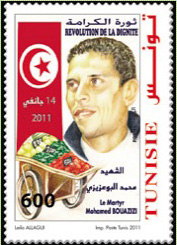 terror. And the Obama administration put America’s weight behind the advancement of gay dignity and equality worldwide.
And in this new world, Obama’s critical contribution is indeed “leading from behind” because in this new world, leading self-righteously from the front, commanding other nations to behave as we wish, unilaterally intervening at will, and generally continuing the role that America played in the last century is an ineffective anachronism. The Bush-Cheney years proved this, when America’s international isolation led to a long, costly disaster in Iraq, where China and Iran benefited more than the US. The rise of the new powers of Brazil and India and Indonesia and China mean that American hegemony in the 1990s sense is over; and if we do not understand that and adjust, we will be caught in the worst trap of declining empires. This does not mean the abandonment of military power and reach, but a much subtler, lighter and more collaborative force.
The man of the year, in my mind, is Mohamed Bouazizi, even though he died a few weeks before the year began. His self-immolation on Decmber 17, 2010, was an act of civil disobedience that became the spark for the democratic wave in the place we never expected it: the Arab Middle East. He was one man, with no power but his own conviction. But, in the words, of RFK:
It is from numberless diverse acts of courage and belief that human history is shaped. Each time a man stands up for an ideal, or acts to improve the lot of other, or strikes out against injustice, he send forth a tiny ripple of hope, and crossing each other from a million different centers of energy and daring those ripples build a current which can sweep down the mightiest walls of oppression and resistance.
Through the recession and deaths of 2011, this truth emerged. There are dark clouds around – specifically the vile regime in Tehran, the dangerously radical government in Jerusalem, the Egyptian military’s fear, the chance of a lingering depression. But if we allow these to overwhelm the real news of this year, we are missing the screen for the pixels.
This was an inspiring year for human dignity and freedom. Know hope.
How Much Did Social Media Shape Politics This Year?
A lot, says Christia Freeland:
What’s important to remember in hindsight is that one of the most provocative ideas of late 2010 — published just two months before a Tunisian fruit and vegetable vendor, Mohamed Bouazizi, posted his suicide note on his Facebook Wall, and three months before the Egyptian government blocked Twitter in an effort to muzzle its people — was Malcolm Gladwell’s characteristically iconoclastic assertion that, as the subhead to his October 2010 New Yorker essay put it, “the revolution will not be tweeted.” At least in public, Gladwell is sticking to his guns, but not too many other people are. In one informed example, consider a recent public interview I conducted with Naguib Sawiris, the Egyptian telecommunications billionaire and liberal politician who backed the Tahrir Square demonstrations. When I asked him about the Gladwell theory, Sawiris first wondered, “Is he here in the room? Do I have to be polite?” and then went on to explain his criticism: “He has no clue what this technology has done to my part of the world. Ninety percent of the success of this revolution is attributed to it.”
Peter J. Munson counters:
Across the Middle East, we saw an unprecedented wave of revolutions. Like dominoes, dictators fell in rapid succession. Some, however, weebled and wobbled but wouldn't fall down. Not yet anyway. What should this teach us? It should teach us that the hope that the artificial suppression of political volatility can be a useful tool in managing change is false. For all the talk of Twitter and Facebook and new technology leading to revolutionary social mobilization and change, these mechanisms were at best tangential to the movements. The market penetration of the internet and these social media services was very low in the countries in question. While it may have helped some elites to mobilize, the true roots were far deeper and more significant. The bottom line is that the rapid economic changes of the past decade or so created a socio-economic dynamic that the political apparatus could not accommodate.
Anything Can Still Happen
Some words of wisdom from Bill Galston:
As I reread my piece before sending it off, my mind drifted back to early 1984, when I was serving as Issues Director in Walter Mondale’s presidential campaign. On February 20, Mondale won the Iowa caucuses with 49 percent of the vote, while Gary Hart finished a distant second with 17 percent. Eight days later, on the morning of the New Hampshire primary, the New York Times published a front-page story whose lead paragraph is seared into my memory:
“With Senator John Glenn continuing to fade and no new challenger emerging strongly, Walter F. Mondale now holds the most commanding lead ever recorded this early in a Presidential nomination campaign by a nonincumbent, according to the latest New York Times/CBS News Poll.”
Sixteen hours later, Gary Hart had won the New Hampshire primary by an astounding 9 percentage points, the race was turned upside down, and Mondale nearly lost it. Could it happen again? I don’t see how. But I didn’t 28 years ago either.
The Dish Awards 2011
In case you missed them, the winners are all here.
Why We Love The Hobbit
Adam Roberts has a theory as to why Tolkien's novel is the fourth best-selling book of all time:
I stress the 'incompetence' angle in my retelling here because, really, that's what characterises the main players. It's an endearing incompetence, used partly for comedy; partly for dramatic purposes (by way of ratcheting up the narrative tension and keeping things interesting) and partly to facilitate the readers'—our—engagement. Because we can be honest; we'd be rubbish on a dangerous quest. We're hobbitish types ourselves, and our idea of fun is snuggling into the sofa with a cup of cocoa and a good book, not fighting gigantic spiders with a sword. Or more precisely, we enjoy fighting giant spiders with a sword in our imaginations only. The book has sold as many copies as it has in part because the Hobbits are able (textually-speaking) so brilliantly to mediate our modern, cosseted perspectives and the rather forbidding antique warrior code and the pitiless Northern-European Folk Tale world.
Picking The Word Of The Year
The Economist offers an overview:
A neologism or new sense of a word catches on, unlike the many neologisms that didn't, and lexicographers ratify what everyone else already knew: that lots of people were saying "occupy" this year, or that in Britain, the "squeezed middle" was the top political catchphrase of 2011. Merriam-Webster, being a dictionary maker, picked a word that many people looked up on its website, and so went with "pragmatic" instead of "occupy". Nonetheless, "occupy" is the frontrunner to win the Oscar of WOTYs, that given by the American Dialect Society.
Geoffrey K. Pullum levies his complaints against "squeezed middle," routinely used by the UK Labour Party:
[M]y real objection is not to the feebleness and blatantly political origin of this phrase (which ordinary people are simply not using), but to the fact that it is fully compositional: squeezed just means "squeezed", and middle just means "middle", and if you put the two together you have the literal meaning. It is ridiculous to think of putting this in a dictionary — as opposed to a collection of political phraseology and cliché.
Ben Zimmer counters Pullum at length.
The View From Your Window Contest

You have until noon on Tuesday to guess it. City and/or state first, then country. Please put the location in the subject heading, along with any description within the email. If no one guesses the exact location, proximity counts. Be sure to email entries to VFYWcontest@gmail.com. Winner gets a free The View From Your Window book. Have at it.
Banning Billboards
Five years later, have all the businesses in São Paulo gone under? Hardly. In fact, most citizens and some advertising entities report being quite pleased with the now billboard-less city. … Anna Freitag, the marketing manager for Hewlett-Packard Brazil, said her company had never considered how inefficient billboards and the like were until they were illegal. "A billboard is media on the road," she told the FT. "In rational purchases it means less effectiveness… as people are involved in so many things that it makes it difficult to execute the call to action."
The Geography Of Popular Music
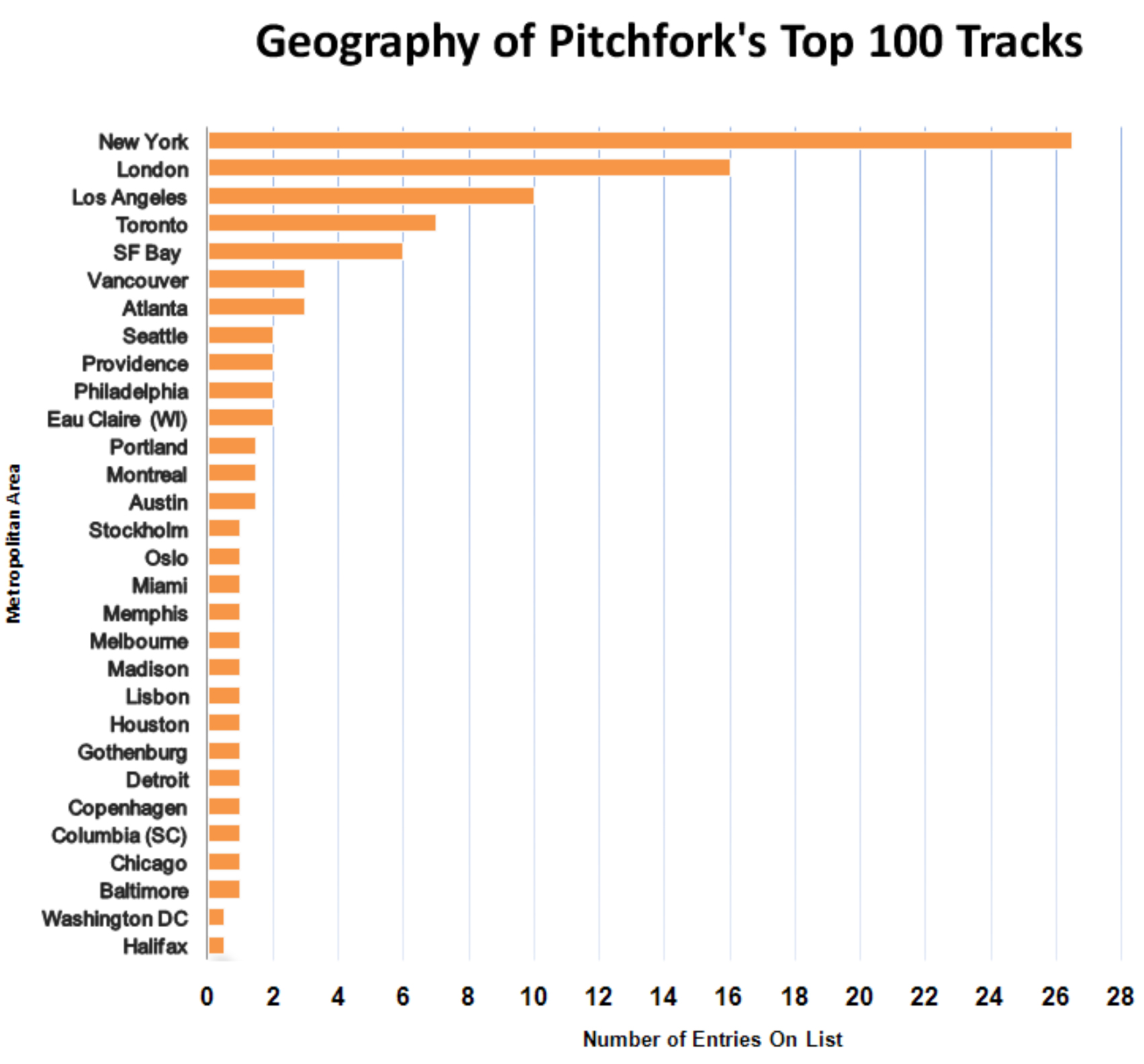
A study by Patrick Adler explores where the biggest hits are conceived. Tom Hawking summarizes:
What does it all mean? That even in this brave new age of internet self-distribution and SoundCloud and unlimited online streaming, you’re much more likely to get heard if a) you’re American and b) you suck it up and go to scrounge a living in the big city in order to get your music heard.
 The Dish