The reinvention of a holiday favorite:
(Hat tip: LikeCool)
The reinvention of a holiday favorite:
(Hat tip: LikeCool)
Paul Miller argues today's world is scarier than its Cold War counterpart:
Essentially, the United States thus faces two great families of threats today: first, the nuclear-armed authoritarian powers, of which there are at least twice as many as there were during the Cold War; second, the aggregate consequences of state failure and the rise of non-state actors in much of the world, which is a wholly new development since the Cold War. On both counts, the world is more dangerous than it was before 1989. Essentially take the Cold War, add in several more players with nukes, and then throw in radicalized Islam, rampant state failure, and the global economic recession, and you have today.
Dan Drezner thinks Miller is going overboard:
Because the U.S. and U.S.S.R. were such implacable adversaries and because they knew it, the possibility of a small dispute — Berlin, Cuba, a downed Korean airliner — escalating very quickly was ever-present. The possibility of an accident triggering all-out nuclear war was also higher than was realized at the time. The current threat environment is more loosely interconnected, in that a small conflict seems less likely to immediately ramp up into another Cuban Missile Crisis. Indeed, the events of the past year support that point. Saudi Arabia essentially invaded Bahrain, and Iran did…. very little about it. The United States deployed special forces into the heart of Pakistan's military complex. The aftermath of that is undeniably uglier, but it's not moving-to-DEFCON-1 kind of ugly. Miller might be more accurate in saying that there is a greater chance of a security dust-up in today's complex threat environment, but there's a much lower likelihood of those dust-ups spiraling out of control.
“How long do you think Sean Hannity’s show would last if four times in one sentence, he made a comment about, say, the President of the United States, and said that he looked like a skinny, ghetto crackhead? Which, by the way, you might want to say that Barack Obama does.” – Brent Bozell, Fox News.
Carmel Melouney captions:
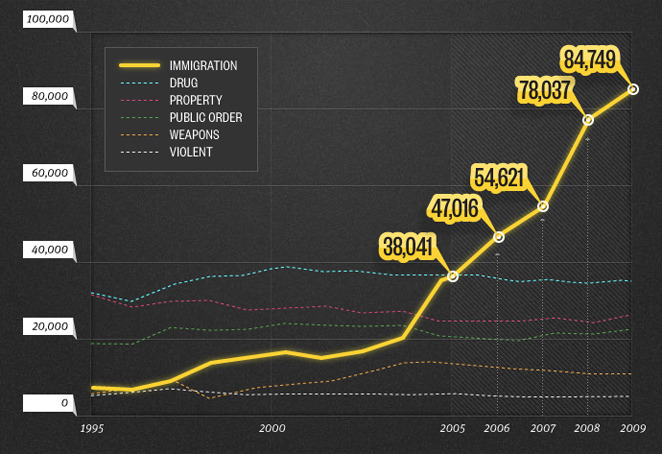
Immigration offenses were the fastest growing federal arrest offenses between 2005 and 2009, increasing at an average rate of 23 percent a year, according to statistics released by the Justice Department’s Bureau of Justice Statistics. In 2009, 84,749 people were arrested and charged with immigration offenses, up from 38,041 in 2005, the agency announced yesterday. With 46 percent of all arrests, illegal immigration was the most common offense for an arrest in 2009, followed by drug violations, accounting for 17 percent, and supervision violations, with 13 percent.
Andrew Gelman considers the evidence:
A vast majority of Americans — including half of all self-identified Republicans — think there is “too much power in the hands of a few rich people and large corporations.” And a solid majority believes that “the country’s economic system unfairly favors the wealthy.” On the other hand, close to 60 percent of Americans do not see the country as “divided into haves and have-nots” and over 60 percent see “big government” as the biggest threat to the country in the future. What gives?
I think it’s fair to say that there’s enough here to support different political themes. A supporter of higher taxes for higher incomes can focus on the “too much power in the hands of the rich” angle, whereas a supporter of cuts in low-income and middle-income entitlement programs can focus on the lack of resonance of the haves and have-nots argument.
Alex Massie thinks so:
Andrew wants us to ignore the awkward parts of Paul's history and concentrate on the better, bigger picture. Which is fine. But it also means that the reason the newsletters (or the goldbuggery, if you prefer to seize on that) aren't "disqualifying" is because you know that Ron Paul won't qualify for the Republican nomination. If he were a more serious contender – in terms of votes, not principles – then the newsletters would be a bigger, quite possibly fatal, problem even for Paul's journalistic admirers. Since he isn't a real contender they may be ignored on the grounds that the other issues Paul raises are much more important.
This is fine and not a disreputable position but it reinforces the fact that, outside the wholly committed, Paul's support is in large part a well-deserved protest vote against the dreadfulness of the other Republican candidates. Again, there's nothing wrong with this. But one should admit it, not try and pretend that it's not really all that important or it's just old news. It's not old news for most of the people who didn't know much about Representative Paul until a few months ago and I reckon most people would think it pretty important if Mitt Romney had baggage like this cluttering up his past.
Jonathan Bernstein agrees. Allow me to point to Nick Gillespie's excellent piece as well. Alex, I think, gets it about right: my backing Ron Paul (again) is a form of protest against the denialism of the GOP with respect to foreign policy in the last decade – not a statement that his past newsletters and associations are irrelevant.
As I said in the endorsement, he's imperfect and I doubt he can win this thing. But I'd like to see him try.
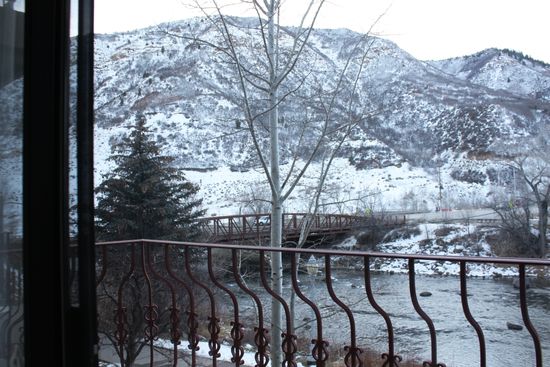
Durango, Colorado, 4.25 pm
Erick Erickson, threatening a GOP Congresswoman over her support for the internet–breaking Stop Online Piracy Act, calls for a left-right coalition to stop the law:
This might mean some allies are taken out. It might mean we take out Marsha Blackburn on the right and Debbie Wasserman Schultz on the left. But sometimes a fight is that important. Killing SOPA is that important. Letting the Attorney General of the United States shut down the internet as he wants, whether it be Eric Holder or a future John Ashcroft, should scare the mess out of every American.
Emily Crockett makes the liberal case against SOPA. Joshua Kopstein slams Congress for its active refusal to learn even the basics of how the internet works. Mark Lemley, David S. Levine, and David G. Post believe the the bill is flatly unconstitutional:
The Supreme Court has made it abundantly clear that governmental action suppressing speech, if taken prior to an adversary proceeding and subsequent judicial determination that the speech in question is unlawful,[2] is a presumptively unconstitutional “prior restraint.” In other words, it is the “most serious and the least tolerable infringement on First Amendment rights,”[3] permissible only in the narrowest range of circumstances. The Constitution requires a court “to make a final determination” that the material in question is unlawful “after an adversary hearing before the material is completely removed from circulation.”[4]
The procedures outlined in both bills fail this fundamental constitutional test. Websites can be “completely removed from circulation”—rendered unreachable by, and invisible to, Internet users in the United States and abroad—immediately upon application by the government, without any reasonable opportunity for the owner or operator of the website in question to be heard or to present evidence on his or her own behalf. This falls far short of what the Constitution requires before speech can be eliminated from public circulation.
Brad Plumer looks at the bill's pathway to becoming law.

Christopher Ryan makes the case that "Santa is Amanita muscaria - the well-known red and white mushroom with a long history of shamanic use from Western Europe to Siberia":
-He comes from the North Pole. The Sami and others live at the northernmost point of Europe.
-He dresses in red and white. Just look at the photo of the mushrooms.
-He has a long, white beard. Of course he does. He's a wise, old shaman.
-He knows if you've been good or bad. Supernatural powers. Sure, he's a shaman.
-He enters the house through the chimney. In mid-winter, the entrance to a Sami dwelling is through the roof, as the walls are buried in snow.
-He puts the gifts under a pine tree or hangs them by the fireplace. Amanita muscaria tends to grow under pine trees, due to the acidification of the soil, and they are traditionally dried by stringing them up near the fire.
-And the flying reindeer?This is my favorite. Indigenous Sami life is centered on these animals. They use reindeer for clothing, shelter, transportation, and so on. But the reindeer have another use as well. It seems that the animals are very fond of Amanita muscaria, and a reindeer that has been eating these mushrooms becomes a very special animal indeed.
(Photo by Flickr user nutmeg66)
The Pew Forum has released a new report on the global growth of Christianity. David Gibson summarizes:
Christianity is still No. 1, at least in terms of overall population, with about 2.2 billion adherents, or a third of the global population. … But the Pew report also notes a sobering irony: Christianity in the Middle East, where the faith was born, is all but gone.
Walter Russell Mead speculates on some geopolitical implications:
[T]he push toward democracy in many countries has been led by Christian laypeople and religious organizations. (That was not true 100 years ago; outside the English speaking world at that time many Christian churches and movements were closely tied to premodern, anti-democratic or anti-republican ideas.) From South Korea to Poland to South Africa by way of Egypt, Christians have been key players in both successful and unsuccessful democracy building movements. Will the rise of Christianity in sub-Saharan Africa promote better, more democratic government there as Christian ideas sink in more deeply among the citizens and leaders of those countries?
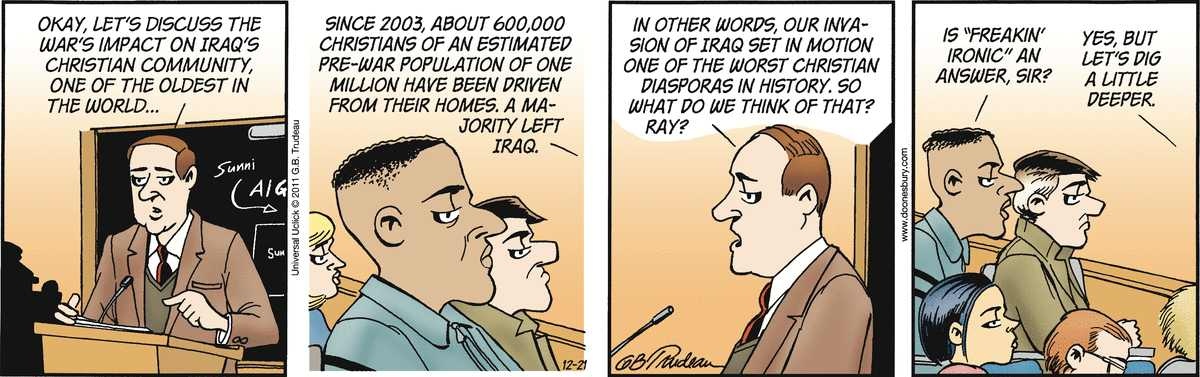
Cartoon from Doonesbury.
 The Dish