Face Of The Day

GT_Stone_Henge

A woman dances as druids, pagans and revellers take part in a winter solstice ceremony at Stonehenge on December 22, 2011 in Wiltshire, England. The unseasonable warm weather encouraged a larger than normal crowd to gather at the famous historic stone circle to celebrate the sunrise closest to the Winter Solstice, the shortest day of the year. By Matt Cardy/Getty Images.

How Prohibition Ended

Ken Burns explains:

The real turning point is the Depression. You say, “OK, we got rid of the fifth largest industry for what reason? We don’t have these jobs that we could use for what reason? And we don’t benefit from this tax revenue for what reason?” Life was so hard in the Depression. We can’t even appreciate it now, even in tough economic times, how bad it was in the Depression. When Roosevelt came in, within a week beer was legal, and the repeal of the amendment went into effect, that is to say alcohol was available, on December 5, 1933. It was almost anticlimactic. It is like, we’ve got to get going with something else more important. 

How Responsible Is Paul For His Newsletters? Ctd

Paul's earlier response to the controversy:

Readers keep the pressure on me:

I just recalled that, in the '08 run-up, you made much of the fact that Romney's LDS church, during his formative years and young adulthood in the 1970s and before, did not allow men of African descent to enter its priesthood.  I believe that you thought Romney should have protested this vigorously, perhaps should even have left his church over it. You felt Romney might still be tinged with that racist view, as I recall. Now you endorse Ron Paul, whose own newsletter has spouted racism. I don't get it.

Aforementioned posts on Romney here and here. You will notice that my point is that Romney once belonged to a church that barred African-Americans from some positions, but that my main gist was that this was "a matter that will require addressing". I hold the same position on Paul and the newsletters. Another reader:

You say, "I’ve made my call." But you were not the object of the racism, were you? He’s ok on gay stuff, so you’re ok with him?

There was plenty of homophobia in those newsletters as well. And yet I find Paul one of the least homophobic candidates on offer among the Republicans. Compared with a candidate who wants to cure us, and others who want to stigmatize us in the Constitution, Paul is a moral leader. Another asks:

Why are you simply saying, "Is he a racist?  I don't see any evidence," when you've been much tougher with other candidates with less questionable records?  (Sarah Palin, for all her lies and nastiness, never went so far as to peddle racist literature bearing her name on a regular basis.) Even if you assume he is not a racist, why not engage with the broader issues about character that this raises?  Was Ron Paul a completely hands-off manager?  Did he know that he was peddling hateful speech and continue to do so because it was profitable?  Do such questions render him unfit for office?

Does it not bother you to endorse someone for the highest office in the land without trying to get the answers?

But I do believe in getting all the answers and don't believe Paul has handled this well this week. And re-reading and reading the newsletters has made me physically sick. They're truly vile emanations from the fringe right, his association with them in any way is disturbing, and I don't blame others for viewing this as a deal-breaker. But I stand by the arguments I made in my endorsement and point to Paul's open disavowal of those newsletters and absence of anything out of his own mouth that echoes them. Let me point out that Jamie Kirchick, who exposed the newsletters, writes: "It’s true that Paul has not said anything explicitly racist in public". Over decades in public life, and three presidential campaigns, is this not something to be weighed in the balance? Another:

I am sympathetic to your support for Paul in the GOP primaries. However, I think you are rationalizing away the newsletter issue. You wrote: "Paul has taken two stands on it: the first was to take formal responsibility, even though he claims he didn't know about the contents; the second was to insist he didn't write them or know who did." However, Paul has, in fact, had a third stance: defending what he wrote as TNC noted in his piece and as Matt Welch documented back in 2008. As Steven L. Taylor wrote this week:

I know some folks think that this stuff doesn't matter, but I think that it does. It raises issues about what Paul actually believed vis-a-vis some pretty vile stuff (for example, see here specifically) and about his honesty (at one point he defended these writings and now claims to have had little-to-no knowledge about them), not to mention his ability to act as a manager (the best case scenario here is that he farmed out his name for cash and paid no attention what was published in association with it).

I am sincerely curious as to your views of the way Paul and his campaign handled this issue back in the 1996 campaign.

More from readers here. Welch rounds up recent commentary on the newsletters. His takeaway:

[T]he movement Paul has helped inspire, to say nothing of the broader libertarian/limited government/classical liberal tendency in America, is not animated by this bizarro-world Archie Bunker crap, nor is Paul himself (in my observation). I'd also say that his campaign has had four years to come up with a better answer than "I don't know who wrote those things," and it hasn't. Front-runners get–and richly deserve–scrutiny, including by adversaries.

I don't begrudge anyone's reasons for voting against anyone, especially if you think he's the type of guy to consciously lunge for power by whipping up race hatred against the descendants of former American slaves. I don't think Ron Paul is that type of guy. I don't (and Reason doesn't) do endorsements, and I would have been happy to see a better GOP primary season from Gary Johnson, whose pragmatic, less hyperbolic, and less socially conservative case for libertarianism I have more natural affinity with.

But I'm rooting for Paul to do well in Iowa and New Hampshire and beyond, because his candidacy offers the only sharp course corrective to the pressing national issues of runaway government spending, bailout economics, entitlement time-bombs, foreign policy overreach, civil liberties intrusions, and the Drug War. These are not small issues, for me or for the country, and 99 percent of politicians are terrible on them.

That's where I am too at this point.

Polls Are Not Magic

Roger Simon makes a bizarre assertion:

Polls are predictions of the future. They are crystal balls. They are magic. Pollsters are wizards, shamans, diviners. They toss numbers around the way astragalomancers once tossed bones to foretell events to come. (The name comes from the Greek astragalos, meaning “knucklebone.” But you knew that.)

 Seth Masket's head hits his desk.

“A Perfect Storm For An Emerging Adoption Industry”

GT_ADOPTION_111221
Kathryn Joyce documents adoption corruption in Ethiopia: 

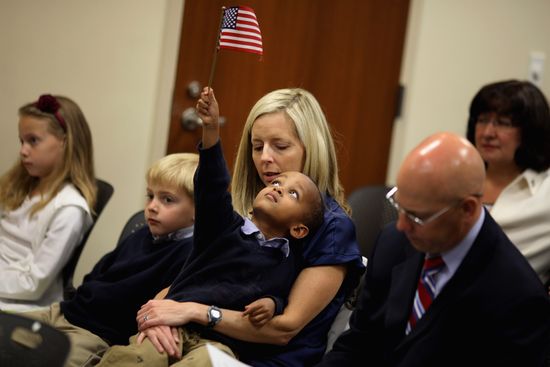
Ethiopia accounted for nearly a quarter of all international adoptions to the U.S. The number of Ethiopian children adopted into foreign families in the U.S., Canada, and Europe has risen from just a few hundred several years ago to several thousand last year. The increase has been so rapid — and, for some, so lucrative — that some locals have said adoption was "becoming the new export industry for our country." 

That increase has also brought stories of corruption, child trafficking, and fraud. Parents began to publicize the stories their adopted children told them when they learned English: that they had parents and families at home, who sometimes thought they were going to the U.S. to receive an education and then return. Media investigations have found evidence that adoption agencies had recruited children from intact families. Ethiopia's government found that some children's paperwork had been doctored to list children who had been relinquished by living parents as orphans instead, which allowed the agencies to avoid lengthy court vetting procedures. 

(Photo: Biniam Volk, 3, holds up a U.S. flag while sitting with his adopted family (L-R) sister Lauren Volk, 10, brother Max Volk, 7, mother Caeli Volk and father Joe Volk of Bristow, Virginia, during the children's citizenship ceremony at the U.S. Citizenship and Immigration Services office November 14, 2011 in Fairfax, Virginia. In celebration of National Adoption Month, 25 children representing nine countries, including Bulgaria, China, Ethiopia, Guatemala, Korea, Liberia, Russia, Taiwan and Vietnam, celebrated their U.S. citizenship during the ceremony.  By Chip Somodevilla/Getty Images.)

Surge Fail, Update, Ctd.

I've bitten my tongue in the last few days, partly because of bronchial issues, partly because the news is so target-rich, and partly because the events in Iraq seemed almost comically to make the point I have been making for years now. The surge only worked as a face-saving device to get out of Iraq. It never worked as it was designed to, to bring Iraq's sects and factions together. It failed. As Iraq begins to unravel, Patrick Porter re-evaulates the surge:

Advocates of enlightened counterinsurgency and muscular state-building argued that Iraq vindicated their position. They argued that the combination of more troops and more restraint played a major role in depressing the levels of violence and giving Iraq a breathing space to recover from the communal bloodletting it suffered in the post-invasion years. But if Iraq descends again into the traumatic violence of 2005-6, we must acknowledge that this approach had its limits. It bought time and got the issue off the front pages – no small thing for a superpower that has seen presidencies destroyed in the past by protracted small wars – but a new civil war of sorts would suggest that the surge did not achieve its most profound objective.

You think?

(Hat tip: Joyner)

Why Ron Paul Matters

Who else would inspire a video like this?:

Joe Klein reports from Iowa:

I watched Ron Paul deliver his stump speech–to large and loving crowds–twice yesterday and he did a very strange thing for a political front-runner. He emphasized the things traditional Republicans are least likely to approve in his libertarian appeal. He began each speech with a long, discursive section on foreign policy–citing George Washington, Dwight Eisenhower and George W. Bush, among others, on the perils of entangling alliances, the military-industrial complex and nation-building. He minced no words. He said the money we saved overseas could be used to bolster programs like Social Security and Medicare, until we transition away from them. Then he devoted another long section to civil liberties, to his opposition to the Patriot Act and the illegality–he believes–of assassinating Anwar al-Awlaki, an al-Qaeda leader who was an American citizen, in Yemen. This was not political comfort food.

Is Romney Stronger Than He Appears? Ctd

A reader writes:

Fred Bauer failed to account for the fact that 1994 was one of the strongest Republican years on record, as opposed to the basically neutral Congressional environments of 1988 and 2000.

Nobody denies that Romney was a better candidate, with or without his Bain baggage, than the roadkill Kennedy faced in his other election years. But Kennedy was considered reasonably vulnerable at points during that 94 race. Couldn’t the fact that he ultimately managed a 17 point margin win over a young, good-looking, intelligent, moderate candidate illustrate that his Bain strategy actually worked very well?

To credit the reduced margin of the ’94 victory purely to Romney’s strength as a candidate is very naïve. And extrapolating those ten (!) points towards “Obama’s margin” is absolutely ridiculous.

Another reader adds:

The democrats lost eight Senate seats that year. In Virginia, Oliver North would have won a seat if an independent candidate hadn't taken 11% of the vote.  The fact that Kennedy still beat Romney in 1994, and by that much, shows how weak Romney is — as does the fact that if Romney had run for re-election as Governor, he would have lost.  

The GOP’s Missed Opportunity

Douthat wishes Republicans had "taken yes for answer" on the payroll tax cut:

The White House’s embrace of payroll tax cut, properly understood, should be a boon to the right, since it involves a Democratic president tacitly admitting that Social Security isn’t really pay-as-you-go, that the trust fund is more a gimmick than a lockbox, and that America’s retirement system could be just as easily paid for out of general revenue rather than through a counterproductive tax on employment and work. Instead, the debate as it’s unfolded has made the Republicans look ideologically confused, politically disorganized, and loath to champion policies that directly benefit the middle class. As the overture to an election year, it’s been the poorest possible advertisement for conservative governance.