Is Romney Stronger Than He Appears?

Fred Bauer thinks Romney's Bain baggage won't weigh him down:

Some rightie activists have suggested that Ted Kennedy’s anti-Romney strategy in 1994 offers a devastating blueprint for Obama’s 2012 strategy against Romney. This parallel should also not be overstated. Kennedy did hit Romney hard on his record at Bain, but Barack Obama is no Ted Kennedy, and the United States is not Massachusetts. Kennedy’s 17-point victory over Romney was a decisive one, but 1994 was the only time Kennedy’s reelection margin fell below 20 points. Even with all his Wall Street attacks, Kennedy’s margin of victory was over 10 points less than it was in 1988 or 2000. Obama lacks Kennedy’s electoral cushion; a 10-point swing would end his presidency.

What Ron Paul Is Guilty Of

Paul talks about his newsletters starting around 1:52:

TNC responds to my thoughts on the Ron Paul newsletters:

[L]et us grant Ron Paul all the charity we can muster and say that he, in fact, did not write any of this. Let us also dismiss the fact that this alleged someone else (Lew Rockwell) remains in Paul's orbit. Having granted that charity, let us "flip it," and ask what we would think of Barack Obama who, under his own name, published such racism directed at whites and HIV. How seriously would we take the "He didn't actually write it–he just published it" defense? Would we really be so forgiving? 

Or would we say, as we should, that this sort of thing is fit for an NOI mosque, but not for the White House? Perhaps we would be completely generous and grant that Obama was not, as Andrew puts it, "a big racist." But would this not, still, raise troubling questions of incompetence? How could we justify handing off the launch codes to a man so careless with his very name?

I could not. You need not be a racist to be disqualified for the presidency; a truly stunning level of incompetence will do in a pinch. 

TNC also flags the above video of Paul talking about the newsletters in 1995:

Yesterday Ron Paul claimed on CNN that he'd never read the newsletters that went out in his name. Here is Ron Paul in a 1995 video discussing the very newsletters he claims to never have read. 

If you can find away to explain away a hateful newsletter written in someone's own name, it's likely you can find some way to explain this video away too. There's always a path to make yourself right, if that's your intent. Indeed, at this point it probably behooves me to stop arguing.

But I would ask you suffer me one final point: Dave Wiegel convincingly argues that Paul isn't a bigot, simply part of coalition who saw bigotry as a potent political force. This is meant as a defense. In fact it's an unwittingly damning indictment, that puts Ron Paul in ugly tradition of non-racist demagogues

One might ask: which current Republican candidate has not been "part of coalition who saw bigotry as a potent political force"? And one might also ask: which other Republican candidate has actually taken a stand on the racial dimensions of the drug war, and on not scapegoating American Muslims? Which other Republican candidate has actually stood up for minorities against the establishment? I'll have more later on what I view as TNC's missing the forest for the trees in this Republican primary race. But meanwhile, more airing of the newsletter stuff. And it should be aired. Tod Kelly, who likes Paul quite a bit, can't bring himself to vote for the guy. The newsletters are one reason:

I realize that they were written 15-20 years ago, but Paul is 76 – which means that the newsletters in question were written in his mid- to late-50s and are therefore harder for me to write off as youthful ignorance. Yes, I also know that it is very unlikely that Paul himself wrote most or any of the newsletters. However, it appears that for some number of years he was willing to have some unknown number of subscribers believe that they were his thoughts; I find arguments that he had no idea what was in them don’t pass my sniff test. Lastly, it is hard not to note that in just about every response to these statements over the years Paul disclaims authorship and notes the passage of time, but never really seems to distance himself from the actual ideas.

Chait piles on:

Let’s stipulate that Paul didn’t write any of those items. He still published a racist newsletter. If Larry Flynt were running for president, I’m pretty sure people wouldn’t care that much that he did not personally take the photographs that appeared in Hustler.

A blogger at I Talk You Bored challenges me to read a Ron Paul letter entitled "Blast 'Em," which provides advice on how to shoot "urban youth" carjackers using a disposable, shadily acquired weapon. I'll respond in due course.
The Treason Card

How easily the neocons use it. It is quite something for a writer to accuse a presidential candidate of essentially supporting America's enemies, and of being full of venom and hatred for the United States, when he has served this country as a congressman for decades. But the neoconservative mindset always first reacts to criticism with smears. Anti-Semite. Racist. Traitor. Rather than reconsider for a second their own appalling record in foreign policy, and see Paul as an opportunity to air some vital questions about how the US conducts itself globally, they turn on the only figure in the current GOP race who got the Iraq war right, rather than wrong.

Somehow, he has something to answer for, while they never do.

And notice the baldly McCarthyite language by Dorothy Rabinowitz.

Paul is "the best-known of our homegrown propagandists for our chief enemies in the world." That truly is a foul accusation of treason, and one that takes not a second to explain the actual arguments he has used – arguments that involve important issues such as blowback, unintended consequences, and the risk of war. It is a sign of a movement that has so lost the narrative it can only smear or ignore those with whom it disagrees – rather than engage them.

But Rabinowitz is not done. Paul is "a leading spokesman for, and recycler of, the long and familiar litany of charges that point to the United States as a leading agent of evil and injustice". Anyone who has ever listened to Paul knows that his love for this country is profound, and his argument with the neocons is about the way in which we have conducted ourselves as a global power – a vital subject for discussion and scrutiny, given the catastrophe of Republican foreign policy under the last administration.

This is the debate the neocons do not want to have. Because they might lose it. A vote for Ron Paul is a vote against their attempt to shut this debate down.

WFB On Ron Paul: No Dorothy Rabinowitz

In a response to Rich Lowry's missive, Daniel McCarthy revisits the NR founder's thoughts on the candidate. He points to this interview between Buckley and Bill Steigerwald from four years ago:

Q: Has conservatism made a bargain with the state or with government power that it should not have made over the last 50 years? Has conservatism forgotten the message of Albert J. Nock’s seminal book, “Our Enemy, the State”?

A: The answer is, “Yes, it has.” Accommodations have been made, the consequences of which we have yet to pay for. Albert J. Nock, although he could express himself fanatically on these subjects, would certainly have pronounced these as major, major mistakes. So, the answer to your question is, indeed those excesses have been engaged in and they affect the probity of the conservative faith.

Q: You know who Ron Paul is — the congressman. He’s derided and discounted by many conservatives and his fellow Republicans as a kook. Yet his strong stands in favor of limited constitutional government, lower taxes, more personal freedoms and nonintervention overseas make him in many ways sound like a conservative of old — a Robert Taft, or a Coolidge kind of conservative in some ways.

A: I agree, yeah.

Q: Is he getting a bum rap?

A: I think that people who cast themselves as presidential contenders are almost universally derided on the grounds that they don’t have manifest orthodox qualifications. In the case of Ron Paul, he doesn’t have a broad enough or huge following and under the circumstances he becomes rather a quaint ideological aspirant than someone who is realistically seeking for power.

McCarthy's conclusion:

[W]hat would Buckley have made of Paul now that he does have a broad and huge following, at least in Iowa? John Derbyshire opined in 2007 that there was “not much” in Paul’s platform with which a young WFB would not have agreed. (Buckley’s father, Will Buckley, was rather a Paul-like libertarian, it’s worth noting.) One thing is clear from the Steigerwald interview: Buckley would not have disqualified Paul on grounds of insufficient fealty to neoconservative foreign-policy objectives.

He tackled the subject previously here. My 2007 take here

Paul Gets The Front-Runner Treatment

And handles it … not-so-well. Weigel analyzes the exchange above, where Paul takes off his mic and ends an interview after being asked repeatedly about his newsletters:

[Paul] has answered some of the questions, but only some — he has never said who wrote the offending stuff, and whether he still associates with the author. I think that's the wound that the press can keep poking. Imagine a less sui generis politician — imagine, say, Mitt Romney being found out for having published internal Bain memos, or something, that indulged in conspiracy theories. The media wouldn't let him off if he just said someone else must have written them.

I'm not sure what he is supposed to say at this point. He's unwilling to out Lew Rockwell and disown him. And the focus on it – rather than, say, his views on Iran or the drug war – is in line with press behavior. This is the "Jeremiah Wright" scandal for Paul. Allahpundit is more blunt:

[H]is answer here tracks perfectly with the reactions I typically see from Paul fans in blog comment threads whenever the newsletters come up. It’s never a matter of “yes, they’re disturbing and absolutely fair game, but we need to elect Paul anyway because we desperately need his fiscal discipline.” Rather, it’s always a case of “Meh, old news. This again?” Good luck in the general election, guys. Exit quotation from Philip Klein: “Ron Paul transparency: Bradley Manning is a hero for leaking classified info, but don’t dare ask who wrote my newsletters!”

For the record, my own position is and has been: yes, this is relevant; yes, it's disturbing; no, it's not disqualifying. And the real debate needs to be about fiscal restraint and global prudence.

Checking In On Healthcare Reform

Google-ChromeScreenSnapz284

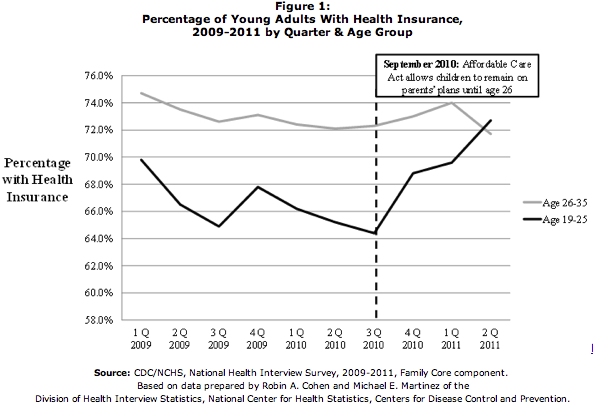
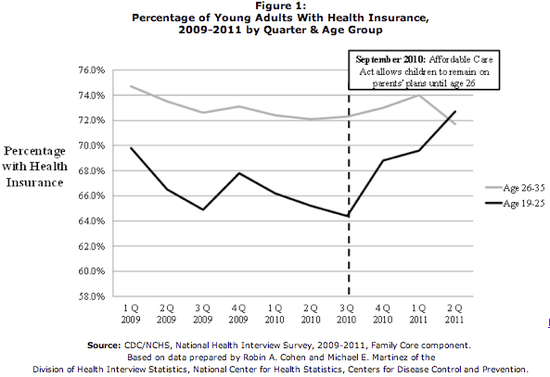
Rajiv Narayan credits the law with a recent surge in insurance rates for younger Americans:

So far, as the mounting evidence can tell us, the boom in coverage seems to be an effect of the Patient Protection and Affordable Care Act (ACA). Indeed, not only were more insured between the ages of 19-25 in the second quarter of 2011 compared to the third quarter of 2010, but coverage by like programs (such as Medicaid) has fallen in that period. With lower disposable incomes in this recession, fewer Americans have the resources to purchase health insurance for their children outright. If programs like Medicaid and private consumption are not insuring young people, the inescapable conclusion is that the Affordable Care Act is responsible for the latest increase in coverage.

(Chart via Igor Volsky)

Is Paul’s Position On Iran Popular? Ctd

Scott Clement digs into the numbers:

Paul’s preference for diplomacy is … shared with many Republicans. More than six in 10 picked “economic and diplomatic efforts” as the best Iran policy right now, according to a November CNN/ORC survey; fewer than one in four chose military action. Paul’s call for eschewing sanctions in favor of free trade agreements, however, stands in stark contrast to his fellow partisans who see Iran as a genuine threat and an enemy. More than nine in 10 Republicans in a 2010 Pew Research Center poll approved of increasing sanctions in an effort to keep Iran from developing a nuclear weapon.

Earlier commentary on the subject here.

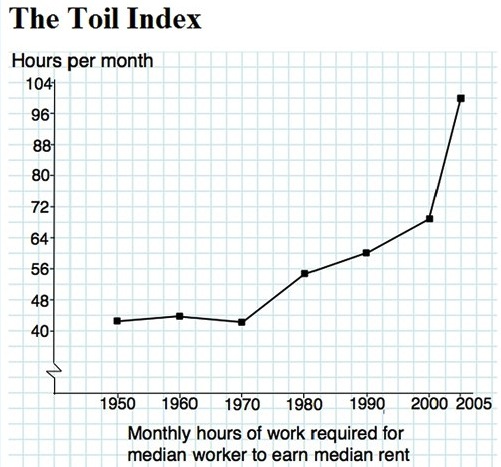
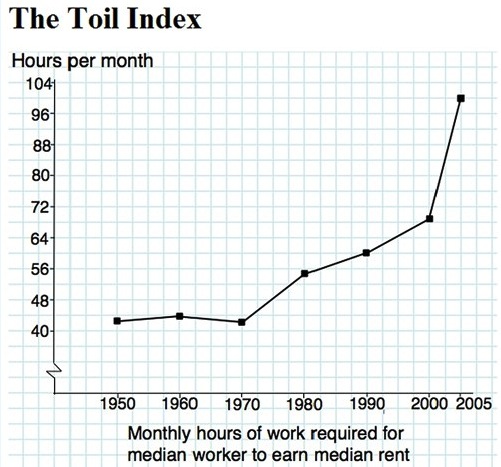
Chart Of The Day

Toil_Index

Ezra Klein asked economists and politicians to submit their favorite charts. Here's Robert Frank's submission:

My entry is the attached graph of what I call the Toil Index. It's an index I constructed to portray the most dramatic element of the middle-class squeeze — the effort required to rent a house served by a school of average quality.