Ron Paul’s Ceiling

Aaron Blake doesn't think it's very high:

So what do the young, the independents, the non-interventionists and the non-Christians have in common? They are all pretty small minorities in the Republican Party. … [A]s [Paul] maxes out among those small, key demographic groups, he’s not able to appeal to others. This appears to be what’s happening in Iowa, and while it might be good enough in a six-candidate field there, it will be tougher to execute it as a successful strategy as the race shrinks.

The Search For The Perfect Gift

Yglesias embarks on it:

The problem with presents is that you’re never going to do a better job of satisfying the gift-recipient’s preferences than she could do herself. But preference sets aren’t fixed. If someone had handed me $10, I never would have spent it buying the Cults album, for the simple reason that I hadn’t heard of the band. When it was given to me, I immediately checked it out and loved it. When you step outside the circle of things you know for sure your gift-getter likes, you risk creating a massive deadweight loss. (You give her a ticket to Las Vegas, without knowing that she hates gambling.) But with the greater risk comes a greater potential reward. You may introduce the recipient to something marvelous she would otherwise have never encountered. 

Do Businesses Need HR Departments?

Brian Hults poses the question:

Adding legitimacy to this skepticism are new technologies that enable automation of routine transactions, offshoring and shared service organizations that specialize in managing many tactical elements of HR. Outside vendors are handling classic HR functions like payroll, staffing and recruiting, and even equal employment opportunities investigations, often at a lower price and higher quality than companies can manage for themselves. Even sacred and often arcane areas of HR such as executive compensation are now largely guided by outsourced providers who are experts in current tax and SEC regulations.

In this world flush with cheaper ways to fulfill traditional HR tasks, is HR becoming obsolete?

Hults concludes in favor of HR's continued relevance.


Manufacturing Deadly Viruses

Anders Sandberg thinks through the ethical issues raised by scientists creating a new strain of potentially pandemic bird flu for lab research. Iain Brassington doesn't think terrorists would want to use bioweapons in the first place:

[I]f you let off a bomb or some nerve gas, you’ve got the effect right there: Here we are, here’re our demands, BANG!, We really mean it.  With something like flu… well, it could be days before anyone even notices what you’ve done, if they notice at all; and then you have the task of persuading the public that the strain of illness really was yours.  We already have the phenomenon where shadowy groups claim responsibility for other people’s bombs; part and parcel of terrorism is that various nutters will appear to claim that they did it.  Translate that to bioweaponry, and the situation becomes ludicrous: Here we are, here’re our demands, Atishoo!, We really mean it… No, honest, it was us, stop laughing, come back.

The Daily Wrap

Today on the Dish, Andrew sensed a watershed moment as the House GOP played "high stakes poker," the WSJ ridiculed congressional Republicans as the McConnell method prevailed, and Romney naturally refused to take sides. The GOP discounted an electable candidate, Paul's candidacy could ultimately make room for pragmatism in the Republican Party, and Jennifer Rubin faced a hard road. The GOP establishment has morphed into a "Washington consensus," Gingrich got pummeled on TV, and he and his party turned away a whole group of people (follow-up here). Paul surged (and he under-polls), Silver broke down Obama's approval rating bounce, and the Dish reader survey continued. In our AAA video, Andrew addressed Reagan's response to the AIDS crisis and his presidency in general, the presumptive nominee equivocated on Iraq, and he's a big fat liar

We tracked developments as Assad slaughtered 250 Syrians in two days, Eli Lake checked in on major political squabbling in Iraq, Issandr El Amrani exposed the reality in Egypt, and we thought through the consequences of a North Korean collapse. Andrew discussed North Korea and torture, protesters marshalled the arts, and Hamas signaled a transition to nonviolent resistance. 

Hitch's life was ended by addiction, deep local knowledge is overrated, and homophobia is fucked up. Piers Morgan was "extremely hands on" as editor of the Daily Mirror, policymakers must behave as if "there will, in fact, be a future," and Ryan-Wyden forged a consensus around competition in healthcare. James Madison approached the environment with humility, readers weighed in on pubic hair and the lack thereof, and cleaning is a form of conspicuous consumption.

Lamest jokes from the GOP candidates here and here, tweet of the day here, Newt's turn at bad lip-reading here, Kim Jong-il dropping the bass here, Moore award nominee here, VFYW here, MHB here, and FOTD here

M.A

The Most Likely Candidate

Intrade gives Romney a 70 percent chance at the nomination. Douthat maps Romney's "three paths to victory":

Because the early states aren’t winner-take-all, there’s no chance of a Gingrich or a Perry doing what John McCain did in 2008, and building up an insurmountable delegate lead by March on the strength of a string of narrow victories. And the winner-take-all contests that follow are mostly in regions that seem likely to break for the former Massachusetts governor – the Northeast, the West Coast and the Mormon-heavy Mountain West. If it’s a two-man race in April, in other words, Romney will (still) have the inside track.

Will Wilkinson is hoping for a Paul win in Iowa:

If Mr Romney sweeps the early states, the most ridiculously enjoyable primary season in recent memory will turn dreadfully dull.  

Face Of The Day

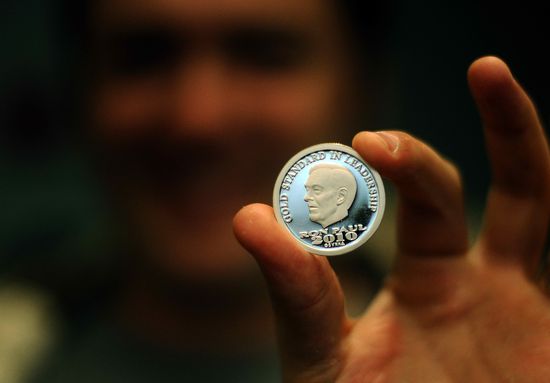
136052981

A supporter shows a coin with Republican presidential hopeful Ron Paul's face on it during a town hall meeting in Mt. Pleasant, Iowa, on December 21, 2011. Paul, courting Iowa voters who are key to his campaign, called Wednesday for a 'minding our own business' foreign policy and an end to 'perpetual war.' By Jewel Samad/AFP/Getty Images.

Whither Pubic Hair? Ctd

A reader writes:

You should know that Matt and Trey already answered this question a long time ago: "It makes your johnson look bigger."

Another shifts gears:

Okay, Romeo and Juliet is a poor example to prove that young teenaged girls have been objects of sexual desire. 1) It's a play about punishing misbehaving teenagers. It only works as a narrative if Juliet is the object of desire. Even so, that desire is regulated through a secret marriage. 2) Previous to the 1885 Criminal Law Act, the age of consent in England was 13 (and had been lower before an 1860 Act).

During Shakespeare's day, a 13 year old could have been reasonably seen as a woman, not a child. When Marie Antionette was married to Louis XVII at the age of 14, all of their advisors couldn't understand why they didn't immediately begin having children. To us it seems clear that it's because of their young ages, but not to observers in the late 18th century. Our extended adolescence comes from our better understanding of how people develop. It's one of the many reasons why the age of consent in the US is now between 16 and 18 – we recognize that 13 year olds don't know what they're consenting to. Indeed, W.T. Stead's series, "The Maiden Tribute to Modern Babylon," which pushed Parliament to discuss the 1885 Criminal Law Act, explicitly made this point. (Incidentally, this bill is remembered more for the Labouchere Amendment, which criminalized homosexuality, than it's intended purpose – to raise the age of consent and stop the traffic of women into brothels.)

I know this has nothing to do with pubic hair, but we can't just use our sexual mores to judge the past or vice versa. I take the writer's point – teenaged females were objects of desire before the 1970s – but attitudes towards sex involve historical context. (Plus, I really detest Romeo and Juliet, which is often read as a romance, when it really is about punishing children who don't follow their parents' rules for marriage. Yeah, the families are told that their children's deaths are their fault, but the real narrative punishment is directed at Juliet, who has to wake up to her dead husband after faking her own death so that they could be together.)

Romney – Shockingly – Has It Both Ways On Iraq

In an interview with Chris Wallace on Sunday, Romney "would not say" whether, in hindsight, the US should have gone to war: 

"At the time, we didn't have the knowledge that we have now," Romney said, pointing to intelligence before the war suggesting that Saddam Hussein had weapons of mass destruction.  After the war, U.S. and international inspection teams did not find those weapons, which had been the basis for much of the Bush administration's case for invading Iraq.  The invasion, Romney said, was "appropriate" because the U.S. acted "in light of that belief," that is, in intelligence that ultimately turned out to be faulty.

Ali Gharib took issue with Romney's account. Chait flags an interview from today:

In an interview with MSNBC’s Chuck Todd today, Mitt Romney asserts that "of course" invading Iraq was a bad idea now that we know Saddam Hussein had no weapons of mass destruction. ("If we knew at the time of our entry into Iraq that there were no weapons of mass destruction, if somehow we had been given that information, obviously we would not have gone in.") Four years ago, Romney said just the opposite. ("It was the right decision to go into Iraq. I supported it at the time; I support it now.")