James Surowiecki applauds Americans for reviving the practice:
Even people who can pay off their credit cards often don’t, since the whole structure of the credit-card industry is designed to make you irresponsible—as long as you make a small monthly payment, the bank will carry you. In fact, that’s what the bank wants: the profits in the credit-card business come from "revolvers," people who pay a small amount each month and rack up big interest charges—far more than the five bucks they’d have spent on a layaway service fee. Layaway, by contrast, fosters virtue: it forces you to save, because if you don’t make the payment you don’t get the product. It’s what psychologists call a "commitment device," a way to get yourself to do something that you want to do but know you’ll have a hard time doing if left purely to your own devices.
Teenagers are less eager to get behind the wheel than ever before. In 1983, 46% of 16-year-olds had a driver's license. That figure dropped to 31% by 2008:
The decline in driving by younger Americans is fed by many factors: the high cost of gas and insurance at a time of economic insecurity; tighter restrictions on teen drivers in many states; and roads that are more congested than ever, making driving less fun than ever. But the impact of the internet is big too. "It is possible that the availability of virtual contact through electronic means reduces the need for actual contact among young people," says Michael Sivak, research professor at the University of Michigan Transportation Research Institute and coauthor of the study on driver's licenses. "Furthermore, some young people feel that driving interferes with texting and other electronic communication."
Texting while driving is, in essence, a wake-up call to America. It illustrates our real, and bigger, predicament: The country is currently better suited to cars than to communication. This is completely bonkers.
New analysis by researchers at Tufts University raises some doubts about Obama's security in the 2012 race, specifically in the key electoral states of Nevada and North Carolina:
"The state-specific data for young voters from both of these battleground states shows what can only be described as a profound loss of the registration advantage Democrats held during the 2008 election cycle," said Peter Levine, Director of CIRCLE. "That decline is a warning sign for Barack Obama, since more than two-thirds of young voters supported the Obama/Biden ticket in 2008."
Jim Geraghty links the findings to the fact that both states rank among the 11 highest in the nation in unemployed young people. Ruy Teixeira's take on the importance of the millennial vote here.
Today on the Dish, the 2011 Dish Award Winners were announced to fanfare and trumpets! Andrew refused to let Glenn Reynolds get away with lying about Obama's record, tangled with Ron Paul's more unsavory writings about gay rights (while reiterating his endorsement retraction), and wasn't buying denunciations of the congressman by either the Manchester Union-Leader or Mike Tomasky. Andrew also looked back at Margaret Thatcher's views on Israel, spotlighted the right's infighting on Santorum and Paul, slammed the Cardinal of Chicago's anti-gay bigotry, and suspected that history may see Romney's nomination as a foregone conclusion. We explained why Iowa always went first, noted that young Iowans liked Paul and old ones picked Romney, and Gingrich did not "respond well to nonrecognition of his world-historical destiny." Todd Purdum recounted some good flip-flops and Hilary was not running for President or VP.
Readers criticized the Moore nomination for Gorbachev's Soviet pseudo-nostalgia, Obama dubiously decided to allow Yemen's dictator into the US for medical treatment, five hundred thousand Syrians took to the streets, and Andrew wasn't as confident as some analysts that Russia and China were moving towards democracy. Readers found Iran's threat to close the Straits of Hormuz implausible while the Washington Times saw an opportunity to never let a good crisis go to waste.
Thursday on the Dish, Andrew placed Ron Paul's views on war firmly in the American mainstream and slammed Michael Medved for replacing discussion on this point with namecalling. Andrew also defended Paul's record on gay rights and racism, checked in on Paul's chances in Iowa and New Hampshire, heartily recommended Mark Lilla's critique of Corey Robin and assessment of modern conservatism, and kept onmocking the absurd headlines generated by Santorum's poll numbers. Larison pooh-poohed Santorum's chances, Ruy Teixeira warned Obama that he needed the youth vote, and Rick Perry drew a blank on yet another critical policy issue.
The US government came up with options for ending the massacre in Syria, Egyptians created hope for their revolution, Iran threatened to strangle the global oil trade, and Michael O'Hanlon threw out some projections for viable defense cuts. We took yet another look at Pinker's thesis on violence, paying teachers more worked, Paul Starr and Jonathan Cohn debated an alternative to the health care mandate, and the ban on electronics during takeoff found a champion.
The "Returning Soldiers' Dogs" video owned the MHB voting (though the others were great), straight dudes shaved their nethers, college students moved back in and Louis CK made a million bucks on the internet. QFTD here, Moore Award here, VYFY here, Airplane window view here, FOTD here, and MHB here.
Wednesday on the Dish, Andrew got angry at Netanyahu's refusal to consult with the US on Iran strikes, called Gingrich out for hyperbolic attacks on Ron Paul, chuckled at Santorum's unfortunate choice of words, and marveled at the blogosophere's inability to make the newsletters hurt Paul in Iowa. Bernstein wasn't as convinced on that last point, a reader kept up the debate on Paul and racism, Steve Kornacki credited a media blackout with Ron's rise, and the paleolibertarian continued to poll well in the Hawkeye state. Pundits grumbled about Iowa's outsized influence, Santorum (gag) surged, and Perry kept up his patented pattern of saying stupid things. Douthat tried to find the good in the GOP field while a 9-year-old grilled the candidates on the most important political issue of our time: superheroes.
Arab League monitors ineffectually surveyed the devastation in Syria, 38 North speculated about a world after Kim Jong-Il's bizarre funeral, and we worried that both India and China might both be heading towards serious economic problems. Chris Christie narrowly led the Yglesias Award voting, readers continued to discuss limiting work hours, and McCardle gave tips on saving money. We counted down the year in ridiculous comments from both Republicans and Democrats while Alyssa Rosenberg thought the Game Change movie should have been about the Edwards campaign. Wikipedia went global, touch was socially important everywhere, and broken Christmas lights got sent to China.
Tweet of the Day here, Moore Award here, Faces of the Day here, MHB here, and VYFW here.
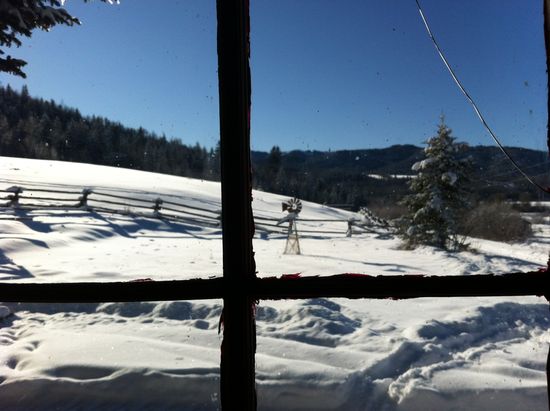
Victor, Idaho, 11.04 am
Tuesday on the Dish, Andrew read Ron Paul's fortune in the New Hampshire tea leaves while Mark Blumenthal cautioned against attempts to do the same in Iowa. Byron York chronicled Paul's appeal outside the GOP, Beinart hoped his support inside the party will be able to change it, Adam Ozimek situated Paul's portfolio in the broader context of his crazy beliefs, and Michael Cohen did the same with respect to the congressman's foreign policy views on issues other than war and peace. Paul's rivals also got some Dish play – we couldn't understand why Romney wasn't getting hit harder, thought through what happened if he flopped in Iowa, and wondered if the Gingrich flop was being oversold.
Dan Savage campaigned to win the Moore Award, the Israeli government's P.R. team screwed the pooch, and analysts had faith in the Arab Spring. The rich continued to run Congress while Robin Hanson couldn't understand why workers in prestigious industries were the only ones allowed to put in long hours.
Philosophers pondered food, birds adapted to cities, and athletes spawned a few little superathletes. Readers raked Tebow and Tom Junow over the coals and ingenious students found a way to repurpose low-value New York metrocards to good use. We also, nicely enough, gave you a belated musical present for Boxing Day. Hathos Alert here, VYFW contest winner here, VYFW here, MHB here, and FOTD here.
Monday on the Dish, we launched the annual Dish Awards poll (you kept voting early and often), which led to the tightest Malkin race evah and a showdown between Andrew vs. Jennifer Rubin in the Von Hoffman race. Jim Henley explained why Ron Paul couldn't produce the newsletters' authors, Nate Silver argued that Paul needed the race to be tight to have an impact on the GOP, and Jonathan Bernstein thought that the new delegate distribution rules weren't really going to help the good doctor – though his son might stand a better chance in 2020.
The Economisttracked the global work ethic while Yglesias worried about America's overlarge houses. Readers sounded off on that awesome Navy kiss and the Christmas gifts thread, Tebow's successes (while they lasted) bolstered a sort of American Christianity, and Teach For America caught some flak. Scientists couldn't figure out why nipples got hard, obsessed over correlations, and explained why people walk the way they do. Though Martin Luther demonstrated things could go viral before the internet, riots have gotten way more efficient in the age of cell phones.
Calvin and Hobbes fans got a belated Christmas gift (seen above), celebrities rode the subway, and KnowYourMeme ran through 2011's best. MHB here, VYFW here, and FOTD here.
Gordon Chang predicts the fall of China's government in the coming year:
As a result, we will witness either a crash or, more probably, a Japanese-style multi-decade decline. Either way, economic troubles are occurring just as Chinese society is becoming extremely restless. It is not only that protests have spiked upwards — there were 280,000 "mass incidents" last year according to one count – but that they are also increasingly violent as the recent wave of uprisings, insurrections, rampages and bombings suggest. The Communist Party, unable to mediate social discontent, has chosen to step-up repression to levels not seen in two decades. The authorities have, for instance, blanketed the country's cities and villages with police and armed troops and stepped up monitoring of virtually all forms of communication and the media. It's no wonder that, in online surveys, "control" and "restrict" were voted the country's most popular words for 2011.
It should be noted that Chang's book claimed the Communist regime would fall in 2011. Sergei Guriev and Aleh Tsyvinski make a similarly bold claim about Russia:
Ironically, the wave of protests since [the election] is consistent with the “modernization hypothesis” that Putin’s government has always used to justify the rollback of democracy in Russia: democracy is sustainable only if society is sufficiently well-off and has a solid middle class; until then, centralized rule is needed.
Now, it seems, sufficient prosperity has arrived, calling forth a middle class solid enough to demand government accountability, the rule of law, and a genuine fight against corruption. Whatever happens in the March 2012 presidential elections, the political mobilization of the middle class will eventually lead to democratization.
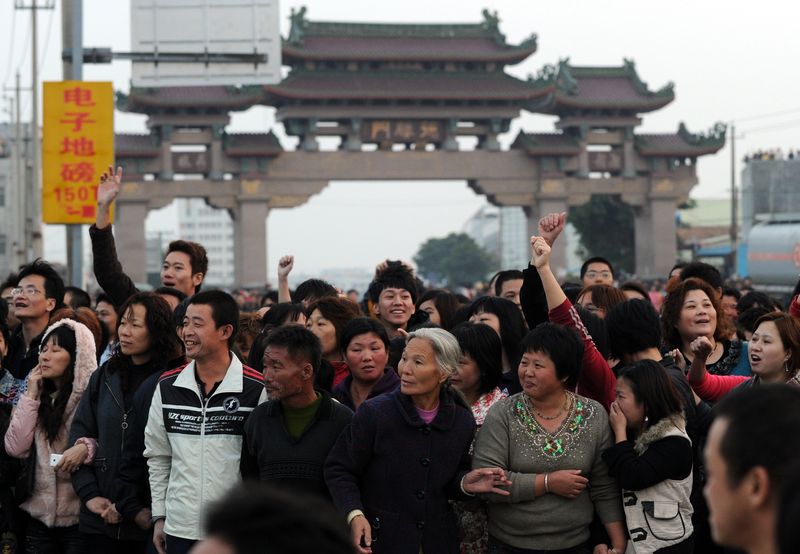
(Photo: A large crowd of villagers forms in front of police lines at the scene of environmental protests over the past few days in the town of Haimen, Guangdong Province on December 22, 2011. Demonstrations over a power plant in southern China turned violent for a second straight day on December 21 when police fired tear-gas and beat protesters, witnesses said. At least six people were said to have been injured in the clashes with police in Haimen, a town in Guangdong province where residents are protesting against a coal-fired power plant that they say is a health hazard. By Mark Ralston/AFP/Getty Images.)
Todd S. Purdum highlights the benefits of changing one's stance:
For F.D.R., who blithely explained his abandonment of domestic priorities after Pearl Harbor by saying that "Dr. New Deal" had become "Dr. Win the War." For Harry Truman, who overcame his border-state background to de-segregate the military, and for Lyndon Johnson, who abandoned his career-long opposition to strong civil-rights measures to pass the strongest ones in history as president. Here’s to Nixon in China, Bill Clinton on a balanced budget, Barack Obama on closing Guantánamo. Oh, wait! So it’s not a perfect theory.
But we’d all do well to remember the first political statement Abraham Lincoln ever made, on March 9, 1832, in his failed campaign for the Illinois legislature. … "Holding it a sound maxim that it is better to be only sometimes right than at all times wrong, so soon as I discover my opinions to be erroneous, I shall be ready to renounce them."
More than 500,000 Syrians may have turned out to protest on the traditionally largest day of the week for protest. To give you a sense of scale, that's the equivalent (percentage wise) of roughly 7 million Americans on the street. Martin Gasciogne demands the global media pay more attention:
In Syria, President Bashar al-Assad has suggested that he is a pragmatic politician trapped by circumstance. Whether, however, his plan of conducting more open elections in 2012 has any hope of offering a way out of the impasse has a rather big question mark over it. The legitimacy of the regime may well have been fatally wounded. Syria, unlike Tunisia or even Libya, risks becoming trapped in a cycle of debilitating violence rather than seeing the sort of political progress for which the opposition Syrian National Council hopes. I might help if the rest of the world would at least pay attention.
Along those lines, Ahmed Al Omran (whose Twitter feed is an invaluable resource for anyone interested in the Syria uprising) pens an extended obituary for rebellion chronicler Basel Al-Sayed, whose death we mentioned yesterday. Daniel Serwer thinks the Arab League is helping, somewhat marginally, but the Free Syrian Army isn't. Joseph F. Jacob exposes the hollowness of Assad's "concessions" on the core right to free speech. Here's a protest outside some beautiful historic ruins:
Here's another enormous protest in Idlib:
These protestors carry off a man wounded by nail bombs, one of the many nasty tools used by Assad thugs today:
And this man was shot in the chest while participating in a march in Hama today:
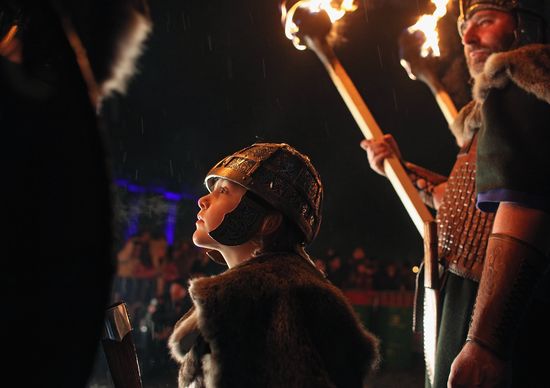
Men dressed as Vikings lead the torchlight procession as it makes its way along Princess Street for the start of the New Year celebrations on December 30, 2011 in Edinburgh, Scotland. Thousands of people joined in the torchlight procession, followed by the burning of a Viking long ship, to mark the start of Edinburgh's Hogmanay celebrations. By Jeff J Mitchell/Getty Images.

 The Dish