How Can We Lower Healthcare Costs?

Contra Ezra Klein, Avik Roy insists that competition works in healthcare: 

[T]he principle of making the sellers of health care compete with each other—is at the heart of competitive bidding, which in turn is the core of the Wyden-Ryan proposal. In rural areas where hospital monopolies reign supreme, Wyden-Ryan will probably have a minor impact on health spending. But in urban areas, where insurers can play competing hospitals against each other to keep prices down, competitive bidding is likely to work, and work big. A demonstration project by the City of Denver in the late Nineties found that competitive bidding saved between 25 and 38 percent, compared to traditional Medicare. So yes, competition works. But you need it on both sides of the equation. Wyden-Ryan will bring competition to health plans. We then need to work on bringing competition to hospitals, by addressing the laws and regulations that protect dinosaur incumbent general hospitals at the expense of innovative, specialized entrepreneurs.

More Ryan-Wyden reax here

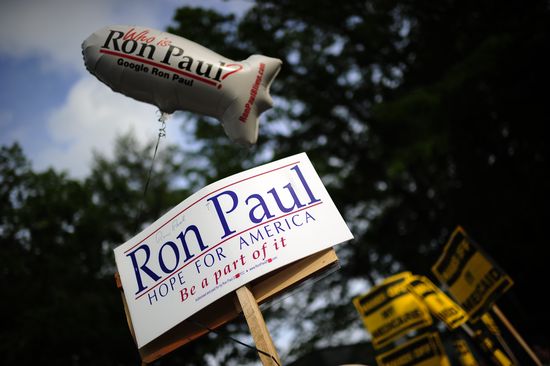
Ron Paul’s Electability

136029814

The man who is the target of a massive smear-job in the current National Review, and whose possible victory in Iowa has already been deemed irrelevant by the national media … is now second only to Romney in match-ups with Obama next fall. Gingrich would lose to Obama by 9 points, Perry by 12.5 points, Bachmann by 14.7 but Paul would only lose by 7.7.

CNN's poll yesterday is even more striking. It finds Romney and Paul tied behind Obama at 7 points behind. Compare that with Gingrich's 16 point deficit. So, in one national poll, Ron Paul does the best against Obama in the fall.

I understand why many do not support Ron Paul. What I do not understand is why he is not taken seriously by his own party. He is the most electable not-Romney. And, yes, I do concede he is not ready for government in the usual sense. But that's his point:

I would be a different kind of president. I wouldn’t be looking for more power. Everybody wants to be a powerful executive and run things. I, as a president, wouldn’t want to run the world.

My point is less that he would be the best president than that he is currently the best medicine for the GOP's degeneracy – and therefore the body politic's. A reader adds:

The quote of the day is perfect.  We all know the GOP is insane, but I like to think that it was Barack Obama that drove them there.  They really have lost their collective shit over him.  For me, the last three years looks like a great big tantrum that a child might throw when they don't get their way.  Why, they can't even vote for the payroll tax cut that they all agree upon lest they give Obama some scintilla of success.  

If the GOP wins in 2012, wouldn't that be an endorsement of this kind of behavior? Wouldn't it be like the parent who gives in to the brat throwing the tantrum?  This party needs to destroy itself so that it can rise again.  What better way to do that than by nominating Ron Paul?  If Ron Paul wins Iowa and gets close in NH, then watch out.  It will be mutiny.  Personally, I can't wait.

Me neither.

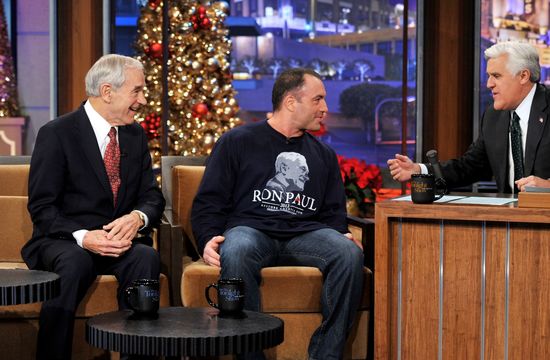
(Photo: Republican presidential candidate Rep. Ron Paul and actor Joe Rogan appear on the Tonight Show With Jay Leno at NBC Studios on December 16, 2011 in Burbank, California. By Kevin Winter/NBCUniversal/Getty Images)
When Will GOP Intransigence End?

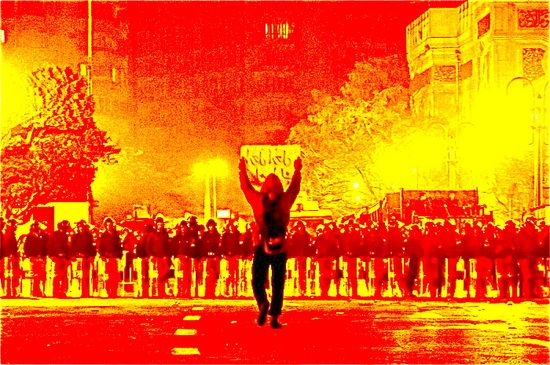
Jamelle Bouie braces for at least one more year of it: 

[Y]ou have to consider that 2012 is a presidential election year, and House Republicans will have little appetite for compromise with a president who, as members of the GOP, they have a fair chance of beating in the general election. It should be said that the same goes for Senate Republicans and Obama’s attempts to fill the federal judiciary. At present there are 14 vacancies and 6 pending nominees on the circuit courts of appeal, along with 63 vacancies and 29 pending nominees on the district courts. I’d be surprised if those numbers budged over the course of next year; given the odds of a Republican president on January 21, 2013, Republicans would be silly to allow Democratic appointees on the federal bench.

What’s Happening To Hamas?

GT_HAMAS_111220

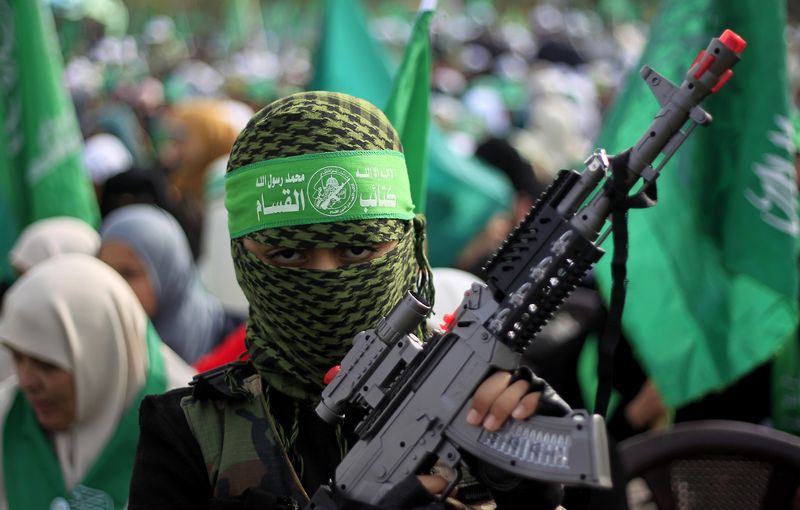
Bilal Y. Saab reacts to reports that the group is giving up violence as its primary strategy against Israel:

The implications of such a Hamas decision could be huge. Theoretically, it will create a united Palestinian front. In other words, there would be few divisions within Palestinian society to inhibit progress in negotiations with the Israelis, a major boost for the Palestinian cause.

Two things remain unclear, however: how Hamas’s constituency and Israel would deal with this massive shift. It is not unreasonable to assume that Hamas would not make such a dramatic move without testing the waters and feeling the mood in the Palestinian street. Hamas knows its constituency well enough to realize that the costs it might suffer as a result of such a decision are likely to be tolerable. Furthermore, Hamas’s support base is not necessarily ideological. Many credible polls suggest that those who have voted for Hamas over the past few years have done so out of pragmatic reasons and anger toward Fatah for its governmental failures.

Hussein Ibish is skeptical of Hamas' capacity to chill:

The big question is whether Hamas’ need to adjust to the changing Arab political order will compel the movement to moderate its positions. Probably not if Hamas can help it, for it remains locked in a long-term power struggle with Fatah over leadership of the Palestinian national movement. Yet its ability to remain a viable contender for such leadership cannot be based on Islamist social conservatism alone. If it cannot outbid the PLO when it comes to the struggle with Israel, it’s hard to see what its broad appeal will be.

(Photo: A Palestinian boy dressed as a member of the Ezzedine al-Qassam Brigades, the armed wing of Hamas, holds a toy gun as he attends celebrations for the 24th anniversary of its foundation in Gaza City on December 14, 2011. By Mahmud Hams/AFP/Getty Images)

Rap’s Gay-Friendly Tipping Point

Chris Lee thinks we're getting close:

[I]t’s not just hip-hop veterans with impeccable street cred and catalogs of platinum hits who are speaking out against homophobia. Even up-and-coming artists such as Harlem rapper A$AP Rocky are voicing discontent with anti-gay attitudes. Never mind that back in the day, such a public stance would have been a professional liability. "I used to be homophobic, but that’s fucked up," A$AP Rocky told the influential music site Pitchfork in October. "I had to look in the mirror and say, 'All the designers I’m wearing are gay.'"

Previous Dish on hip-hop and homosexuality here

Creative Disobedience

6157149068_8a8257c460_b

Saleem Haddad thinks through the impact of the Arab Spring on art and society:

Creative expression of resistance is not just something for reflection: for many, creativity was sometimes the only way to resist the Arab regimes. In its early stages, public protest in Syria needed to be creative to survive: a garbage bag full of ping pong balls, each with anti-regime slogans carefully written on it in permanent marker, were left to roll down a Damascene hilltop and into the city. This is just one example of many…

(Image via Flickr user Painted Tapes)

Frisked On A Whim

Nicholas Peart has been stopped and searched five times by police [NYT] merely for being young and black. Radley Balko ponders just how defenseless we are from this abuse of power:

Police need only the flimsiest of suspicions to stop you on the street, detain you, and search you. But even if they don’t even have that, they aren’t likely to suffer any serious sanction for an illegal search. Nor is a court likely to believe you should you try to complain. If you resist—physically or verbally, whether the search was legal or illegal—they can bring the hammer down, with damn-near impunity. And after the violence, you’ll be the one going to jail.

What Paul Could Do

GT_Ron_Paul

Noah Millman outlines a couple possibilities. Among them:

I agree with Daniel Larison that if Paul wins, the fact that he will have won in spite of flouting that consensus is significant. Andrew Sullivan says his priority is "remaking" the GOP on foreign policy by opening up debate. Paul himself cannot make that debate happen – because he’s a rigid ideologue and his opponents are mostly behaving like thugs and hysterics. A debate of that sort isn’t really a debate at all. But if Paul wins Iowa, and does well in New Hampshire, he’ll have established that, in a post-9-11 world, there is room not to toe the line on foreign policy questions, room for someone with pragmatic views more like Dick Lugar’s (or Mitch Daniels’s) to run and not do what Romney and Huntsman have been doing. To a much lesser extent, I think the same thing can be said of civil liberties concerns.

(Photo: Emmanuel Dunand/AFP/Getty Images)

The Limits Of Local Knowledge

Jay Ulfelder challenges the idea that one must be an expert in the politics of a specific country to make good judgments about its future:

I’ve encountered many people in my professional life who know a lot about the history, culture, and social and political dynamics of specific places, but I remain unconvinced that the deep "local" knowledge they possess automatically positions them to give more reliable diagnoses of, and forecasts about, every situation that arises there. Sometimes–maybe even usually–a little distance and a lot of comparative perspective can be a good thing. … When it comes to diagnosing and forecasting the outcome of rare political crises, I think deep knowledge of specific cases is overrated. Specialists in what Charles Tilly called recurrent "mechanisms" and "processes" can bring something valuable and important to the party, too.