The Daily Wrap

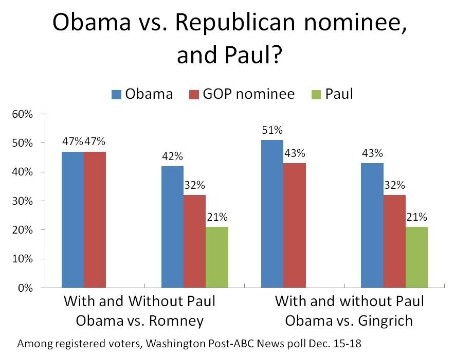
Paul third party
Today on the Dish, Andrew stood by his endorsement of Ron Paul, he reflected on Hitch's force of will, and Marc Tracy put forth a theory of Hitchens' Jewishness. Obama has had a good fall, we wondered when his views on marriage equality would fully "evolve," and Keith Humphreys predicted that the president would win the Iowa caucuses. Ron Paul is officially the frontrunner in Iowa, we dusted off his eponymous racist newsletters (a reader's take here), and the RNC-FNC prepared to continue to ignore Paul and disregard Iowans. We pictured a Paul victory in Iowa, everyone can agree that Congress is a disaster, and Caddell channeled Kaus. Erick Erickson highlighted some important inconsistencies in the GOP field, Romney's nose grew, and the former governor made jokes about butts. In our AAA video, Andrew elaborated on his critique of the Catholic Church.

Russia absorbed the Arab Spring, Syrian protestors retaliated with song and mockery, and a sanctuary in Costa Rica gave orphaned monkeys a second chance. We worried there would be no genuine democratic transition in Egypt, rated US leverage in the Middle East, and discussed the implications of Saudi Arabian investment in Twitter. North Korea remained a mystery, the Israeli left was crowded out, and Maliki's government came apart

Piers Morgan equivocated, he encountered the "whole new universe" of ethics, and likely voters are unreliable. Thatcher's handbag was her gavel, tobacco posed a colossal threat, and readers reimagined cable. 

Shit black girls say here, supervillain or Newt? quiz here, MHB here, FOTD here, VFYW here, and VFYW contest winner #81 here. Our thriving Dish reader poll here

M.A

The Evil In Pyongyang

TNR's editors critique the Kim Jong-Il coverage:

There’s nothing wrong with pointing to a mad dictator’s quirks or attacking authoritarian regimes through humor. (We ourselves have done it with our intermittent "Today in Despotism" series, which chronicled and mocked the exploits of dictators as told by their official government media outlets—and in which Kim invariably played the starring role.) But now the obsessive documenting of Kim’s eccentricities threatens to overshadow the most basic fact about him: No single person who lived in the last few decades has inflicted as much suffering and cruelty on others.

Jordan Weissman explains how the Dear Leader killed "between one million to three million" in a government-caused famine:

The demise of the USSR threw North Korea's entire economy into chaos, and agriculture was among its most important casualties. Without imports of cheap fuel (self-sufficiency had its limits), the country's industrial base fractured, and production of fertilizer dwindled. Farm yields plummeted, and the government started a campaign urging citizens to consume less. Its cheery slogan: "Let's eat only two meals a day."

It was against this background that the Kim Jong Il took power. The country was at a crossroads, says Marcus Noland, a leading expert on North Korea at the Peterson Institute for International Economics. With the USSR gone, the prospects for a small, isolated, neo-Stalinist regime looked rather grim. The government could have opened up its economy, much like Vietnam did with great success. Instead, North Korea chose to stay frozen in time.

Why Pay For Channels You Don’t Watch? Ctd

A reader writes:

I’ve been in the cable television business for over 33 years. I remember when the new Fox News channel first approached the company I worked for at the time.  To obtain carriage, they offered us $10.00 per customer we served to launch them on our "basic" level of service.  The money wasn’t really free, because their monthly fees kicked in at 15 or 20 cents a month in the first year.  My company was unimpressed with the offer, but many other cable companies took the bait.

Once on the cable system, Fox then ramped up its fees as soon as the original contract expired, and also tied FNC carriage to other Fox satellite and broadcast channels (and raised the retransmission fees for those too.)  They bundle all these channels together, raise the rates, and hold a gun to the head of cable companies if you don’t renew.  "Pay us for all the channels or we will force you to take them all off." One of these days someone is going to call their bluff.  But not yet.

Another writes:

One small issue with your reader's statement: "I cannot stop paying Fox News no matter how much I hate it. I'm captive." Actually, you can. You can cancel cable.

I did about six months ago, and it's been a joy to fill time I would have otherwise spent watching TV by reading, hanging out with friends, watching movies, or watching TV – just online instead of on TV. Daily Show/Colbert Report, Louie, 30 Rock … it's all available online, for free.

Another is on board:

My response is that I don't pay for Fox News and I can't imagine how the reader that said this is unable to stop paying for Fox News or any other channel.  I don't have a television, therefore I don't have cable, don't pay for cable, and don't pay for Fox, or MSNBC, or any other cable channel. I do watch television shows through Hulu and I have a Netflix subscription and get my fix of current events, politics, and analysis through a subscription to The Economist, the BBC online, the Dish, The Atlantic, some broadcast radio, and various other sources.

When I visit relatives that tend to have a cable news channel on all the time, I am reassured that I am not missing out on any news of substance (although they seem to be missing out on much that is happening in the world).

My one loss with this arrangement is that I don't get to watch ESPN.  I can enjoy baseball on the radio, but basketball on television is a great way to spend a winter evening.  Eventually, I would suppose that ESPN would wise up to the fact that they are sitting one of the most valuable assets in the cable package and look for ways to offer their product to streaming viewers on a stand-alone subscription basis.

According to our unscientific survey of Dish readers, 29% of you have "cut the cable".

Everyone Hates Congress

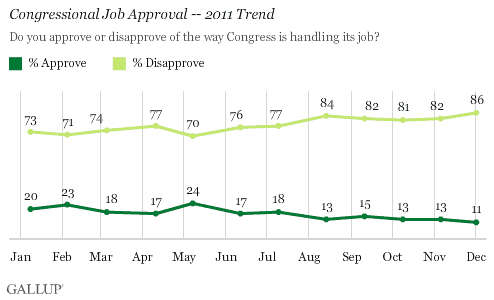
Gallup reports that the current lot is the least popular ever recorded:

Hate_Congress

Ezra Klein looks ahead:

If the Republican strategy is to break Washington so badly that voters want to throw everyone out, they're well on their way. But there are a lot of incumbent Republicans included in that "everyone." Right now, InTrade gives Democrats a 30 percent chance of retaking the House in 2012. If money begins disappearing from paychecks next month [because no payroll tax cut deal is reached], expect that to skyrocket. 

What Do We Know About North Korea?

Fred Kaplan investigates:

According to various press analyses, the new leader is either a bumbling naïf or a clever, multilingual operator who’s already formed alliances with key generals. He will either push market reforms or preserve the status quo. He will reach out to the West or step up confrontation or do neither. Here’s the real answer: We really don’t know much of anything.

Takashi Yokota thinks the generals are in control:

[S]o far, there’s no evidence of disapproval or disloyalty to Kim Jong-un. Yet recent trends in North Korea suggest the regime is more stable than meets the eye. That’s because for quite some time, the ones in control has been the military, rather than the Kims. Contrary to the popular assumption that Kim Jong-il was the absolute leader, the Dear Leader was more of a figurehead who depended on his generals, instead of the other way around.

A Moscow Spring? Ctd

Steve LeVine expects continued upheaval in the wake of questionable elections in Russia and Kazakhstan:

No longer can it be said with certainty that Putin can defeat any opponent in a fair fight. Whether consciously or sub-consciously, others including the Russians have absorbed courage and inspiration from the Arab Street.

Gregory L. White nods. Joshua Foust counters:

Both Putin and [Kazakh President] Nazarbayev are facing a situation where the order they want to impose on their population is not in line with the amount of legitimacy they have, or with the violence they’re willing to inflict. It’s clear Nazarbayev is aware of the Arab Spring and is trying to avoid being caught by a rapidly snowballing protest movement; it is not clear, however, that there is actually a Spring-like movement in Kazakhstan. The oil workers, despite their large numbers, just haven’t been drawing the kind of broad, feet-on-the-street sympathy they’d need to to replicate the same mass movement we saw in, say, Tunisia. While there have been small protests in Almaty and Astana (a whole 12 people in Astana), they pale in comparison to previous protests over Chinese farmland leases, or even the housing crisis from a few years back. Unless there is some secret stash of Kazakhs waiting to protest who haven’t, but are open about wanting to protest at the right sign, I don’t see how you can say that there is an Arab Spring afoot. The same applies to Russia.

Earlier thoughts along these lines here.

Is Egypt Screwed?

GT_EGYPT_111220

Marc Lynch panics over the military junta:

[I]t is ever more clear that the SCAF is not capable of overseeing a genuine democratic transition, and that its recurrent resort to violence against its own people should badly undermine its legitimacy.  The protest-violence dynamic is turning uglier with every iteration.  It needs to be short-circuited in favor of a bold new transition plan before it's too late.

Walter Russell Mead zooms in on the economy:

In Egypt, they are facing a new problem.  They’ve changed rulers, but the crops still won’t grow.  As this Washington Postpiece shows, the Egyptian economy has been going downhill ever since Pharaoh Hosni began to tremble on his throne. This is a bigger problem in Egypt than bad times are in countries like the US.  In America bad times can mean cutting back; during bad times in Egypt, poor people don’t eat…If the Muslim Brotherhood can’t make the crops grow, Egypt will start looking around for a new ruler more likely to win divine favor.  That will be the moment the Salafis are waiting for. Let’s hope the crops start to grow.

Aymenn Jawad Al Tamimi blasts Egyptian liberals for letting it come to this.

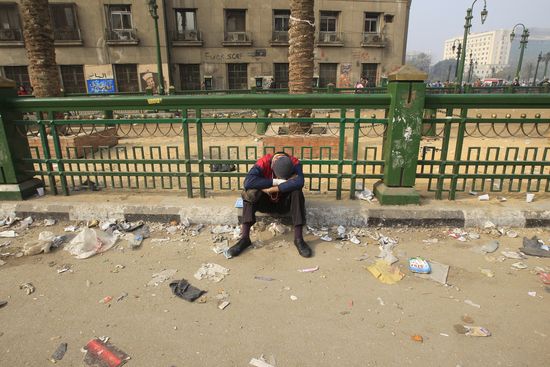
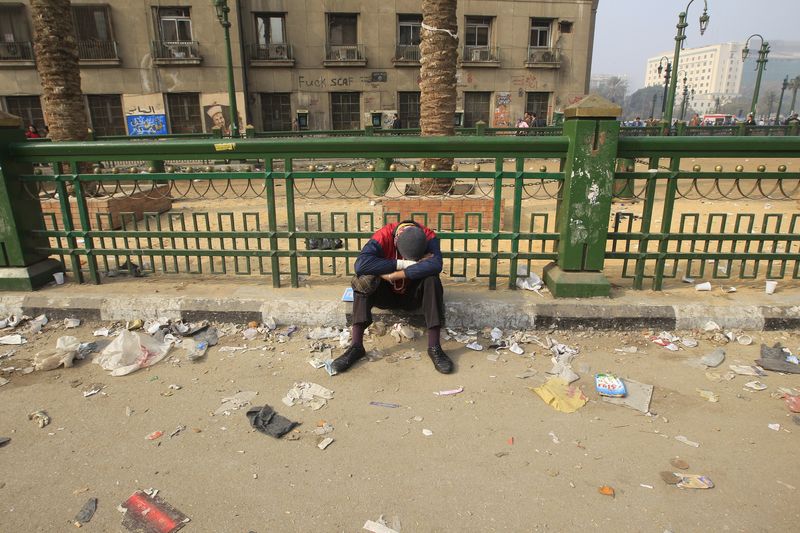
(Photo: An Egyptian protester rests in a littered street off Tahrir Square in central Cairo on December 20, 2011. Clashes between Egyptian security forces and protesters demanding an end to military rule entered a fifth day in violence that has left 12 people dead in less than a week. By Mohammed Abed/AFP/Getty Images.)

A Billion Deaths

Harold Pollack counts tobacco fatalities: 

In 2012, an estimated six million people around the world will die as a result of tobacco use. The World Health Organization projects that one billion people could die of tobacco-related causes over the remainder of this century. That’s an almost unfathomably huge number. If anything like this comes to pass, tobacco will numerically dwarf just about every other threat to human life and health.