Can The Saudis Change Twitter?

5430142049_6242e5fb04_b

Mathew Ingram has doubts as to whether Prince Alwaleed Bin Talal's $300 million investment in Twitter is going to buy insurance against a Saudi spring:

Would Twitter accede to requests from Prince Alwaleed, even if he were to make them? The company’s track record suggests this is unlikely: among other things, Twitter forced the U.S. government to admit that it was going after the personal records of several Twitter users who were affiliated with WikiLeaks, something it could easily have provided in private if it wanted to. Instead, it made the news public and did its best to resist the government’s court order. Twitter’s general counsel Alex MacGillivray has also made it clear the company sees freedom of speech — especially during events such as the Arab uprisings — as a core principle.

But the fact that some users are afraid of what a Saudi Arabian investment might mean for the company is further evidence that Twitter has entered, or is entering, a new phase of its life. Instead of being just a plaything, it has become over the past year a media entity in its own right

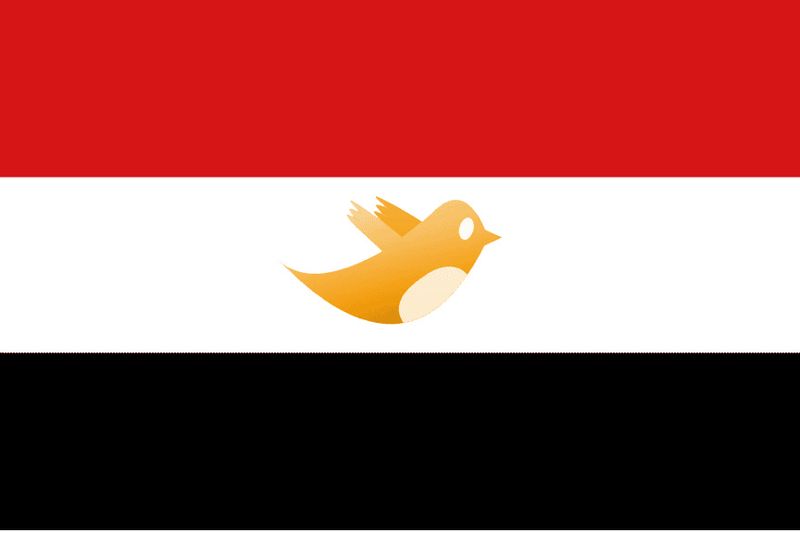
(Photo of Egyptian flag with Twitter bird via People's Open Graphics.)

Hitch’s Drinking

Katha Pollitt hated it:

His drinking was not something to admire, and it was not a charming foible. Maybe sometimes it made him warm and expansive, but I never saw that side of it. What I saw was that drinking made him angry and combative and bullying… Drinking didn't make him a better writer either–that's another myth. Christopher was such a practiced hand, with a style that was so patented, so integrally an expression of his personality, he was so sure he was right about whatever the subject, he could meet his deadlines even when he was totally sozzled. But those passages of pointless linguistic pirouetting? The arguments that don't track if you look beneath the bravura phrasing? Forgive the cliche: That was the booze talking.

It was actually a problem for me, since I don't really drink much and don't actually enjoy alcohol (apart, go figure, from an occasional Jager shot). So my visits chez Hitch were never quite as rollicking as they might have been – because his addiction kept us apart. But what struck me about alcohol and Hitch was that it was a kind of rocket fuel. What killed him was not the alcohol as such or the many years of smoking, but the force of will that simply didn't rest, and seemed to punish his body with ludicrously brutal days and nights of sleepless drive. He seemed unable to turn down any speaking engagement or cable news appearance or party or dinner … or any chance to increase social interaction. In this, we were totally alien.

But I sometimes wondered about this compulsion always to be on the move, always to say yes, always to file on time, always to take that trip, when a little restful weekend might have been healthier. And this reminiscence of his last days haunts me:

The next morning, at Christopher’s request, Alexander and I set up a desk for him under a window. We helped him and his pole with its feed-lines across the room, arranged pillows on his chair, adjusted the height of his laptop. Talking and dozing were all very well, but Christopher had only a few days to produce 3,000 words on Ian Ker’s biography of Chesterton.

Whenever people talk of Christopher’s journalism, I will always think of this moment.

Consider the mix. Constant pain, weak as a kitten, morphine dragging him down, then the tangle of Reformation theology and politics, Chesterton’s romantic, imagined England suffused with the kind of Catholicism that mediated his brush with fascism and his taste for paradox, which Christopher wanted to debunk. At intervals, Christopher’s head would droop, his eyes close, then with superhuman effort he would drag himself awake to type another line. 

He literally died writing. Like his hero:

His face looked practically dead, Muggeridge recorded, oddly like a picture he had once seen of Nietzsche on his death-bed. He detected a kind of rage in his friend's expression, as though the approach of death made him furious. They talked about Orwell's exploits in the Home Guard, his time in Spain in the civil war, the prospect of Switzerland, "and all the while the stench of death was in the air, like autumn in a garden"… There was a chance that the doctors might let him start writing again, Orwell explained, and he was anxious to get on with the novella and the Conrad book. "I shall go to Switzerland next Wednesday," Symons recalled him saying, laughing as he did so, "if I don't catch cold."

(Hat tip: Fallows)
Mental Health Break

Old guys shufflin':

Update from a reader:

They were dancing what's known as "flatfoot" (or clogging or buck+wing) style, a (mostly) Southern adaptation of Irish sean nós ("old style") steps. Wikipedia has it down pretty good. Instead of shaking your ass to music, the very definition of traditional dance is to interpret and keep time to the music using your feet.

What If Paul Wins Iowa?

Dave Weigel imagines the reaction:

Paul is in a curious place—a three-time presidential candidate who has barely been vetted by the media. He’s been the GOP’s proudest anti-war, anti-torture voice for four years. That position has earned him soft interviews with Jay Leno, and countless segments on The Daily Show.

If Paul wins Iowa, that stops. The conservative press, which has been bored but hostile to Paul all year (just see the National Review’s cover story), will remind its readers that Paul wants to legalize prostitution and narcotics, end aid to Israel (as part of a general no-aid-for-anyone policy), and end unconstitutional programs like Medicare and social security. The liberal press will discover that he’s a John Birch Society supporter who for years published lucrative newsletters studded with racist gunk. In 2008, when the media didn’t take him seriously, Paul was able to get past the newsletter story with a soft-gummed Wolf Blitzer interview. (“Certainly didn't sound like the Ron Paul that I've come to know and our viewers have come to know all this time,” said Blitzer.) This was when Paul was on track to lose every primary. It’ll be different if the man wins Iowa.

Meep Meep Watch

As the House GOP revolts against its own Speaker and risks raising taxes on millions in January, and as Obama re-emphasizes the need for bolstering the economy and spreading the sacrifice more evenly … the polls are on the move:

Obama's gains have come at the expense of the Republicans in Congress and the GOP in general. By a 50% to 31% margin, people questioned say they have more confidence in the president than in congressional Republicans to handle the major issues facing the country. Obama held a much narrower 44% to 39% margin in March.

And the GOP's overall favorable rating has dropped to six points, to 43%, since June, while the Democrats' positive rating remained steady at 55%. "The Democrats do particularly well among middle income Americans, while the Republicans win support only from the top end of the income scale," adds Holland.

In the battle for the middle class, Obama has had a good fall. My own view is that the GOP nomination circus has helped him immensely. With the exception of Romney, they just don't look ready for government. And their absolutism against taxing the very rich combined with their plans to transform Medicare is not a great advertisement for their middle class voters.

Will Obama Come Out For Marriage Equality Before The Election?

Richard Socarides is optimistic

[T]he remarkable new reality for Obama in this election is that supporting marriage equality is smart politics. A majority of independents and young voters already favor equal marriage rights. These are important voting blocks, and a key part of the President’s reëlection strategy. Support for gay rights will also help him energize liberals in the Party and others who think he has not acted boldly around core progressive issues such as immigration and the environment and on other civil-rights issues. Hard-right conservatives who strongly oppose marriage rights, meanwhile, will never support Obama anyway.

It won't happen.

Face Of The Day

Banks_main_1423476a

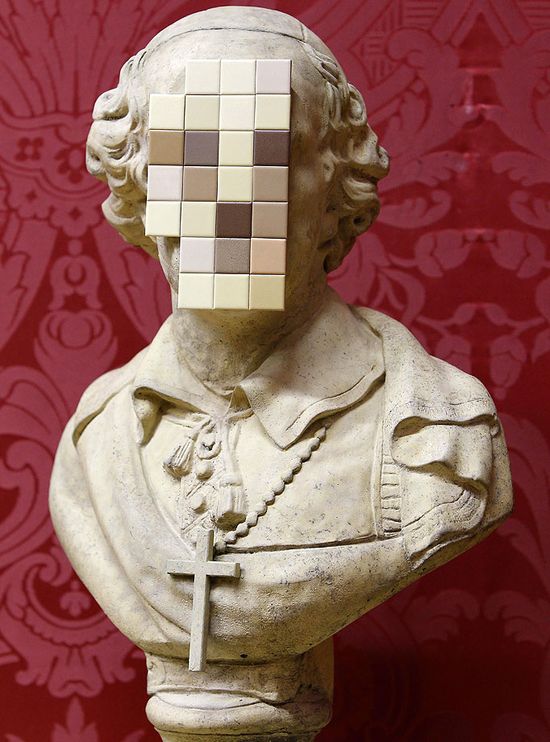
"Cardinal Sin" by Banksy – a reflection on the refusal of the hierarchy of the Catholic church to take full personal responsibility for the rape, abuse and torture of countless innocent children. More here:

The statue is on show in one of the 17th century Old Master galleries, home to many religious works and sculptures. Belgian artist Rubens' The Virgin and Child with St Elizabeth and the Child Baptist is the most well-known piece in the gallery.

Reyahn King, Director of Art Galleries at National Museums Liverpool, said Banksy had asked that his sculpture was shown specifically in the gallery's period collection. She added: "We were very happy to oblige. We are thrilled to display the work of this major contemporary artist. It is a huge coup and we're sure his work will spark a reaction with visitors."

Getting Handbagged

Amanda Foreman explains:

Thatcher’s handbag, at first a symbol of weakness, had become a thing of unparalleled power. “The men I talked to about Thatcher,” says Streep, “claimed when she reached for the bag, you just never knew what was going to come out. Your heart went into your feet.” At one cabinet meeting the ministers arrived to find her absent but the iconic article sitting on the table. “Why don’t we start,” suggested the environment secretary. “The handbag is here.” The handbag became her leitmotif, marking her out as a prime minister who was part Lady Bracknell and part Winston Churchill.

A history of the Iron Lady's accoutrements:

Her pocketbooks came to be viewed as veritable munitions depots constructed of polished black leather. They became a synecdoche for the woman herself: conservative, intimidating, feminine. (An Asprey bag that belonged to her sold this summer at auction for about $39,000.) Thatcher didn’t need to wield a gavel. She could place her bag on the table to announce her presence. This swaggering announcement of womanhood was a way to consume space and demand attention. It marked her territory. To be sideswiped by Thatcher was to be "handbagged."