What Christians Owe Hitch

Since it’s pay-walled, my thoughts on the long conversation Hitch and I had over the decades about Christianity:

For me, his finest moment was when he went on Fox News, the propaganda channel for the American far right, and went after Jerry Falwell as a charlatan, a cynic, a money-grubber and a hater of people he didn’t know. And yes: on the day after Hitch-chairFalwell’s death. He was utterly unintimidatable, drily dressing down the interviewer and finally rebelling against the whole charade with a rallying last retort: “If you gave Jerry Falwell an enema, you could bury him in a matchbox!”

Too much? For most. But we need the man or woman who says these things in public without fear. Freedom demands it. I’m a life-long believer in God and Jesus Christ, a dogged Catholic who, despite profound alienation within the current institution, cannot find a way to stop believing. Hitch knew all this from the get-go and teased me about my Catholicism with the same mischief he did my sexual orientation. He got extremely excited when I wrote an op-ed saying I was withdrawing from communion because of the sex abuse crisis and the Vatican homophobia that blamed it on gays in general. “I hear you’ve abandoned Mother Church!” he exclaimed, and then sank into despond when I told him the more complicated reality.

One night, we talked like college students about the Big Things, and my faith, and his hostility to faith. And it is my belief that he was a tonic for today’s Christianity.

I read his book on God with some trepidation but agreed with almost all of it. Ridiculing organized religion is like shooting a shark in a tiny barrel. But there was something quite exhilarating about Hitch’s deployment of a rhetorical AK-47. What the book didn’t do – what it couldn’t do – was weaken my faith. He was attacking the human follies and lies and cruelties that exploit and abuse faith.

As a Christian, I am grateful for that. If Christianity is to survive and prosper, it will not be because it has drawn back inside the castle of rigid orthodoxy, but when it has confronted and extirpated its anachronisms, absurdities, and abuses. Hitch’s reaction to the appalling child abuse scandal in the Church was less anguished than mine, but his point was inarguable. The current Pope himself was an accomplice to the rape of several children in Munich, when he was an archbishop, as well as complicit in the hideous abuses of Father Marcial Maciel. In any moral institution, which takes moral responsibility seriously, Benedict XVI would have resigned. So would all of the criminals in the far heights of the Church. It was an atheist who pointed out this Christian truth with the starkest moral vision. An atheist.
Experiments With Chimps

The National Insitute of Helath, in response to an Institute of Medicine (IOM) report, has suspended [NYT] any new research using the animals, allowing it in the future only "when absolutely indispensable, and when no other alternatives exist." Tom Beauchamp, Hope Ferdowsian, and John Gluck think the new guidelines don't go nearly far enough:

The following is made a necessary condition—or "criterion"—of the use of Mental-Health-Large
chimpanzees in biomedical research [in the IOM report]: "The research in question cannot be performed ethically on human subjects." The problem with this criterion is that it begs the most critical issues that ought to have been addressed in the report. The fact that it is unethical to perform the research on humans does not render it ethical to perform the research on chimpanzees, nor does the unavailability of human subjects contribute to the justification of use of chimpanzees. There is a huge gap that the report does not address.

This report inadvertently heightens the importance of this problem. The report repeatedly states how close chimpanzees are to humans in anatomical structure, in cognitive structure, and even in moral capacity to act altruistically. Given that a chimpanzee is as close to a human being as this report correctly indicates a chimpanzee is, it is hard to understand why the same level of protections should not be provided to chimpanzees as are provided to humans. It is disappointing that the report never addresses this central issue.

Barbara King, thinking along the same lines, calls for a blanket ban. Hilary Bok counters:

Some have argued that the committee should have considered the ethical issues involved in chimpanzee research in more depth, and in particular, that they should have considered the question whether intrusive research on chimpanzees can be justified at all. But that is not what they were asked to do. The committee was given a fairly limited mandate…Deciding how strictly to construe the term ‘necessary for progress’ requires some judgment about the underlying moral issues: one might describe research on rocks as ‘necessary’ for some line of research if it promised to yield any information, however trivial, that might advance that research; one would not be so quick to describe research on human infants as ‘necessary’ on those grounds. But it does not require answering the question whether intrusive research on chimpanzees can be justified at all. Had the committee tried to answer that question, it would have exceeded its mandate. Nor is there any obvious reason to think that the committee would have done a good job of answering that question had it tried to do so.

Eric Randall thinks critics may be making a mountain out of a molehill given the stringency of the criteria for exceptions.

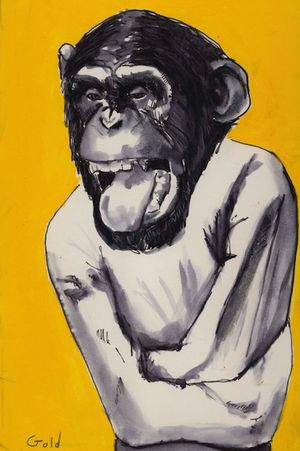
(Photo: The painting "Straight-Jacketed Chimp" by Nathaniel Gold, via Bora Zivokic.)

A Friend And A War

Yes, an argument remains. And Greenwald makes it best, as often. Just as Cockburn sinks to the occasion. I remember that New York Observer piece by Ron Rosenbaum depicting the two of us as pith-helmeted Englishmen riding forth into battle against al Qaeda and subsequently, Saddam. Here's what I wrote in the Sunday Times of London today:

His finest moment in this was his instant understanding of what the fatwa against Salman Rushdie meant. It was an act of war against the free mind. He saw the gathering cloud before it hit America's shores. He loved Jefferson for a reason. And he saw the totalitarian evil in Tehran and Baghdad more clear-sightedly than most. He wouldn't want me to hold back on one criticism, but I found his refusal to disown that war, and to re-think its premises, a rare act of pride over reason.

Yes, he acknowledged the torture and the chaos and the failure. But his hatred of religion and tyranny overwhelmed his pragmatism. There were times when he relished violence against the violent and evil – and even believed in its virtue. I cannot. My faith prevents me. But I understood his secular good faith and realized how big and sudden a leap he had made from "left" to "right" and the difficulty of admitting, in retrospect, that the left had been right, in this seminal case, if for almost all the wrong reasons.

As Nietzsche put it, "In a friend one should have one's best enemy. You should be closest to him with your heart when you resist him."

The Greatest Invention Of All Time

Samantha Weinberg considers the choices:

How do you measure the wheel against the space shuttle? I am taking the greatest to mean the invention that has had the greatest impact on the most people in a relatively immediate sense; power equals energy over time. And for that, we don’t have to look very far back at all. If I had been writing this article 22 years ago, it would have taken much longer. I would have had to traipse around libraries, wade through encyclopedias and newspaper cuttings, and bother a host of people with a stack of questions. Instead, I’ve been sitting at home, in front of a flickering fire (c. 1.4m BC), drinking tea (first recorded in the 10th century BC; teabags patented 1903), tapping at my laptop (1983), and distilling what I’ve found by trawling the world wide web.

Face Of The Day

Dancing_Monkey

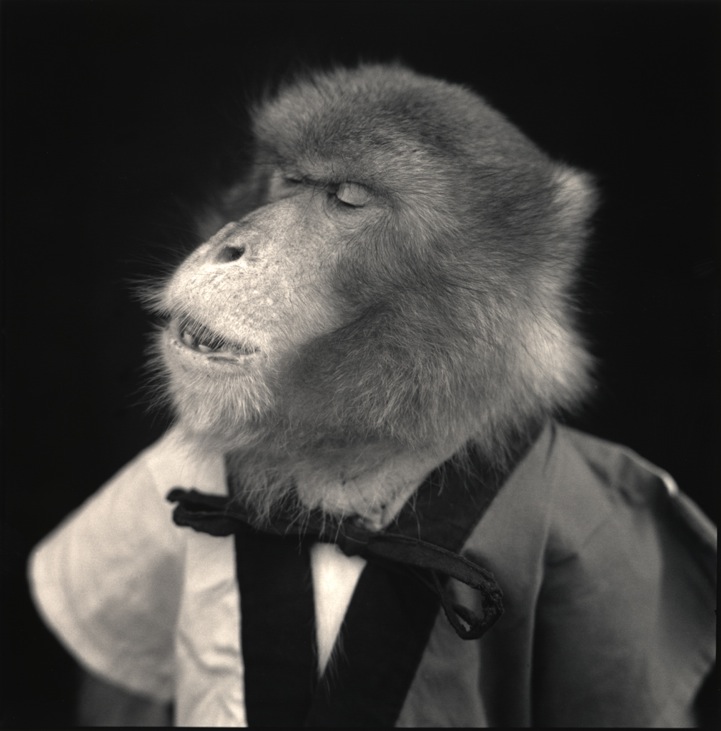
Dressing monkeys up in samurai uniforms was a tradition in ancient Japan. Hiroshi Watanabe photographs the practice today. My Modern Met explains:

The exceptionally trained macaque monkeys used to don outfits and perform religious ritual dances to keep the country's warrior horses safe. Over the thousand-year history of the ancient art, the performance has evolved into a traveling act for entertainment purposes, escaping extinction. The practice, known as Sarumawashi, is literally translated as "monkey dancing" and is one of the most popular traditional Asian performing arts these days, along with Kabuki and Noh.

(Photo courtesy of the artist)

Can Literature Replace God?

After reading All Things Shining: Reading the Western Classics to Find Meaning in a Secular Age, Arne De Boever wonders:

Is it really a religious, polytheistic mindset that is required to live the good life? Or might an imaginative, literary mindset suffice? (And what is the difference between the two?) If the question is not metaphysical (does God or do the gods exist?) but phenomenological (how will we respond to the world?), why would we hold on to the experience of the sacred that the authors try to capture? Literature might, in the end, be enough. 

How The Senses Mix

The Epicurean poet and philosopher Lucretius argued that each sense "has powers discrete and apart, its separate force.” Neuroscience has proven that wrong, finding that all senses interact with one another:

While neuroscientists have been piecing together how senses connect in the brain, [psychologist Charles Spence] work has revealed how the crossing of sensory information affects perception and behavior. His recent work on the psychology of flavor perception, for instance, has shown that the flavor of your food is influenced by touch, vision, and even sound. A study from his lab a few years ago showed that people rate potato chips as crisper and better-tasting when a louder crunch is played back over headphones as they eat. A study published this year showed that people thought a strawberry mousse tasted sweeter, more intense, and better when they ate it off a white plate rather than a black plate. Other researchers have conducted similar studies showing that our impressions of experiences, and our emotional responses to them, derive from a blending of different kinds of sensory input — a process that is usually completely unconscious.

A Poem For Sunday

Hitchens

The end of "Mandalay" by Rudyard Kipling:

Ship me somewheres east of Suez, where the best is like the worst,
Where there aren't no Ten Commandments an' a man can raise a thirst;
For the temple-bells are callin', an' it's there that I would be —
By the old Moulmein Pagoda, looking lazy at the sea;
    On the road to Mandalay,
    Where the old Flotilla lay,
    With our sick beneath the awnings when we went to Mandalay!
    On the road to Mandalay,
    Where the flyin'-fishes play,
    An' the dawn comes up like thunder outer China 'crost the Bay!

The entire poem is here. Hitch reflected on the pleasure he got from poetry, in 2005:

Yet very often, late at night, when I am not tired enough for sleep but too tired to carry on with absorbing or apprehending anything "serious" or new, I will walk over to the appropriate shelf and pull out the tried and the true: the ones that never fail me. And then I will always stay up even later than I had intended. And sometimes, in the morning, I really can "do" the whole of "Spain 1937" or "The Road to Mandalay," and can appreciate that writing is not just done by hand.

(Image by Tom Jellett for The Australian)