Seeking Bad Sex

Jonathan Gharraie reports an unintended consequence of the Bad Sex in Fiction Awards, founded in 1993 by Auberon Waugh:

Waugh’s intention was to discourage the gratuitous inclusion of scenes of a sexual nature by writers seemingly desperate for attention. This plan, as his son Alexander concedes tonight, has backfired. Writers respect and fear this award, but they also court it. Alexander Waugh explains that publishers will now encourage their authors to lace their sex scenes with added "spunk," and recounts how former political spin doctor Alastair Campbell was deservingly cheated out of last year’s award simply for wanting it too much. 

Jonathan Beckman, Literary Review editor and a judge for the awards, defends them:

Good sex writing … is clear, precise and unillusioned in both senses: it refuses to take part in a diversionary pantomime of imagery; and it knows that sex is rooted in the physical. It is generally unobtrusive and undemonstrative. For this reason it makes no sense, as our critics have often argued, to institute a good sex prize, any more than it would to reward the best scene involving a kitchen garden or the most skilful use of semicolons. The awkwardness and evasion with which some writers describe sex, however, frequently point to more widespread stylistic flaws.

Without Words

Sven Birkerts confronts a common affliction:

Writer’s block — or, maybe more accurately, a writer’s expressive frustration — has many presenting symptoms and many causes, but it is at root language-related. Versions of creative stasis may afflict those who practice in other fields — painters and composers can find themselves short of ideas or inspiration — but the situation is not quite the same. Certainly we never hear anything comparable affecting statesmen, lawyers, coaches, electricians or pastry chefs. This affliction afflicts self-anointed users of language, writers, and because their medium of choice — or compulsion — happens to be the universal medium of consciousness and communication, it takes on a metaphysical inflection.

Is Recycling An Artistic Crime?

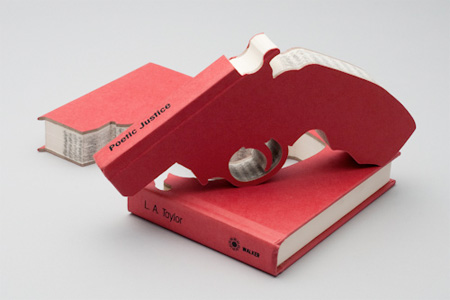
Bookgun11

Jonathan Lethem explains his views on influence and originality:

I think originality is a word of praise for things that have been expressed in a marvelous way and that make points of origin for any particular element beside the point. When you read Saul Bellow or listen to Bob Dylan sing, you can have someone point to various cribbings and it won’t matter, because something has been arrived at which subsumes and incorporates and transcends these matters.  In that way, sourcing and originality are two sides of the same coin, they’re a nested partnership. 

I don’t think originality has any value as a description of process.  In that regard it's as meaningless a process word as beauty is.  No artist says, "Let me sit down and do some beauty now."

(Book Gun by Robert The via Toxel)

Retro On Repeat

Kurt Anderson chronicles the lack of new popular styles:

Since 1992, as the technological miracles and wonders have propagated and the political economy has transformed, the world has become radically and profoundly new. … Here is what’s odd: during these same 20 years, the appearance of the world (computers, TVs, telephones, and music players aside) has changed hardly at all, less than it did during any 20-year period for at least a century. The past is a foreign country, but the recent past—the 00s, the 90s, even a lot of the 80s—looks almost identical to the present.

He believes gay culture helped democratize style so that it is now affordable to most. Alan Jacobs spotlights a big oversight of the piece:

[I]t’s noteworthy that Andersen keeps saying, "Well, except for technology." As though technological change — change in our gadgets, our electronic encounters, our newly-digital lives — don’t really count somehow and aren’t matters of style. Maybe the real story is that a lot of the energy that once was directed towards altering styles of art and fashion has gone for the past twenty years into figuring out how we engage with the digital world.

Tyler Cowen concurs

Today the areas of major breakthrough innovation are writing, computer games, television, photography (less restricted to the last decade exclusively) and the personal stream. … Although that is a relatively optimistic take on the aesthetics of the last decade, it nonetheless supports the view that aesthetic innovation relies on technological innovation.  Most (not all) of the major areas of progress have relied on digitalization, and indeed that is the one field where the contemporary world has brought a lot of technological progress as well.

Face Of The Day

Line1

Kyuhee Baik explains the process that Ayaka Ito and Randall Church used to make the series "Scribbled Line People":

Combining each of their respective creative expertises along with a shared admiration for Rachel Ducker’s tautly wired sculptures and the defiant Flash paintings of interactive designer Erik Natzke, the two discovered a way to create an interface that integrates 3D line work into photographic compositions. Using applications like Flash and Photoshop, Ito and Church reconfigure images into interwoven portraits where the subject becomes part of the environment.

Is Amazon Killing Literary Culture?

Richard Russo took to the NYT to encourage more shopping at local bookstores. Farhad Manjoo rejects Russo's logic, noting that independent bookstores charge twice as much as Amazon:

After all, if you’re spending extra on books at your local indie, you’ve got less money to spend on everything else—including on authentically local cultural experiences. With the money you saved by buying books at Amazon, you could have gone to see a few productions at your local theater company, visited your city’s museum, purchased some locally crafted furniture, or spent more money at your farmers’ market. Each of these is a cultural experience that’s created in your community. Buying Steve Jobs at a store down the street isn’t.

But say you don’t care about local cultural experiences. Say you just care about books. Well, then it’s easy: The lower the price, the more books people will buy, and the more books people buy, the more they’ll read. 

D. G. Myers applauds:

Despite feeling sorry for the employees who lost their jobs, I wasn’t particularly upset to see Borders go bankrupt, and I am not saddened by the plight of the independent booksellers. They bet everything upon the literary elite, and the shooter has crapped out.

Chad Post vehemently disagrees. Scott Esposito broadens the debate: 

We seem to presume that it’s always the best thing for the economy and our own well-being if we can get an item for the absolute least money possible to spend on it without actually stealing it. … , I believe in a diverse world, and one where one-stop-shopping is not a dream but a nightmare. That’s why I like indie bookstores and why I buy from both indies and Amazon.

A tumblr tracks the backlash.