The Death Of Autopsies

Why the decline of autopsies is dangerous:

Without autopsies to confirm patients’ precise causes of death, public health officials say, the health-care system overall suffers. Erroneous information sometimes ends up on death certificates. Broad categories of disease such as cancer are probably accurate, but specifics such as the type of cancer may not be, said Robert Anderson, chief of the mortality statistics branch of the CDC’s National Center for Health Statistics.

“These data are used to set public health priorities, to develop public health programs and allocate resources,” Anderson said. “We do the best that we can given the information we have, but if you put bad information into the system, you’re going to get bad information out.”

An earlier look at this trend here.

Date Rape And Personal Responsibility, Ctd

A reader writes:

Thank you for airing both sides of this issue. It's frustrating that many women's interests writers are so afraid to lose ground on the fact that "blame the victim" is reprehensible (which is obviously true) and engrained in society (also true) that they shut down any discussion about teaching young women individual agency when it comes to protecting themselves from violence. Their tactic places a priority on messaging over good decision-making; it's more important to be "right about rape" than it is important to prevent rape.

It's a luxury to think that way. Life on earth owes no one safety; it's up to ourselves and our communities to create safety – both by stopping violent criminals and by protecting victims. Teaching young girls to stay out of bad situations is not equivocal with teaching young girls that it's "their own damn fault" if they're victimized. Both can co-exist! When I have a daughter, if I've raised her right, I'm confident she'll be able to get her head around that.

Another writes:

I think the people who are upset over the ad are losing sight of whom the ad is talking to.  Whatever the perceived implications, the ad is not talking to the rapist, and the ad is not talking to girls who would be victims.  The ad is talking to girl's friends.  We're accustomed to "friends don't let friends drive drunk"; this ad is, in my opinion, a positive message, saying something along the lines of, "keep an eye on your drunk friends."

And who hasn't realized at some point that this is necessary?  Of course rape is never the victim's fault, and a drunk girl shouldn't have to worry that any given guy is going to rape her.  But the fact is that alcohol is at work impairing judgment long before the moment of truth.  Maybe a woman decides to pay attention to a guy that, were she sober, she would realize was a creep.  Or maybe despite the creep vibe, impaired judgment makes her to shrug it off and keep talking – something she wouldn't do if she were sober.  And THAT leads her into a dangerous situation.  This is where friends can help, and I think it's good to remind people of that.

Another steps back:

Something I’ve always been confused by:  When it comes to date rape, it seems to me both the left and the right are totally inconsistent.  Why is it that the left is comfortable discussing context for political violence but not for sexual violence?  Why is it that the right is comfortable discussing context for sexual violence but not for political violence?

People on the left are more than open to discussing how American Foreign Policy influenced the terrorist attacks on 9/11.  I don’t think any serious person thinks they’re taking the blame off the shoulders of the attackers.  These discussions don’t make the attacks less heinous or cruel, but they are part of the broader thought process.

Those on the right seem comfortable offering context for violence against women.  Yes, they suggest that it’s not a great idea for a young female to get completely trashed in a seedy bar with a man she’s never met before without telling her friends where she is.  Why do their detractors interpret this as blaming the young woman for her rape?

Louis CK Conquers The Internet, Ctd


Alan Jacobs has some doubts that everyone could make a living like CK:

It would be really gratifying if this model (not unlike the one Cory Doctorow has been using for a few years now in the book trade) works for a lot of people; but I have a suspicion that it will work best for artists and entertainers who have the ability to generate a distinctive aura of shared trust with their audiences. And not everyone has that, even artists and entertainers who are extremely popular.

The GOP’s Iraq War Disconnect

Friedersdorf reflects on it:

A November 2011 CNN poll found that 68 percent of Americans oppose the war. A CBS News poll from the same month found that 49 percent of Republicans believe the Iraq War was "not worth it" compared to 41 percent who said the war was worth it. And as President Obama oversees a substantial pullout from the country, 71 percent of Americans say bringing our troops home is the right decision. Despite all that, the Republican Party is attacking President Obama over his withdrawal of troops. And the Republican primary race is full of candidates who supported the war 

Worst Socialist Ever

Obamasocialist

Derek Thompson pokes fun at the right's apocalypticism: 

[T]he president's agenda is not entirely devoid of socialism. No, really! After all, he defends Social Security, which is a forced savings program. He nationalized the troubled automakers in his first months as president — totally socialist.

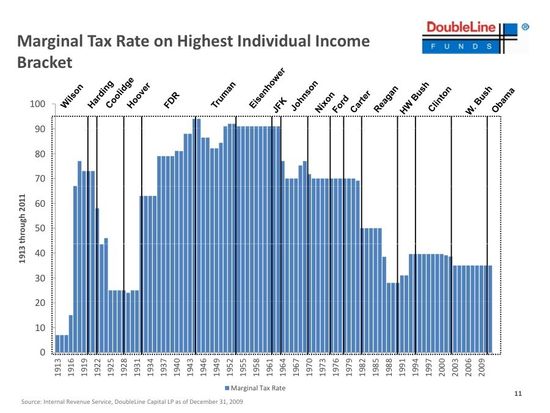
He signed a law expanding the health care regulations and requiring Americans to buy medical insurance, which I suppose you could classify as socialism-lite; although public decency and child abuse laws already require families to buy clothes and food, and nobody complains much about those. But when it comes to tax policy and redistribution, a not-insignificant part of modern democratic socialism, it's fair to say that President Obama is in the running for worst socialist in history. Rather than raise taxes, he has inherited the lowest tax rates in a generation … and lowered them repeatedly while presiding over a period of exacerbating income inequality and a stupendous wealth comeback on Wall Street. … To date, the "socialist" White House has presided over the lightest overall tax burden in half a century.

“If I Was A Poor Black Kid”

Gene Marks offers some advice:

If I was a poor black kid I would first and most importantly work to make sure I got the best grades possible. I would make it my #1 priority to be able to read sufficiently.   I wouldn’t care if I was a student at the worst public middle school in the worst inner city.  Even the worst have their best.  And the very best students, even at the worst schools, have more opportunities. 

TNC demolishes Marks' simplistic logic:

Let us not be hypothetical here. I am somewhat acquainted with a poor black kid from West Philly, and have been privileged to grapple with some of the details of his Black-fathers-ta-nhisi-coates-SO02-vl-verticallife. When he was six he came home from school and found his entire life out on the sidewalk. Eviction. He says he saw some of his stuff and immediately reversed direction out of utter humiliation. He spent the next couple of weeks living on a truck with his father, his aunt and brother. Everyday they'd search the trash for scrap to take to the yard for money. His father abused everyone in the family. He last saw his father alive when he was 9. At 17, convinced he would die if he stayed in Philly, he dropped out of high school and lied his way into a war.
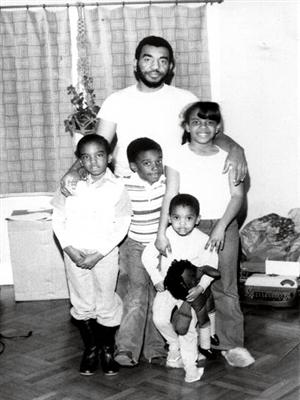
You will forgive me if I've written in these pages of my father with a kind of awe. It is not merely the fact of being my father, but having acquainted myself with his childhood conditions, I shudder  to think of what might have become of me. 

Cord Jefferson supports TNC's take, with an example of a problematic student whose behavioral problems kept escalating, but only because he wanted to be sent home to protect his mother from turning tricks while he was at school. Karl Smith defends the rationality of not choosing Marks' route:

For a 16 year-old girl regular unprotected sex will result in a full term pregnancy in the modern world with roughly probability one. …  Now, just like any other parent the birth of that child will be the most important event in her life. And, the love of that child will be the most valuable thing she experiences. Some people say that looking back their career was more important than their children, but those people are few and far between. So, if the girl has unprotected sex she gets right here, right now, the most important and valuable thing in life will happen immediately with PROBABILTY ONE.

McArdle runs through some of the barriers that stand in the way of those who do want to change their lives:

Poor people have very little financial capital.  But they have very strong help networks that help them survive.  These networks are vital to keeping them off the bottom, but also make it harder to rise–there's a much greater expectation that if you get your hands on some money, you share it; that you will take in needy friends and relatives even if that makes your life much harder, and so forth.  (There's some really interesting work on how microfinance actually functions as savings for people who cannot save because their savings will be tapped before they can be used by needy relatives and friends.  The EITC seems to work the same way here).  The more you have, the more you have to share.  This erodes the incentive to get more.

Kelly Virella examines the Civil War roots to Marks' reasoning. Imani Gandy points to the obvious problem of racism, even if the kid isn't poor:

[B]eing a black child—poor or not—is also difficult because teachers and administrators take a look at you and make assumptions about your intelligence and abilities based solely upon your skin color. In my case, even after I told my teachers and principal that the classes in which they had placed me were too easy, they didn’t believe me.

Marks' piece inspired the creation of an "Ask a poor black kid anything" tumblr, maintained by a certified poor black kid.

(TNC is the little kid at the bottom of the above photo. You can watch him talk about his family in this video.)
The Brains Of London Cabbies, Ctd

 A reader writes:

Fascinating post. I lived in London a few years ago, and as an American accustomed to cities about as big as London, but arranged on a grid, I was always amazed at the cabbies' ability to remember so many details in a metropolis that had developed organically, with no master plan and few major thoroughfares through the tangle of streets and alleyways. About as close as you get are the high streets that used to be the main highways in and out of the old villages that over the years got gobbled up to become London neighborhoods.

US cities are completely different. 

It's pretty easy, for instance, to drive to Lexington and 125th in New York, even if you've never been anywhere near Harlem, because the grid fills in all the unknown areas in a predictable pattern. In a tiny city like my current hometown of Washington, DC, it is nearly impossible to get lost if you know how the grid is arranged. London, on the other hand, is a sprawling maze. No wonder tourists become so laughably dependent on the Tube, not realizing they've taken two trains to cover a quarter mile. Other European cities are rarely so complicated because order has usually been imposed after a war or a revolution to facilitate the movement of troops (Paris's barricade-proof grand boulevards come to mind). As far as I know, Boston is the only major US city not arranged on a grid, and Glasgow may be only big UK city that is on a grid.

Having to memorize such an astounding sprawl, and to create all the different neural connections needed to remember how it all fits together would have to impact the structure of the brain. Thanks for giving me a fond memory of London.

Another DC resident vents:

I wish all places tested their cab drivers the way London does. Often I've had to give turn-by-turn directions to a cab driver. In the DC area, I recently had to tell one to go West on Route 50 (a major road for your non-DC readers) until he reached the road I needed. He then couldn't manage "West" on his own and asked me which direction to turn onto the highway. Imagine if I'd been an out-of-towner.

While they're very useful in the right situations, cell phones and GPS have made it worse much of the time (besides talking on their phones while driving in the rain on icy roads – it happened!) by allowing them to outsource much of the job's brain activity and never learn the roads.

Another reader adds:

This study shows how GPS use can hasten atropy. By the way, a couple of  years ago an analogous fMRI study found that googling was better than crossword puzzzles and passive reading in engaging more areas of the brain, thus warding of Alzheimers.

Can Paul Win? Ctd

A reader writes:

You wrote: "What I object to is the automatic liberal media bias that doesn't treat this serious principled candidate seriously; and the consistent, sustained, vicious war on him by Fox, and the neocon right."

I think it's fairly obvious why both camps are against him. He represents the greatest threat to the entire Republican establishment. If he wins, Ailes, Limbaugh and company have lost the movement.

And on the left side of the aisle? He's the only Republican who stands a decent chance of winning an election against Barack Obama.

Paul can credibly claim to be more anti-war than Obama, can credibly claim to be more interested in civil liberties than Obama, and (alone among the Republican field) can credibly claim to be more pro-gay rights than Obama. He might not actually be any of that, but he's the only Republican candidate who wouldn't be laughed off the stage – or disowned by his own party's voters – for saying so.

Paul is the only Republican in the field that the youth won't reject as an anti-gay fundamentalist. If Paul gets the nomination, Obama will have to fight for the youth that he won so overwhelmingly in 2008 and that the Democrats have taken as a given since just about forever. Nobody is going to be excited over Romney, and everybody hates Newt. Paul is really the biggest danger to a second Obama term.