Romney’s Experience Of Poverty: Living In A Parisian Mansion

The Telegraph has looked into Romney's claims that he subsisted as a missionary in France, taking dumps in holes and using showers from hoses. His fellow missionaries remember a different experience:

The Republican presidential hopeful spent a significant portion of his 30-month mission in a Paris mansion … It featured stained glass windows, chandeliers, and an extensive art collection. It was staffed by two servants – a Spanish chef and a houseboy. Although he spent time in other French cities, for most of 1968, Mr Romney lived in the Mission Home, a 19th century neoclassical building in the French capital’s chic 16th arrondissement. “It was a house built by and for rich people,” said Richard Anderson, the son of the mission president at the time of Mr Romney’s stay. “I would describe it as a palace”.

Check out the Telegraph's photo of the elegant palace. Romney says he didn't think it had a refrigerator. Maybe the chef didn't let him in the kitchen. As for the outdoor shitting, a fellow missionary notes:

"All of the missionary rooms had something like a bath or a shower attached to it. The home had several". Maybe Romney is referring to trips in other cities, although most of his time was spent living in the palace. But when told of Romney's story:

Jean Caussé, a 72-year-old Mormon who met Mr Romney in Bordeaux, said he “would be astonished” if that had been the case. “I never knew missionaries who had to do that,” he said. “I don’t see why he would have lived in conditions like that for two years when it was far from the general case”.

Why would Romney go out on a limb like that – when it could easily be disproven by an enterprising reporter? Maybe this has something to do with it:

Tearful as he described the house, Mr Anderson, 70, of Kaysville, Utah, said Romney aides had asked him not to speak publicly about their time together there.


Does Newt Even Want To Be President?

Noam Scheiber senses a lack of urgency: 

Newt obviously doesn’t want to do the things you generally have to do if you want to become president. More to the point, I don’t think he even wants to be president—by which I mean, undertake the grueling, 24-7 challenge of running a country. It’s much more of a grind than his current lifestyle of book-hawking, seminar-giving, and extravagant vacationing. (I think he’d be happy to do a job where he gets called "Mr. President" but someone else takes care of the demanding stuff.)

My sense is that what’s motivated Newt these past few months is just ego—a determination to prove that he could be president if he really wanted to, that the idea isn’t patently absurd, the way most commentators and even his own staff concluded this summer. But having proved his point, I don’t think Newt has much more to play for. If he’s campaigning like a man who’s already done what he set out to do, that’s probably because he has. 

Dissent Of The Day

A reader writes:

I'm sure Christopher Hitchens is generous enough to take your request for what it is: a good-hearted and loving act. Still, it's a bit like telling people to bring sugar to a diabetic. Hitch has made clear what he thinks of prayer, while acknowledging that praying for him might make the one who's praying feel better in some way. But it's still sort of an insult when encouraged in a public way. (Didn't you just last week criticize Tim Tebow for his public displays of prayer?)

It's an insult not only because of Hitch's clarity on the matter, but because it's among the most internally contradictory things a Christian can do. To believe in a god who would respond to prayer is absolutely not to believe in one who is all-knowing and all-powerful and all-loving, one who has a plan for us all. Do you really think that if enough people respond to your suggestion, god will intervene in some way that he hasn't yet? If so, what does it say about that god?

In a post not too long ago you mentioned a rabbi's thought that the purpose of prayer is to bring the supplicant closer to god, as opposed to expecting a specific result. It sounds great until you think about it: I pray because I believe in god, and in praying I confirm that I believe in god.

To begin with, I did not just say pray for him. I offered an atheist option: to keep him in your thoughts. I also did not ask people of faith to pray to cure him. Just to pray for him in this painful passage in his life. The reader continues:

I assume you're aware of the study of prayer that was done in a heart-surgery ICU a few years ago: Having solicited groups to pray for them, it divided patients into three groups: one received prayer while not knowing they were being prayed for; another received prayer while knowing it was happening; the third received no prayer. In terms of post-op recovery, there was no difference between the group not prayed for and the group prayed for anonymously. The group being prayed for and knowing it did worse.

As a physician who's seen his share of dying, and who's always acknowledged the role of belief in making the process easier for some, I'd never discourage it. And I've always found a way to gently hedge when asked by patients if I was a believer. When told god was guiding my care, I say I'll take help from wherever I can get it.

The Dish had a thread called "Should We Pray For Hitch?" that ran a year-and-a-half ago. Here's to many more installments in the years to come.

The Selfish Insider

GT_GINGRICHPROLIFE_111215

That's how James Wolcott characterizes Newt and his unlikely rise:

Some have compared Gingrich’s comeback to Richard Nixon’s after Nixon’s gubernatorial loss in California in 1962 and his bitter "You won’t have Nixon to kick around anymore" kiss-off to the press, but there’s a huge dissimilarity. After Nixon lost, he dedicated himself to making hundreds of speeches on behalf of Republican candidates, earning the respect and loyalty of candidates and local organizations and accruing political goodwill. For someone who had been thisclose to the presidency, it must have been humbling, like a once-famous comedian hitting the club circuit again, and it paid off for Nixon, but there was no guarantee of that; in the short run, however, it paid off for those Republicans seeking office who had gotten a boost from him.

Contrast this with Newt. Who basically has done everything for himself, for the greater glory of Newt and to feed the insatiable maw of Newt Inc and his Tiffany account.

Tim Murphy recalls Newt's 1989 reaction when asked whether he would support cutting down on the amount of money elected officials can earn from personal speaking engagements:

The idea that a congressman would be tainted by accepting money from private industry or private sources is essentially a socialist argument.

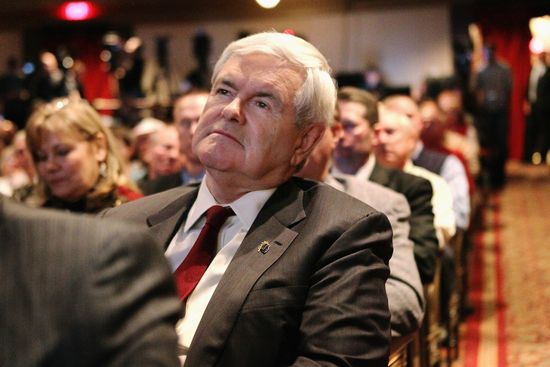
(Photo: Republican presidential candidate Newt Gingrich attends a screening of 'The Gift of Life,' a pro-life documentary at the historic Hoyt Sherman Place on December 14, 2011 in Des Moines, Iowa. By Scott Olson/Getty Images)

Kids And Cannabis

After looking at the most recent numbers on teen marijuana use, Rob Kampia argues that "continued decline in teen tobacco and alcohol use is proof that sensible regulations, coupled with honest, and science-based public education can be effective in keeping substances away from young people." Jacob Sullum largely agrees:

The once startling fact that high school seniors are more likely to have smoked pot in the last month than tobacco (22.6 percent vs. 18.7 percent) reinforces Kampia's point. While we should not ignore the likelihood of leakage from a legal marijuana market, it is important to emphasize that the law distinguishes between adults and minors with respect to many risky decisions, that concerns about underage access hardly count in favor of maintaining a black market where such distinctions are ignored, and that the government should not treat all of us like children simply because some of us are.

An “Invented People” Ctd

Matt Steinglass continues the debate on the formation of national identity:

It is fruitless to attempt to deny the reality of a nation once it has come into being, though it's also a typical strategy of imperial control.

The French relied on differences in dialect and political fragmentation to deny there was any such thing as a Vietnamese people, breaking the country up into Tonkin, Annam, and Cochinchine. (That argument recently resurfaced in Mark Moyar's "Triumph Forsaken", an apologia for America's Vietnam War.) I've heard Turkish nationalists insist at great length that there is literally no such thing as Kurds, denying even the existence of the Kurdish language. Chinese will deny the existence of a separate Tibetan people. Serbs long insisted there was no such thing as a Bosnian. Some Russians used to insist that Ukrainians were simply Russians who spoke a difficult dialect. And had a few wars and other political events turned out differently, they might have been right.

Have We Hit Peak Gingrich? Ctd

Nate Silver thinks that, though the new polling looks bad, it's not a death knell for Newt:

There are several prominent examples where a candidate’s momentum seemed to have sagged before turning right back around. … Although the Rasmussen poll gives Mr. Romney the lead in Iowa, other polls conducted at about the same time give him as little as 12 percent of the vote and put him in fourth place there. It is difficult to make definitive statements about what sort of momentum candidates carry out of Iowa because this can vary greatly from election cycle to election cycle. But if Mr. Romney finishes fourth or fifth there, which remains eminently possible, it would make him vulnerable to a number of candidates in New Hampshire and leave the race wide open heading into South Carolina.

Molly Ball reports from Iowa on the hammering Newt is taking there.