Ryan-Wyden Reax

Healthcare_Spending

Congressman Paul Ryan and Senator Ron Wyden have a new plan to reform Medicare. Joe Klein claps:

It doesn’t fully address the cost containment issue at the heart of Medicare. It doesn’t fully address the excesses of fee-for-service medicine. But it does recognize that you can’t simply repeal ObamaCare–that the health care system has to be reformed if we’re going to get a deficit problems under control. It also is clear evidence that there are compromises to be had, if politicians eschew cheap politics and begin thinking about the greater good.

Josh Barro's main criticism:

I like this proposal structurally. What I don’t like about it is another feature it keeps from Ryan’s original plan–it wouldn’t be effective until 2022, and then only for new retirees. That means, like Ryan’s proposal before it, it saves no money this decade and almost no money in the next decade. I understand the political impulse–it avoids impacting anybody now, so maybe Ryan and Wyden won’t get beaten up for taking away Granny’s benefits. But this delay is still a serious mistake–reforms should be effective immediately, and for current participants as well as new ones.

Noah Millman thinks the plan would cement Obamacare into law:

[F]rom the right the big win here is that the door is open to “privatizing” Medicare. There’s likely some benefit to innovation from such a move; I also think it’s a small way to hedge possible bureaucratic missteps by the Medicare bureaucracy, since private health insurance bureaucracies might not make identical errors (though, in practice, there’s a huge amount of convergence here). From the left, the wins are that this reform basically can’t work without the ACA, and, moreover, post-reform it’s much easier to argue for expanding the Medicare public option to include people besides the elderly. But the real question, in my mind, is: are these wins big enough to induce left and right to agree on a serious cap in health-care costs? Because that’s the big win for the country.

Kevin Drum makes related points:

[T]he entire Wyden-Ryan plan goes a long way toward making Medicare similar to Obamacare. Basically, Obamacare moves our current private insurance system in the direction of government support with competitive bidding, while Wyden-Ryan moves our current federal Medicare system in the direction of private support with competitive bidding. Somewhere in the middle they meet, and our entire healthcare system becomes a fairly homogeneous blend of public and private, similar in some ways to the systems in Switzerland or the Netherlands. Yuval Levin makes this point explicitly here, and as a conservative he's not especially happy that this is where we could end up. But done right, it wouldn't necessarily be a bad place to be.

Jonathan Cohn disagrees:

Wyden is embracing premium support and, in the process, lending respectability to Ryan and the House Republicans. Ryan although distancing himself from his former proposal, still isn’t coming to terms with the Affordable Care Act. That’s been the story for a while now: Democrats are more willing to compromise than Republicans. Until that changes, Democrats make concessions at their own peril and with great risk for their constituents. 

Ezra Klein is skeptical of the plan as a whole:

[W]e have tried competition-based structures before — the Federal Employee Health Benefits Program, Medicare Advantage, Massachusetts, etc — and they’ve never lived up to the high hopes of advocates. I hope that we just haven’t cracked the code yet, as I think there are important reasons to prefer a competition-based system to one in which the government simply sets prices. But I’m not optimistic.

Neither is Peter Suderman:

[T]he Ryan-Wyden compromise seems like an effort to work around the major difficulty rather than solve it: If federally run “traditional” Medicare is the problem—and it is—then why propose an overhaul that promises to keep it in place? That already tough fight may have just become more difficult thanks to this compromise.

Is this a step toward a better Medicare system than the one we currently have? Perhaps. But it may also be a step—or two—toward a too-easy, politically driven compromise that fails to fix the real problem.

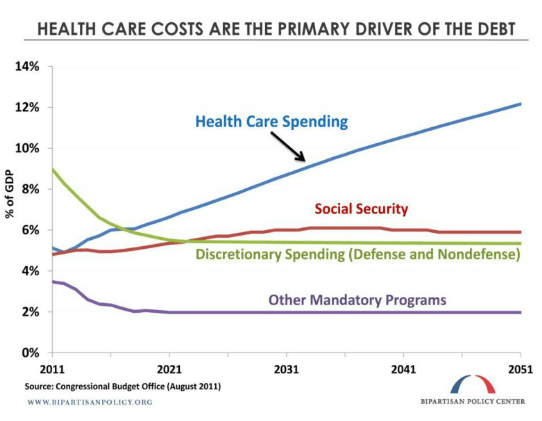
Chart above from the Ryan-Wyden plan, which Weigel posted as a Scribd document.
“Christopher Hitchens Has Not Found God”

Goldblog defends Hitch against a vile and despicable Daily Caller article insinuating that he's about to convert:

Hitchens … said that if information emerged that he had, at some late stage, made a statement of faith, or a religious confession, including but not limited to, "I accept Jesus as my lord and savior," or, "Muhammad, peace be unto him, is the messenger of God," or, "the Lubavitcher rebbe is the true messiah and currently living in Brooklyn," that his friends were to make it known that it was not the true Hitchens doing the confessing. This is what he told me once, during a video conversation we posted on this website: "The entity making such a remark might be a raving, terrified person whose cancer has spread to the brain," he said. "I can't guarantee that such an entity wouldn't make such a ridiculous remark. But no one recognizable as myself would ever make such a ridiculous remark."

In response, Rod Dreher argues that physical suffering can genuinely lead one to God:

In Hitchens’s view, the mind perceives truth (of the spiritual and metaphysical sort) when the body is healthy, and unencumbered by pain, either physical or emotional. Only then, when not under duress, is the mind capable of sorting out truth from falsehood. In the Christian view, a mind embodied in a healthy body is one that finds it all too easy to deceive itself, especially about its own finitude and frailty. Suffering has a way of forcing the mind to understand that the body will die, and to recognize how much it depends on others — especially God. On this view, suffering, when properly embraced, is a mode of understanding that brings us to the truth — a truth that it’s easier to ignore or to deny when one is in good health.

Have We Hit Peak Gingrich?

Gingrich_Peak

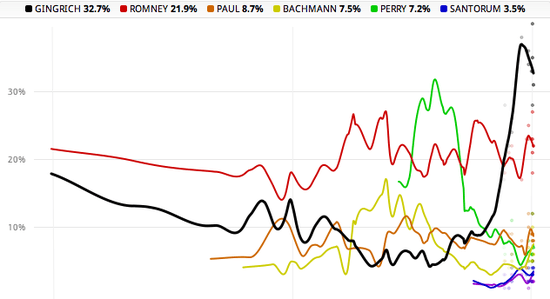
Gallup's daily tracking poll has Gingrich down several points. TPM's poll of polls (above) also has Gingrich on the decline. Doug Mataconis wonders what comes next:

[I]t’s not too surprising that Gingrich’s rise would be halted at some point once the attacks started. The real question is whether he continues to slip in the polls and who it benefits. Right now, it doesn’t seem like anyone has benefited from this initial dip. Instead, some voters have gone back to sitting on the sidelines in the undecided category. 

Shit Girls Say, Ctd

As the Dish awaits the straight dude version of this and this, a reader spoils all the fun:

Despite the widespread conviction that women talk like this but men talk like that, the truth is that our perceptions are often out of step with reality.  The best example of this is the use of the word "like" as a hedge.  It's widely perceived to be a predominantly female form of speech – when presented with written text, people overwhelmingly identify the use of the word "like" with women – but in fact there are studies that show that men use it about as much as women do. Here's a pretty extensive Language Log post on the subject.  Another common misconception is that women talk more than men do – read here.

My bottom line is that playing with stereotypes about how women talk may satisfy our intuitions about gender differences, but they're not obviously grounded in fact.

The Most Important Question Of The Night?

Joe Klein expects that the moderators at tonight's debate will bring up Romney calling Gingrich "zany":

This could be the crucial moment of [Gingrich's] candidacy. The most important thing: he will have to control his anger. In the past, he has used such opportunities to attack the press–he might not tonight, since it’s a Fox News debate–but he could say, "I don’t think it does the party any good for you and me, Mitt, to stand here attacking each other. That’s exactly what Barack Obama wants." And then he could make the case for himself.

Why Isn’t Ron Paul Treated Like A Normal Political Choice?

Brian Doherty reacts to my Paul endorsement:

What's most interesting about the language of his Paul endorsement is that it's a guy who absolutely does not agree with Paul on everything and is bothered by aspects of his past being able to treat him like a normal political choice, someone who after deliberation seems on balance best, an act of comparative political intelligence that I've found many Americans can't seem to do with Paul.

I've noticed many people find Paul's very solid ideological consistency proof in some sense that if they disagree with him on anything at all they can't get anywhere near him (a problem that other politicians, more clearly a random grabbag of stances largely based in sociology and the type of people they want to appeal to, don't face–most Americans' political views are similarly a random grabbag of stances).

“Full Unconcealed Panic” Ctd

Washington Examiner has endorsed Romney:

Republican voters seem to be engaging in willful amnesia about what is euphemistically called Gingrich’s “baggage.” They shouldn’t: It would be used against him in ugly ways in a general election campaign.

National Review likewise rules out Gingrich:

If he is the nominee, a campaign that should be about whether the country will continue on the path to social democracy would inevitably become to a large extent a referendum on Gingrich instead. And there is reason to doubt that he has changed. Each week we see the same traits that weakened Republicans from 1995 through 1998:

Josh Marshall marks the moment:

This morning we’ve officially reached the end of the Newt Surge and — whether the data support the thesis or not — moved on to the Establishment Counterattack. After a week or so of stunned silence, the Republican establishment, under the very uneasy leadership of Mitt Romney, has roused to the unavoidable truth (now backed up by hard data) that nominating Newt Gingrich means all but giving up any chance of taking the presidency in 2012.

Earlier round ups of anti-Gingrich commentary from Republicans here, here and here.

“Leaving” Iraq

GT_IRAQ_111215

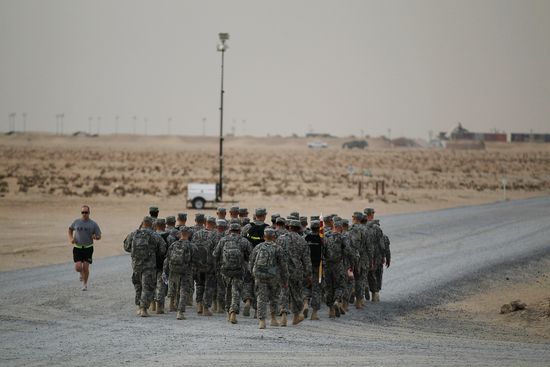
The Iraq war officially ended today, though 4,000 troops still remain. Joel Wing is keeping tabs on the retrospectives popping up in the media. Daniel Serwer laments the costs:

No, Iraq has not been  “worth it.”  Even a majority of its veterans don’t believe that. President Bush launched the war believing that there were weapons of mass destruction.  That in any event was the only argument that really held water.  Neither Saddam Hussein’s marginal role in supporting international terrorism nor his gross mistreatment of the Iraqi people would have garnered the broad support that the Bush Administration managed to assemble for the invasion.

The Iraqi toll is huge:  more than 100,000 killed seems to be the consensus.  The American toll, though much smaller, is deeply felt:  almost 4500 killed and more than 33,000 wounded, not counting civilians.  In a decade of financial collapse the economic costs, projected to reach trillions, cannot be ignored.

Brian Michelson and Sean Walsh draw lessons from our failures as nation-builders there. Zakaria isn't convinced we're really leaving:

They are, in a sense, disguising the drawdown so it is not a drawdown quite to zero. We have some paramilitary forces, some who are protecting the embassy, embassy personnel, USAID people. There's going to be a fairly healthy contingent, I'm sure, of CIA people. There'll be people from the DEA. You add that together and the United States will have a certain kind of offensive presence in Iraq.

Reider Vissar notes some trouble signs in the debate over the Iraqi constitution. Marc Lynch thinks the pullout heralds a better Middle East. Teddy Spain reflects on his experience fighting in the country.

(Photo: U.S. Army soldiers from the 2-82 Field Artillery, 3rd Brigade, 1st Cavalry Division, walk to where they will board buses to fly home to Fort Hood, Texas after being one of the last American combat units to exit from Iraq on December 15, 2011 at Camp Virginia, near Kuwait City, Kuwait. Today the U.S. military formally ended its mission in Iraq after eight years of war and the overthrow of Saddam Hussein. By Joe Raedle/Getty Images.)