Fighting For A Country That Looks Down On You

A reader writes:

I appreciate the comparison you highlighted between the gay vet who confronted Mitt Romney and the black veterans in history observed by Ta-Nehisi.  I am a former soldier, having served in the US Army from 1985 until 1989 before being discharged after a witch hunt.  My sister is a retired soldier and my son is currently serving.  We have a tradition of military service going back to at least the Second World War.  It is my father, who fought with the storied 761st Tank Battalion (the Black Panthers) and his generation for black soldiers and airmen that I want to talk about briefly.  

On my mother’s side, there were three Tuskegee Airmen.

My father, as I said, was a tanker.  Before WWII, both my father and my uncles had lived every day of their lives in either Louisiana or Alabama, respectively.  My father joined the Army the week following the attack on Pearl Harbor because the Army would let him fight as either infantry or a tanker but the Navy would have had him shining shoes or being a cook.  My father wanted to fight.  

He spent four years in the Army, was decorated with the Purple Heart and the Bronze Star.  When he came home at the end of the war, he went to college where he met my mother, who had spent the war building airplanes as a ‘Rosie’.  Because my father served, he and my uncles got the GI Bill that allowed them to go to college.  World War II made my father who he was.  

My parents stayed in Alabama, where I was born, until 1968 when they moved us to California.  The 1968 election was the first time my father ever cast a vote in the nation he had fought and bled for. When I joined the Army my father was very opposed to it – partially because my sister had joined four years earlier, partly because of his memories of serving in a segregated military.  To convince him that my reasons were good, I told him that it takes a special kind of man to go and fight for a country that does not consider him enough of a human being to go to school where he wishes, to vote in elections, to live where he can afford and to work in any job he is qualified for.  That generation of black men who signed up and served knowing that they would return home and not be able to vote were very special men.  

When I think of the generations of gays and lesbians who served in our military, I think that whether the likes of Romney (or a non-trivial swath of the GOP for that matter) realize it or not, they are in the debt of these folks and are in the presence of the very best of America.  

I am not trying to blow my own horn.  This is not about my service.  I went in because I felt that I had grown up in a nation that did consider me an actual citizen and if my father could put on the uniform when he was, at best, a second-class citizen I could do no less.  I just want us, as Americans, to acknowledge that gays and lesbians have served and continue to do so and that these are the very best of our nation.  They get up and they do their duty knowing that the man or woman they love back home is not considered their actual, wedded spouse and yet they do it anyway.  We should honor them as the exceptional Americans they are.

Face Of The Day

SeymourTemplarSocialLights2

For his series "Social Lights: A Certain Night Life," Seymour Templar photographed the ethereal light a smartphone casts on faces. Templar spoke to Claire Ha of My Modern Met:

It came about by itself: once I noticed I had a few images in the same vein, it was easy to draw the correlation. The meaning emerged as a "eureka" moment, when everyone sees what has been there all along but only notices when it is put in evidence. I have to refrain from shooting "just" another image of someone starring at their SmartPhone, I try to select a moment when something happens, when the scene is touching me for some reason.

Louis CK Conquers The Internet

The comedian is experimenting with selling video of his new act directly over the web:

The show went on sale at noon on Saturday, December 10th. 12 hours later, we had over 50,000 purchases and had earned $250,000, breaking even on the cost of production and website. As of Today, we've sold over 110,000 copies for a total of over $500,000. Minus some money for PayPal charges etc, I have a profit around $200,000 (after taxes $75.58).

This is less than I would have been paid by a large company to simply perform the show and let them sell it to you, but they would have charged you about $20 for the video. They would have given you an encrypted and regionally restricted video of limited value, and they would have owned your private information for their own use. They would have withheld international availability indefinitely. This way, you only paid $5, you can use the video any way you want, and you can watch it in Dublin, whatever the city is in Belgium, or Dubai. I got paid nice, and I still own the video (as do you). You never have to join anything, and you never have to hear from us again.

I really hope people keep buying it a lot, so I can have shitloads of money, but at this point I think we can safely say that the experiment really worked. If anybody stole it, it wasn't many of you. Pretty much everybody bought it. And so now we all get to know that about people and stuff. I'm really glad I put this out here this way and I'll certainly do it again. If the trend continues with sales on this video, my goal is that i can reach the point where when I sell anything, be it videos, CDs or tickets to my tours, I'll do it here and I'll continue to follow the model of keeping my price as far down as possible, not overmarketing to you, keeping as few people between you and me as possible in the transaction. 

Joshua Gans looks at how Louis CK minimized piracy. CK's attempt to drum up sales on Reddit, while answering fans' questions, is here. Over the weekend, the Dish featured a video from his latest project.

Romney Is Running Against Himself

Now he's attacking Gingrich's wealth. Allahpundit analyzes:

He brought up Newt’s Tiffany expenses not once but twice today, first with CBS and then again during his radio chat with Hannity this afternoon. (Audio here.) At first blush this looks like he’s pulling a tu quoque as damage control following his dopey $10,000 bet offer at the debate on Saturday night, but I don’t think he’s worried much about that. It was tin-eared, and the competition’s bound to tweak him for it, but the election won’t turn on goofy stage theatrics. What’s panicking him, I think, was Gingrich’s attack on Monday about him “bankrupting companies and laying off employees over his years at Bain.” Kennedy used that against Romney in 1994 with great success and the class-warrior-in-chief is going to hammer him relentlessly for it in the general if Mitt makes it that far. 

Muslims Are Just As Boring As The Rest Of Us

Jonah Goldberg defended "All-American Muslim" in the show's latest controversy. Friedersdorf highlights the following comment on Jonah's post:

I, somewhat randomly, attended the annual convention of ISNA, the largest Muslim organization in the United States a few years ago. It was a massive affair in a Chicago convention center, attended by tens of thousands of people and it was EASILY among the most boring events I've ever been to. Tens of thousands of people schlepping their kids around to endless booths, selling halal cookbooks, prayer mats, and other random ephemera, while there were panel discussions about whether kids should attend public or religious schools, about discrimination in the workplace, etc. The young people were relentlessly flirting and getting into minor mischief. It reminded me EXACTLY of the Jewish conferences I attended in my youth. 

This is the face of Muslim America. This is the face of America. Anybody who's been swept up in the nonsense that Islam is incompatible with America should be sentenced to witness with endless line of minivans filled with whining kids at the ISNA convention. Maybe this show will have a similar effect. To boycott is utter nonsense.

Amy Davidson compares the two sides in the debate.

Is Afghanistan Getting Better?

GT_AFGHANISTAN_111213

Charles Kenny says the war-torn country is looking up:

World Bank data and the recent Afghanistan Mortality Survey suggest heartening progress in quality of life over the past decade as well. Not least, adult mortality has been declining both because of reduced violence and improved conditions for good health. Death rates among men ages 15 to 59 has approximately halved over the last 10 years. For men and boys together, war and other violence now account for about the same number of deaths as drownings and traffic accidents combined. War-related injuries kill about as many males as die from diabetes-related complications and one-quarter the number who die from infections and parasitic disease. Additionally, deaths from infectious diseases have also been declining, not least because the proportion of the population (some 48 percent) with access to clean water more than doubled between 2000 and 2008.

Joshua Foust darkens the picture:

Things in much of the country really are not good, and leaving the internet data archives (and even Kabul!) can show that to anyone brave enough to look for it. If the international community had spent $100 billion on development over ten years and accomplished nothing, that would be shocking. So it’s no surprise that some things have improved. What Kenny should be asking isn’t, did we get anything for our vast expenditure, but have the improvements been worth the cost? And could another policy have achieved the same or more at less cost?

(Photo: US crew chief sergeant Monique Thevenet of US Army's Task Force Lift 'Dust Off', Charlie Company 1-171 Aviation regiment takes a stretcher to the Shock Trauma Platoon (STP) to carry the wounded Sayed Wali from the Afghan National Police (ANP) to a medevac helicopter for his transferr to a hospital in Helmand province on November 7, 2011. Sayed Wali was wounded by a grenade losing three fingers and wounds on the abdomen. The United Nations says the number of civilians killed in the Afghanistan war in the first half of this year rose 15 percent to 1,462, with insurgents behind 80 percent. By Behrouz Mehri/AFP/Getty Images)

“Stranger And Prophet”

In a response to a conservative's lament, Rod Dreher revisits Russell Kirk: 

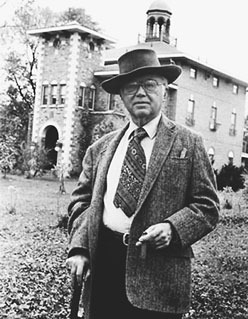
In Kirk’s conservatism, you won’t find policy prescriptions. What you will find is a Russell Kirk in hat in front of Piety Hill disposition, both believing and skeptical. Believing in God, and what Eliot called the Permanent Things, but skeptical of mankind’s powers, because of our tragic nature. We need laws, and government, because man’s heart is corruptible. But laws will not save us if our hearts are lawless. I’m thinking of the Kansas City diocese that adopted a new set of laws and bureaucracy to protect against child molesters in the priesthood, and which, if prosecutors are correct, is now living through the spectacle of those rules and that bureaucracy having been violated by the bishop, who appears to have been determined to evade them to protect a particular priest. But of course there are plenty of examples.

The great conservative insight is that man is imperfectible. Conservatism is not an end, but a means — the most reliable means, I believe — to a tolerably decent society. Even, if we’re lucky, a good one. What’s most wrong with contemporary American conservatism, I think, is a thing that afflicts the American character: a lack of a tragic sense. 

 (Photo via The Imaginative Conservative.)

Who Identifies As Rich Or Poor?

Almost nobody:

According to the General Social Survey at the University of Chicago, which has been asking people what social class they belong to since 1972, more than 90 percent of Americans put themselves squarely in the middle – belonging either to the working class or the middle class.

Historically, less than 6 percent of people identify with the lower class – well below the poverty rate, which was 15.1 percent in 2010 – and about 3 percent with the upper class. 

How To Attack Gingrich

Pete Spiliakos provides tips:

Solyndra was crony capitalism that cost the taxpayer $500 million dollars.  The Freddie Mac bailout was  144 Solyndras and counting.  And it is even worse than 144 Solyndras.  Obama got campaign cash from Solyndra executives.  The Freddie Mac bailouts have cost each and every individual American resident $230.  That is counting children, noncitizens, everybody.  Gingrich got $1.6 million of Freddie Mac spend-it-any-way-you-want-it-money and then praised the company’s business model.  Then the taxpayers and the mortgage market were hit with a brick.  But Gingrich got his.