Google serves up a poignant review:
Month: December 2011
Was Thatcher An Anti-Semite?
Au contraire, of course. She was a rare Tory without an anti-Semitic impulse in her psyche. But in today's Washington, she'd surely be a target for neocon venom:
Despite her support for Israel, and though she rejected the stridently pro-PLO stance of some members of her government, she believed Israel needed to trade land for peace, wishing in her memoirs that the “Israeli emphasis on the human rights of the Russian refuseniks was matched by proper appreciation of the plight of the landless and stateless Palestinians.” She also condemned Israel’s bombing of Osirak, Saddam Hussein’s nuclear reactor, in 1981. “[The Osirak attack] represents a grave breach of international law,” she said in an interview with London’s Jewish Chronicle in 1981. Israel’s bombing of another country could lead to “international anarchy.”
And can you imagine a current Republican candidate ever saying:
Just because a country is trying to manufacture energy from nuclear sources, it must not be believed that she is doing something totally wrong.
Only one candidate, actually: Ron Paul.
Waiting For Hillary
Robert Reich's dubious prediction is that Obama will swap out Biden for Clinton:
Obama needs to stir the passions and enthusiasms of a Democratic base that’s been disillusioned with his cave-ins to regressive Republicans. Hillary Clinton on the ticket can do that. Moreover, the economy won’t be in superb shape in the months leading up to Election Day. Indeed, if the European debt crisis grows worse and if China’s economy continues to slow, there’s a better than even chance we’ll be back in a recession. Clinton would help deflect attention from the bad economy and put it on foreign policy, where she and Obama have shined. The deal would also make Clinton the obvious Democratic presidential candidate in 2016 — offering the Democrats a shot at twelve (or more) years in the White House, something the Republicans had with Ronald Reagan and the first George Bush but which the Democrats haven’t had since FDR.
The Anchoress counters that Hillary should run this year as a third party candidate. Doug Mataconis throws cold water on both ideas:
[T]he Obama Administration has consistently shot down any of the Biden-Clinton swap rumors that have come up over the past three years. Moreover, Vice-President Biden has said more than once that he intends to run with the President in 2012, while Hillary Clinton has made clear that she considers Secretary of State to be her last public job and that she has no interest in running for political office again. …
[I]t’s fairly clear that a Clinton candidacy in the General Election would take votes from Obama, possibly cost him most if not all of the battleground states that he needs to win the election, and hand the election to the Republicans. Why in the world would Hillary Clinton, who has been a loyal Democrat all her life, want to do that?
Treating Yemen’s Dictator In America
Exum fumes over Obama's decision to allow Ali Abdullah Saleh to get medical care in New York:
That sound you subsequently heard this evening was America's Yemen experts (all three of them!) banging their heads on their desks in frustration. What kind of message does it send to the people of Yemen and the greater region when the United States allows an abusive autocrat to take refuge in a New York hospital while his people demonstrate in support of democracy in the face of bullets from his security forces? Just whose side is the United States on in the Arab Spring? If Bashar al-Asad gets pancreatic cancer, should we expect for him to be treated at Johns Hopkins?
How, you might ask, did this golf foxtrot come to pass? An aforementioned strength of this administration — its ruthless and successful campaign to decimate al-Qaeda and its affiliates — is also a weakness in that it overshadows everything else and causes the administration to see entire regions of the globe through a [counterterrorism]-shaped soda straw.
Paul Pillar nods. Daniel Serwer situates the mistake as part of a broader failure in Yemen policy:
The conditions that enable Al Qaeda to thrive in Yemen are not going away so long as Saleh and his family maintain their autocratic rule. It may be tactically convenient to get Saleh to the U.S., but it is strategically stupid for the United States to remain in his pocket, snookered into supporting his sons as the only bulwark against Al Qaeda in the Arabian Peninsula. The problems that make Yemen home to Al Qaeda in the Arabian Peninsula go far beyond terrorism: sectarian and secessionist rebellions are raging north and south, water and oil are running out, qat is king, poverty is endemic and abuse of the population is reaching epic proportions.
Any serious counter-terrorism effort in Yemen should include this bigger picture, as John Brennan knows. But I fear it does not. If Saleh comes to the U.S. it will be a symptom of a much bigger problem with U.S. policy in Yemen.
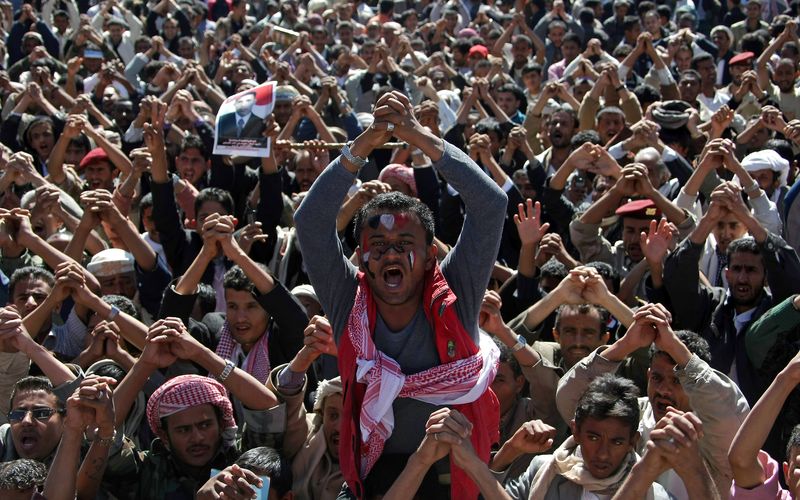
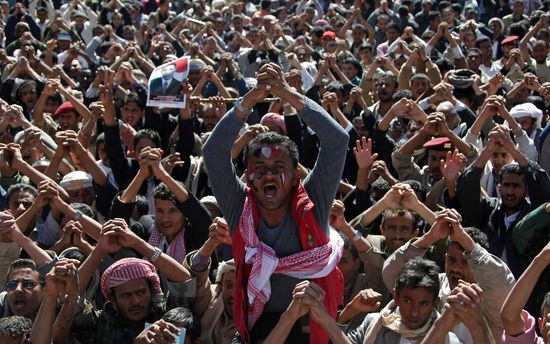
(Photo: Yemeni anti-government protesters raise their hands while shouting slogans during a demonstration calling for the trial of outgoing Yemeni president Ali Abdullah Saleh in Sanaa on December 27, 2011. By Mohammed Huwais/AFP/Getty Images.)
The Conjoined Conundrum
Reacting to a recent conjoined twin birth in Brazil, Julian Savulescu thinks through the moral issues at work when separating the twins would require one to die:
[T[he case of competent adults is different to infant conjoined twins. In one case, lethal separation for the benefit of one twin is impermissible but in the case I tis permissible. Why is this? The reason is that infants are not yet persons capable of conceiving themselves existing across time, with hopes and plans for the future. It is striking then that the law, in permitting lethal separations, implicitly accepts infanticide, just as it accepts feticide.
It is time to revise our laws on killing. Not only in cases of euthanasia and assisted suicide but also in our treatment of infants. Instead we prefer to redescribe such infanticide as not killing at all.
Stephen Latham has related ponderings.
Creepy Ad Watch

Copyranter digs up a classic:
"We want you to live." But first, we want you to SHIT YOUR PANTS as you're paging through your Life magazine. Mobil is well known (among retired ad honchos) for their 1960s road safety campaign (Here's one of the more famous ones.). "Improper driving" kills and maims more drivers then any other cause? Can't dispute that. The copy on this ad is pretty novel coming from an oil company—drive less! (I don't think you'll see Exxon/Mobil running this type of an ad, oh, ever.)
Iran’s Oil Gambit, Ctd
A reader writes:
The reality is that Iran doesn't need to actually stop the flow of oil through the Straits of Hormuz in any significant way for the threat to be effective. The mere threat itself has already pushed up the cost of oil a bit, so imagine what happens if Iran managed to sink a single tanker in the Straits. While it might only be one tanker of oil eliminated from global supply, the markets would freak out. The panic would drive up the price of oil, increase Iran's profits, and likely lead to a global recession.
Another writes:
I ran offshore oil field supply boats in the Persian Gulf for a couple of years a long time ago. It is inconceivable that Iran would be able to close the Strait of Hormuz. Three potential ways to do it have been discussed:
– attacking ships with planes, boats, or artillery as they pass through the strait. They've tried this before and failed. The US Navy would destroy any planes, boats, or artillery that tried it. The Iranians might slow it down for a day or two.
– placing mines in the shipping lanes. We are pretty good at sweeping mines. I watched US navy helicopters sweep the Gulf of Suez after Kaddhafi dumped a bunch there in the early 1980s. One boat was damaged out of (we think) several hundred mines dropped.
– sinking ships in the middle. The shipping lanes are 6 miles wide, plus a safety buffer, and about 300 feet deep. You'd have to sink a lot of ships to pile them up that high and that wide.
The Daily Wrap
Today on the Dish, Andrew placed Ron Paul's views on war firmly in the American mainstream and slammed Michael Medved for replacing discussion on this point with namecalling. Andrew also defended Paul's record on gay rights and racism, checked in on Paul's chances in Iowa and New Hampshire, heartily recommended Mark Lilla's critique of Corey Robin and assessment of modern conservatism, and kept on mocking the absurd headlines generated by Santorum's poll numbers. Larison pooh-poohed Santorum's chances, Ruy Teixeira warned Obama that he needed the youth vote, and Rick Perry drew a blank on yet another critical policy issue.
The US government came up with options for ending the massacre in Syria, Egyptians created hope for their revolution, Iran threatened to strangle the global oil trade, and Michael O'Hanlon threw out some projections for viable defense cuts. We took yet another look at Pinker's thesis on violence, paying teachers more worked, Paul Starr and Jonathan Cohn debated an alternative to the health care mandate, and the ban on electronics during takeoff found a champion.
The "Returning Soldiers' Dogs" video owned the MHB voting (though the others were great), straight dudes shaved their nethers, college students moved back in and Louis CK made a million bucks on the internet. QFTD here, Moore Award here, VYFY here, Airplane window view here, FOTD here, and MHB here.
– Z.B.
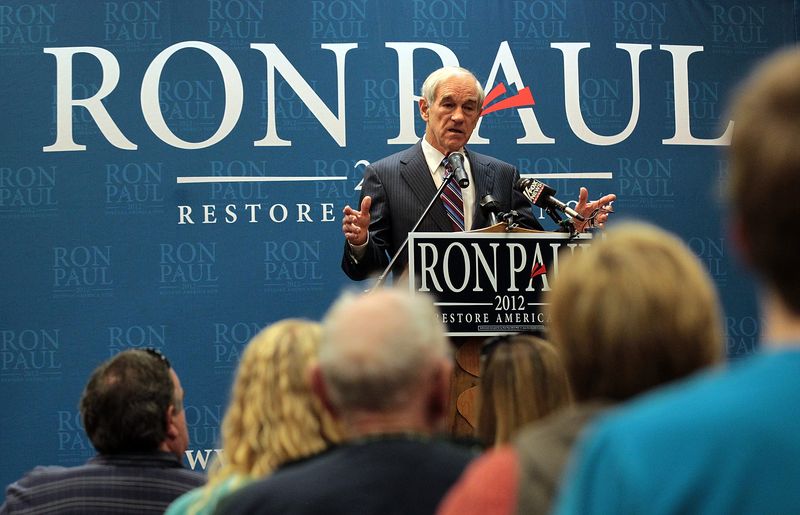
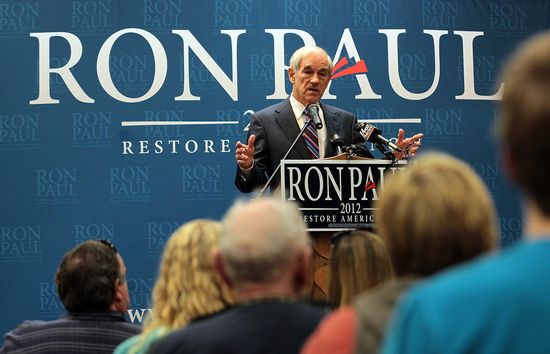
(Photo: Presidential hopeful U.S. Rep Ron Paul [R-TX] speaks during a town hall meeting at the Cass County Community Center on December 29, 2011 in Atlantic, Iowa. With less than one week to go before the Iowa caucuses, Ron Paul continues to campaign through Iowa. By Justin Sullivan/Getty Images.)
Quote For The Day
"I voted for Obama in 2008 but we need a change. Dr Paul is consistent and honest, which is very hard to find. He is not just telling us what we have heard before," – Samantha Dunn, a 28-year-old teacher in Iowa, to the Daily Telegraph.
How Dumb Is Rick Perry?
This dumb.
 The Dish