
Sayulita, Mexico, 12 pm
Sayulita, Mexico, 12 pm
Richard Haass summarizes a new report [pdf] by F. Gregory Gause on the US-Saudi relationship:
He recommends that the United States reimagine the relationship as simply transactional, based on cooperation when interests—rather than habit—dictate. Prioritizing those interests will therefore be critical. Rather than pressuring Riyadh for domestic political reform, or asking it to reduce global oil prices, Gause recommends that the United States spend its political capital where it really matters: on maintaining regional security, dismantling terrorist networks, and preventing the proliferation of nuclear weapons.

Today on the Dish, Andrew discussed meditation, he considered the many ways to God, and "that thing out there" is conscious. Conservatives went berserk over the Gingrich surge (more unconcealed panic here), and the former speaker proposed an average tax cut of $1.9 million for everyone in the top 0.1 percent. Romney defined his views as "progressive" in 2002, he had a hard time connecting with a gay vet, and his lead in New Hampshire may not be forever. The "less weird" candidate will win, Newt mastered the counter-punch, and he waged a lonely campaign. We collected reax to the Gingrich-Huntsman "debate," a conservative Christian brought Perry back to earth, and Ron Paul could "change the math" in Iowa (more on Paul as protest vote here).
The foreign minister of Israel defended Putin's corruption, Assad has murdered more than 5,000 Syrians, and drones hovered in the US. We explored Palestinian identity, and the EU faces a problem of scale.
We debated the merits of political fact-checking, met YouTube's oppo researcher, and covered the controversy surrounding Lowe's and All-American Muslim (Jonah Goldberg's thoughts here). DOMA complicates the tax code, cable bundling enables Fox News, and the blogosphere's most talented political reporter ditched blogging. We have a primordial need to hoard food, sugar makes us tired and sad, and e-cigs are an effective replacement for cigs. City rankings are useless, and the pit bull is the American muscle dog.
Poseur alert here, FOTD here, MHB here, VFYW here, VFYW contest winner #80 here, the 2011 economy in 10 graphs here, and the Christmas gift idea for the man who has everything here.
— M.A.
Apparently, the recent UN estimate of 4,000 murdered was off by a full quarter; the newest figures say Assad has killed over 5,000. Ian Black doesn't think the dictator will be tried for his crimes:
[T]he international criminal court (ICC) can only act at the request of the UN security council. With Russia and China still backing him and prepared to wield their vetoes, he is safe – for now. Navi Pillay, the UN commissioner, spoke for many when she told the council that the situation in Syria had become "intolerable". But the problem here is the echo of February's referral of Libya to the ICC, which subsequently accused Muammar Gaddafi, his son and intelligence chief of crimes against humanity.
Michael Doran is angry that, despite these roadblocks, Obama isn't doing more for Syria. James Miller summarizes the overall state of the conflict as he sees it:
The city of Homs and Hama continue to be under siege, but this is not new news. The Syrian military seems content to continue to attack these cities, particularly, Homs, which has been facing nearly constant bombardment for months. However, the regime has seen a surge in opposition in Daraa province, particularly in Dael and in the city of Daraa. Crackdowns have not worked. The regime seems to be moving against the villages in order to enforce its authority and frighten the citizens of Daraa province into line.
In Idlib, we've been seeing more defections, and reports that weapons smugglers are helping to arm the Syrian Free Army. The Syrian army has repeated made blitz-style attacks on prominent towns in the region, but today the Syrian Free Army appears to be launching a concerted defense of several of the villages around Ma'arrat Masreen. As protests continue to grow, and the crackdown continues to escalate, and the defectors are increasingly bolder and stronger, it is increasingly clear that Assad is not capable of ending this crisis.
In other Syria news, there are some updates about Razan Ghazzawi, detained blogger we spotlighted here. The government has formally charged her with, among other things, "weakening the national sentiment." Jillian C. York rounds up the social media backlash, noting that a Facebook page is serving as the #FreeRazan activist hub. Here's a big student demonstration in Aleppo, often thought of as a more pro-regime area:
These Free Syrian Army fighters chant against the regime in Idlib:
Finally, a group of Iranians brave their own regime's wrath by standing up for Syria at a soccer game:
A water-powered jetpack:
Ryan Lizza rounds up more comments from Republicans against Gingrich. Here's Jonah Goldberg writing in the LA Times today:
The other night while having drinks with some prominent conservatives, I said I thought there was a significant chance that Gingrich will not only win the nomination but that he might be the next president. Going by their expressions, I might as well have said I put a slow-acting poison in their cocktails.
Earlier GOP panicking here.
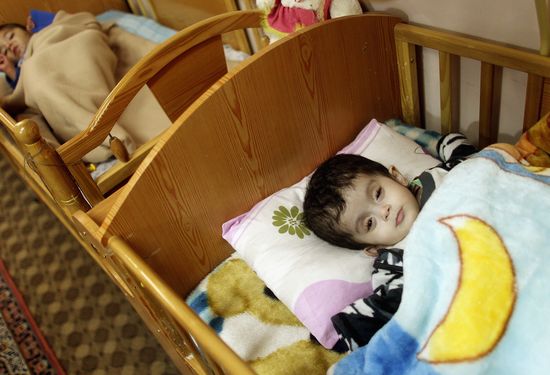
Disabled orphan Rasha, 2, rests in the orphanage where she lives on December 13, 2011 in Baghdad, Iraq. Rasha was abandoned at birth by her parents at the hospital. Iraq's healthcare system remains in shambles following two decades of war and economic sanctions. Following the 2003 U.S. invasion, thousands of physicians fled the country while others were killed. Some physicians have since returned but there is still a critical shortage of doctors. Iraq is transitioning nearly nine years after the U.S. invasion and subsequent occupation. American forces are now in the midst of the final stage of withdrawal from the war-torn country. At least 4,485 U.S. military personnel have died in service in Iraq. According to the Iraq Body Count, more than 100,000 Iraqi civilians have died from war-related violence. By Mario Tama/Getty Images.
Lena Groeger fits the noodle-burn problem into broader pattern of poor product design:
What makes it so infuriating is that the solution is a simple design tweak. To build a better instant soup cup, all you have to do is adjust the cup to a
slightly wider, shorter shape. According to this study by David Greenhalgh, once that simple change is made—Wallah!, the chance of a spill plummets dramatically. … The paper was published in 2006, so this isn’t exactly breaking news. Yet those instant soup cups have stayed stubbornly tall—and dangerous. Clearly, CupNoodle-maker Nissin Foods has higher priorities than preventing little kids from being rushed to the emergency room with horrible blisters all over their face and arms. But design flaws with serious health consequences don’t just limit themselves to the kitchen.
Groeger goes on to critique the design of street signs, fireplaces and coffee grinders.
(Image via NPR)
Douthat counters Fred Barnes:
For all the limits of the "8 candidates on a stage" debate format, there is something to be said for having a forum in which the "also-rans" and "peripheral candidates" get a chance to confront the frontrunners without having to raise a fortune to buy TV time.
In the 2008 Republican primaries, the debates served a valuable purpose in this regard: They helped both Mike Huckabee and Ron Paul break through, and in doing so helped make the primary debate more serious — mostly because Huckabee and Paul were willing to actually critique the record of the Bush administration (on the economy for Huckabee, on foreign policy for Paul), rather than dance around it as the leading candidates all tried to do. The fact that the the 2012 debates elevated Michele Bachmann and Herman Cain, both of whom brought rather less to the table, suggests that the fault this time around lies as much in the candidates (and what G.O.P. voters seem to be looking for them) as it does in the debates and their moderators.
He follows up here.

Harlem, New York, 1 pm
 The Dish