Fear Domestic Drones?

Greenwald gets worked up about Brian Bennett's report that a Predator has been used for the first time in serving an arrest warrant:

The fact is that drones vest vast new powers that police helicopters and existing weapons do not vest: and that’s true not just for weaponization but for surveillance. Drones enable a Surveillance State unlike anything we’ve seen. Because small drones are so much cheaper than police helicopters, many more of them can be deployed at once, ensuring far greater surveillance over a much larger area. Their small size and stealth capability means they can hover without any detection, and they can remain in the air for far longer than police helicopters. Their hovering capability also means they can surveil a single spot for much longer than military satellites, which move with the earth’s rotation.

M. Ryan Calo thinks this sort of fear will end up bolstering privacy rights:

[Drones] represent the cold, technological embodiment of observation. Unlike, say, NSA network surveillance or commercial data brokerage, government or industry surveillance of the populace with drones would be visible and highly salient. People would feel observed, regardless of how or whether the information was actually used. The resulting backlash could force us to reexamine not merely the use of drones to observe, but the doctrines that today permit this use.
Who’s Got Newt’s Back?

Not Krauthammer: 

Frum doesn't believe that Gingrich will be the nominee:

In many ways Perry is a stronger candidate than Newt because Perry is less disliked by the Washington Republican leadership.

Seth Masket points out that Newt has few visible supporters to defend him:

The key thing here is that Gingrich has no backers. Romney can slip up — make a silly statement or give a bad interview — and there are legions of journalists and elected officials who can explain it away or provide context or still point to his other qualities as a candidate. When Gingrich messes up — as he most assuredly will at some point in the next few weeks — no one's got his back. He'll be on his own, forcing to either recant what he said (flip-flopper!) or double down (loony!). What will his next apostasy be? I don't know, but it's exciting to watch.

Romney’s Firewall Is Getting Less Fiery

GOP_NH

Michael Crowley imagines a Romney loss in New Hampshire:

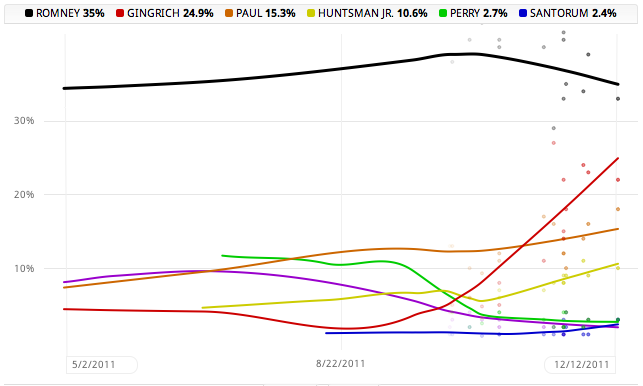
Flash back four years: By mid-2007, Romney held a durable New Hampshire lead. After a brief October run by Rudy Giuliani, Romney went into December leading the GOP pack by double digits. Then, at almost this precise moment in December of ‘07, John McCain began a surge that would lead him to victory on primary night. Note that on this day exactly one cycle ago, the gap between Romney and McCain was only a few points narrower than the one that now exists between Romney and Gingrich.

Chart from TPM.

The Makings Of A Ron Paul Upset? Ctd

125440739

Allahpundit considers the latest polling:

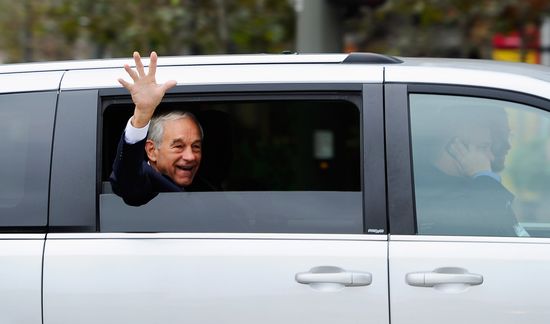
What’s Paul’s ceiling in Iowa? A friend on Twitter was arguing earlier that it’s 20 percent, which is borne out by the polls — so far. If he’s right then Paul can’t win. But … what if Paul’s ceiling is actually 30 percent? Note that his favorables are trending upwards while Newt’s are sinking under the weight of renewed scrutiny of his various conservative heresies. If you’re an Iowan who’s unhappy with the “electable” candidates — Romney for being too opportunistic, Gingrich for flirting too often with activist government, Perry for seeming too darned hapless — then Paul’s an obvious choice for your “none of the above” protest vote. So obvious, in fact, that both Glenn Beck and Joe Scarborough are threatening to back him as a third-party candidate if Gingrich is the nominee.

(Photo: Kevork Djansezian/Getty.)

Yglesias Award Nominee

“[A]s a Christian who attends church on a weekly basis, hosts a Bible study, reads the Scriptures, speaks openly about my faith (and even writes about it from time to time on this web site), and who can pray at any moment of the day or night, I would say this: Whatever is happening in America today, it cannot fairly be considered a “war” on Christianity. … As for Perry’s invocation of gays in the military: that is a prudential judgment having to do with military readiness. And many of our top military officers support allowing gays to serve in the military. To contrast gays serving in the military with kids not openly celebrating Christmas is a very unfortunate road to travel down. If Governor Perry, a self-proclaimed Christian, is really interested in channeling the cares and concerns of Jesus, he might consider saying a word about poverty and injustice, which seemed to have concerned Jesus even more than gays in the military. Sometimes the worst advertisements for Christianity are its adherents,” – Pete Wehner on Perry’s “war on reality.” My take here and here.

Faith In Many Routes To Salvation, Ctd

Polling shows that many believers reject the idea that only practitioners of their religion can be saved. Dreher contemplates this idea:

I believe Orthodox Christianity is the fullest expression of the true path to salvation, liberation or paradise. But I don’t agree that only Orthodox Christians will find their way to salvation. My view is that God may save anyone, but that if anyone is saved, it is through the death and resurrection of Jesus Christ, and through the mercy of God the Father, who, in his infinite wisdom and compassion, may choose to extend it to those who confessed Christ imperfectly, or who didn’t confess him at all. That, by the way, is the official teaching of the Catholic Church. It’s not the same thing as universalism, which holds that everyone will be saved, no matter what.

I'm a little less orthodox than Rod here (surprise!) because I find the strict atonement doctrine too, well, un-Jesus like in its exclusivity (and then there's the problem of limbo). I share Rod's view that what we can glean of Jesus from Scripture and tradition endures as a world-historical revelation of God's love, and it was when that entered human consciousness that salvation became possible for everyone. And not just salvation after death, but salvation that has nothing whatsoever to do with the future. I think the Buddha reached the same conclusion centuries earlier, in a very different cultural and historical context, but Jesus' calm acceptance of an unjust and brutal fate and the widespread belief in his resurrection, gave his drama a force that spread it around the world with stunning speed.

Have other sons of God existed? Surely. Saints have always existed. We probably meet them now and again and have no idea. Is faith in Jesus essential to being saved now and for ever? Yes and no. Yes, because he exemplified the way and the truth and the life. No, because he wasn't the only human being to have done so. But can those who affirmatively reject Jesus' message be saved? I don't see how. But I don't know. I am not God. Nor should any of us pretend to be.

The Importance Of Seeming “Human”

BOBBLEMITTAlexWong:Getty

Rob Long introduces an eponymous theory of winning elections: 

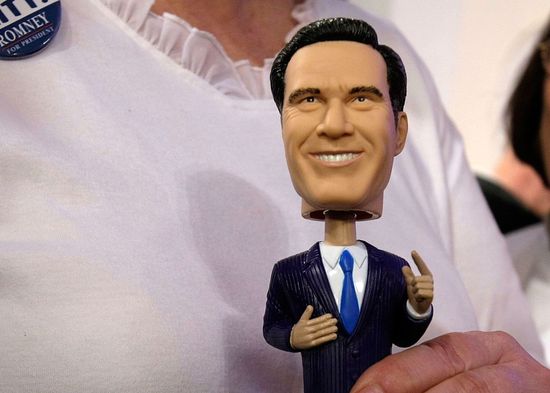
You have to act less weird than your opponent. Note:  Long's Law doesn't say you have to act normal.  For most office-seekers, that's just not an option. Long's First Law of Winning Elections is, you have to act only slightly less weird than your opponent. Think about it:  Bush v. Gore. Clinton v. Bush.  Obama v. Clinton.  Even Obama v. McCain.  All of these races were colored, primarily, as a contest between an awkwardly packaged and remote-controlled candidate and one who seemed more, well, human. Less weird. In the epic clash of Mitt v. Newt, what we have is a perfect example of Long's Law. Both of these men are in a race to prove something that is, for whatever reasons, hard to demonstrate to the voters: "I'm less weird than the other guy."

That's a contest that could last a while. He notes Romney's post-$10,000-bet debate pivot to "humanization," according to Politico:

In the past 24 hours, the former Massachusetts governor has talked about his father, experiences while working as a missionary that weren’t even in his memoir — and twice in two days, he’s brought up the Mormon faith that he’s until now largely steered clear of.

The Makings Of A Ron Paul Upset?

PPP's latest poll puts Paul second in Iowa, behind Gingrich by a single point:

Paul's supporters are considerably more committed to him than Gingrich's are.  77% of current Paul voters say they're definitely going to vote for him, compared to only 54% for Gingrich.  Romney has much more solid support than Gingrich as well, 67% of his voters saying they're with him for the long haul. Among only voters who say their mind's totally made up, 29% support Paul to 21% for Gingrich, 18% for Romney, and 11% for Bachmann.

Doug Mataconis wonders if Paul is about to get his turn in the spotlight:

Right now… it looks like some of the attacks on Gingrich are having an impact while Paul seems to be the one benefiting from them. Romney, on the other hand, is pretty much stuck where he’s been for a month or more. The one piece of good news for Gingrich here is that its better to have the numbers dipping three weeks out than one week out. We’ve got another debate coming Thursday, then we head into the holidays. If this trend continues, get ready to see a lot more Ron Paul coverage between now and January 3rd.

Mark Blumenthal considers on-the-ground organization in Iowa:

[Peter Giangreco, a Democratic strategist] says the "secret sauce" of traditional field organization was the ability to provide voters with information about how and where to participate that was otherwise hard to find. The advent of the internet and social media makes it "pretty easy to go find the information now about how to participate and where to go." It also makes it easier for campaigns to push that information out to their supporters.

Those changes can help Gingrich, Giangreco adds, but they may aid Rep. Ron Paul (R-Texas) even more. Paul could "change the math," he says, like Barack Obama, who turned out thousands of younger and independent voters to participate in their first caucus. "Paul is going to bring [out] people who are on nobody's list."