An “Invented People” Ctd

Palestine_GT

Goldblog insists that Palestinians exist. Noah Millman puts the debate in perspective:

When people say that the Palestinians “are just Arabs” they are on one level correct. In 1900, before Palestinian Arabic could have been influenced by Hebrew, the Arabic spoken by a citizen of Haifa would have been extremely similar to the Arabic spoken by a citizen of Damascus. “Palestinians are just Arabs” is as historically and ethnologically correct as “Palestine is just part of Greater Syria” – which, at various points in history, has in fact been the Syrian perspective on the matter.

And, on another level, it’s obviously incorrect. The Arabs of Palestine had the nationalizing experience of reacting to Jewish colonization of their country – country in the French sense of “native land” rather than “state”. That experience was foreign to the otherwise-similar population in Syria, and resulted in a distinct identity.

Jonathan Zasloff makes related points:

You don’t need Gingrich to tell you that the idea of a “Palestinian people” is relatively new.  All you need is the foremost historian of the idea, Columbia’s Rashid Khalidi, to confirm it.  In his (very good) book Palestinian Identity: The Construction of Modern National Consciousness, Khalidi puts the crystallization of the idea slightly after 1908, the year of the Young Turk revolt in Istanbul.  That event, Khalidi argues, catalyzed the Arabs in what is now known as Palestine to reconsider their allegiance to Ottoman Sultan (also the holder of the Caliphate), and begin to think in more nationalistic terms.  (For Khalidi, this timing is important because it allows him to argue that Palestinian Identity did not arise simply as a reaction to the Balfour Declaration and the beginnings of mass Jewish migration).

Earlier thoughts here.

(Photo: A protester with the Palestinain flag painted on her cheek takes part in a sit-in in Sweimeh, a few kilometres from the Israeli-occupied West Bank, to commemorate the 64th anniversary of the partition of Palestine on November 25, 2011. By Khalil Mazraawi/AFP/Getty Images)

Poseur Alert

"While the Occupy movement excavates its history of successful political actions, as Julie McIntyre points out we should also incorporate into this narrative the "libidinal disruptions" and cultural productions that characterize interventions into militarized space. The golden age of rave is over (many claimed it was over by the Nineties), but squat raves persist, while sloughing off some of the more carnivalesque trappings of old. Whereas the early squat ravers’ militancy was mostly semiotic, in the language of their flyers and track titles, a generation growing up under the militarized police forces of neoliberalism often take things a step or two further," – Gavin Mueller, Jacobin.

What Good Is Fact-Checking?

Mark Hemingway dismisses organizations like Politifact as "the liberal media’s latest attempt to control the discourse." John McQuaid finds the liberal bias accusation silly but thinks Hemingway points to a real concern:

The common problem with fact-checking is a misplaced reverence for "expertise" as a substitute for hard-nosed reporting and independent evaluation. So here are a few friendly suggestions for better fact-checking: Reporters do not represent the establishment, they should be suspicious of it; politicians who seem reasonable may not be; politicians who depart from the Washington consensus may be saying something important. If you think you can even get to the truth of a complex, contentious issue with a couple of phone calls, you are kidding yourself and your readers. And don’t invent a "truth" where the truth is genuinely in dispute.

PolitiFact's own guide to fact-checking here. Paul Waldman believes the site's "Lie Of The Year" competition has been thoroughly politicized. Recent Dish on improving fact-checking here.

The Huntsman And Gingrich Show

Huntsman_Gingrich_GT

John Heilemann watched it (full video of the exchange here):

If you happened to devote 90 minutes to the Lincoln-Douglas-style debate between Newt Gingrich and Jon Huntsman that took place yesterday at St. Anselm College in Manchester, New Hampshire — and you are in tenuous possession of even modest mental faculties — you will almost certainly have had one or more of the following four reactions: (a) Hey, this isn't a debate, it's a two-man panel discussion; (b) Hey, this isn't a debate, it's a two-man circle jerk; (c) Hey, this isn't a debate, it's a two-man exercise in well-intentioned high-mindedness; or (d) Hey, this isn't a debate, it's a profoundly cynical two-man political maneuver masquerading as an exercise in well-intentioned high-mindedness.

Joe Klein also tuned in:

What we got was, with certain admirable exceptions, the appearance of substance. And, more often than not when Gingrich was speaking, what we got was dangerous nonsense passed off as considered thought. A waste of time? No. We learned a lot about Gingrich’s depth of knowledge on foreign policy. It is kiddie-pool deep.

Fallows is more positive:

This time there were two informed-sounding adults talking in complete thought-sequences — even to the point of dullness, which is not bad compared to the preceding craziness. And they offered thoughts that they simply could not have developed, or that would have been batted away with slogans, in the "normal" crowded-house debate with its 30- or 60-second segments. For instance, both of them explained why the defense budget really had to go down. Or the realities of what can be expected with Pakistan and Afghanistan. The ways in which China is both rival and partner, etc. Because they both knew they'd be able to make their points, there wasn't the desperation for air time that had made performers in all the other debates act as if they have to blurt out their attack-lines and applause-points whenever they have a chance.

Larison lambastes Huntsman for saying he'd consider Gingrich for veep:

I hope this extinguishes whatever enthusiasm realists and non-interventionists had for Huntsman’s candidacy. Can he be serious? Gingrich is at the top of his short list? No doubt Gingrich is relieved that Huntsman is willing to consider him for the No. 2 position. Huntsman will be lucky to be considered for the role of Ambassador to Vanuatu in a Gingrich administration.

(Photo: Republican Presidential Candidates Newt Gingrich (R) and Jon Huntsman share a laugh following a Lincoln-Douglas style debate at Saint Anselm College on December 12, 2011 in Manchester, New Hampshire. By Matthew Cavanaugh/Getty Images)

Is The Political Blog Dying?

Enhanced-buzz-15678-1323718376-55

Ben Smith, the blogosphere's most talented political reporter, is leaving Politico to helm the web's most popular meme generator:

It is a tenet of BuzzFeed that the Web pages users like to click are different from the pages they like to share with others. BuzzFeed encourages the second case, the sharing of links, articles and photos on Facebook, Twitter and other social sites. The reporting by Mr. Smith and his staff will be produced with that sharing strategy in mind. "I already write for the social Web and consume most of my news on the social Web," said Mr. Smith, who calls Twitter his main source of news.

Ben indicated his discontent with blogging in an AdWeek piece by Dylan Byers a few months ago:

Since the early days of the 2008 campaign, Smith has distinguished himself by being first to the news. Having a jump on the competition of even just five minutes has made all the difference, he says. But a lot has changed since 2008. Twitter, Smith says, is "sort of draining the life from the blog."

"Where people were hitting refresh on my blog because they wanted to see what my latest newsbreak was, now they’ll just be on Twitter, and I’ll tweet it out and they’ll see it there," he says. "What I’m doing right now is just incredibly old school. I might as well have ink all over my fingers and be setting type."

Adam Clark Estes sizes up the "burgeoning BuzzFeed model for journalism":

Instead of just reporting on a major story, [Buzzfeed co-founder Jonah] Peretti explained, BuzzFeed's new editorial team will "refract that story in a lot of different ways." Instead of just reporting that a teenager won the Siemens prize for developing a potential cure for cancer, we'd imagine, BuzzFeed would cover the news as well as the Internet memes that the story spawns as well as other fun, shareable reactions. …

Somehow refreshingly, we couldn't get Peretti to engage in the we're-gonna-kill-print dialogue we heard earlier this year when Arianna Huffington and former executive editor Bill Keller got into a public argument about aggregation. After all, Smith will continue to write a weekly column at Politico, and we wouldn't be surprised to see BuzzFeed start sending traffic to the wonkier sites that Smith frequently links to. It all sounds so… welcoming.

What we try to do at the Dish is all of the above. There's politics up front, but also Internet memes, YouTubes, reader threads, window views, etc. It's less like a blog than it was five years ago – and more like a blogazine. Ben's own announcement here. The above image is from Buzzfeed's announcement:

[W]e wanted to reassure you all that our new classy political coverage won't mean the end of our Internet silliness. So with that in mind, here is your newest meme: "Ben From BuzzFeed."

More examples here. Honey badger meme explained here.

Romney Meets A Gay Veteran

Amy Davidson analyzes the encounter:

[Vietnam veteran Bob Garon, who was sitting at a table with his husband,] asked Romney where he stood on gay marriage. Romney was against it; when Garon followed up by asking why a same-sex partner shouldn’t get the veterans’ benefits available to spouses, Romney repeated that “I believe that marriage is a relationship between a man and a woman, and we apparently disagree.” What is striking is how Romney, despite picking up—sooner than some of his rivals might have—what Garon thought of the issue, completely fails to turn this into any sort of a human moment. You are a politician; here is an old man, sitting next to you in a diner, who, one way or the other, has had a complicated life. There was no strand Romney could seek out and hang on to? Ask what years he fought in the war, express some sense of respect or internal struggle—anything.

TNC compares gay soldiers to black soldiers:

[A]sking people to die for this country, while denying them the full rights accorded other citizens is an ancient and disreputable tradition. Daniel Walker Howe, in his award-winning history, notes how Andrew Jackson won the Battle of New Orleans with a truly American army of blacks, Native Americans and Irishmen, and then went on to become his country's foremost white supremacist. 

Blacks fighting in the Civil War suffered mortality rates 35 percent higher than their white comrades. Moreover, they faced court martial and execution at much higher rates. If they surrendered they were subject to enslavement, torture or massacre. Ten percent of all troops who fought for the Union were black. For their sorrows, they were turned over to the tender mercies of Red Shirts and White Liners and their sacrifice was erased from the history books

The View From Your Window Contest: Winner #80

Vfyw_12-10

A reader writes:

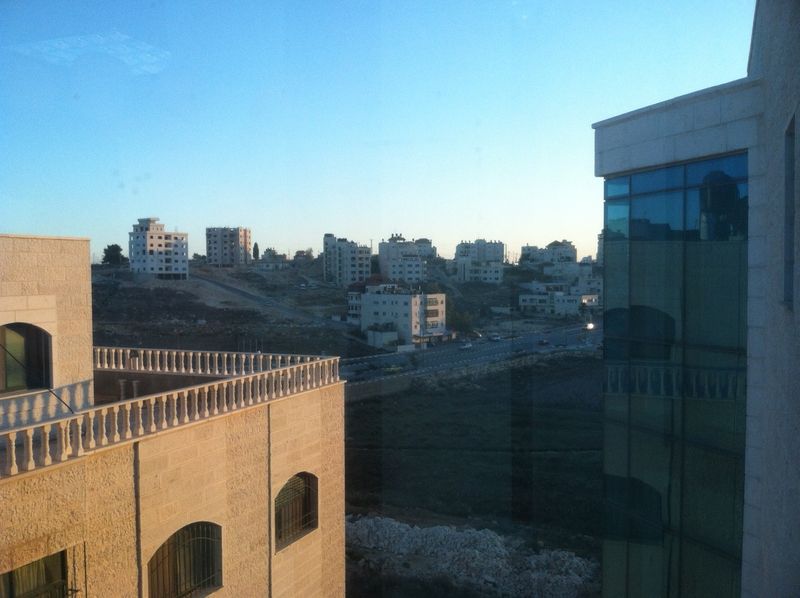
So easy, and yet so hard. The limestone construction screams Amman, Jordan. The problem is, it screams literally every single building in the entire city, since they are all built with the same materials.  I'm guessing a western suburb, relatively well off, too new for all the vacant lots to have filled in. I'm giving myself two more minutes to Google map it while I wait for a file to download. If nothing in two minutes, I'll just guess …

And time's up. I'm going with the Amman suburb of Naour, from a window that looks across King Abdallah bin Hussein II Road.

Another writes:

The low sun on the white stone is so specific to Amman, not to mention the endless new construction. Over recent years the city has been growing and growing.  This must be on the Dead Sea road, before it begins to descend into the Jordan Valley. It's hard to pin down exactly, as all the new apartment blocks look the same. The coordinates from Google Earth must be around 31.52.14.49 N, 35.50.26.11 E.

Another:

First time entering and I don't know how people do this! But I was home sick with a cold and spent the better part of the afternoon happliy googling away. The picture immediately said Fertile Crescent to me, with the sun rising from the east and the Mediterranean nearby. The tesselation of the building columns and the arched windows also point to Middle Eastern style, along with the lone cypress tree and the scrubby landscape. I was able to find an apartments-for-sale site in Aleppo, Syria that showed very similar 5-story modern apartment blocks as the ones climbing the hills.

Another:

I am in the middle of finals so no time for serious photo scouring or googling, so I will just say "Tangier, Morocco". There's some arabesque architecture, but it's only a hint.  And something about the blue sky suggests there is ocean right over that ridge (like Tangier). So that's my half-hearted guess.

Another:

Tough one this week!

To me, it recalled stories of the new American embassies and consulates that are being built on the fringes of cities now in places like Ankara, Turkey. So I started googling for images of the American consulates and embassies in the Near East. Being in a country that is particularly suspicious of terrorism and without a lot of Internet freedom (scary that this description also now includes the United States), I decided that I'd probably tripped enough alarm bells for a day, even though I never came away with a solid guess. So, Ankara – and now I'm slowly closing my laptop and walking away.

Another:

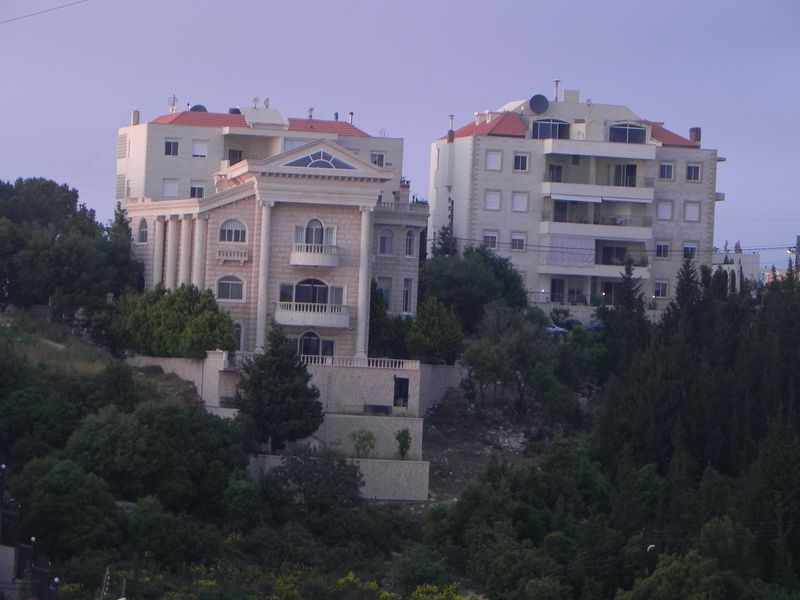
Minimal clues: The weather, topography and trees.  Then there's the buildings in the 54045592foreground and middle ground and signs of lots more beyond.  So far I am thinking this is SE Mediterranean, Turkey maybe but no luck finding a fit.  Cars driving on the right and I think the yellow one might be a Mini convertible. Where else but Lebanon then? In fact this is probably not Fatqa, but this photo shows both arabic windows with the right proportions and grille, and white balustrade.  So it may be nearby.  Or use the same builder!
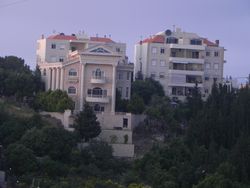
Another:

That is definitely Jerusalem. I would recognize those hills, the light and the low architecture anywhere. I do wonder though if it's outside or within the green line, that might complicate how you decide if it's in Israel or not …

Another:

Longtime reader, fellow Washingtonian and former high school debater with intern Zack (I think we were .500, but who cares?). The limestone strongly suggests Israel. This week's farcical RJC forum and Newt's interview on The Jewish Channel also suggest that we're ripe for a VFYW from a so-called 'Judea and Samaria' settlement. The buildings closely resemble those in Gilo, East Jerusalem, Israel. I visited Gilo during my first trip to Israel in the summer of 2000, a few months before both the First Intifada and my Bar Mitzvah, and the white and yellow limestone architecture made a huge impression on me. The highway is most likely #60, which connects Jerusalem with major West Bank cities.

Hope that's close – it's probably not enough to win because there are no Google Maps screenshots, but I'd give someone odds that this is one of the Jewish towns outside of the Green Line.

Another:
Room+with+a+view+2

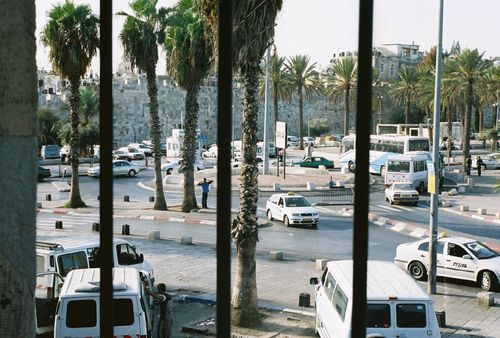
I’m not certain where around the city this is, but I’ll bet it’s Jerusalem (the same city my attached photo was taken, which I submitted four years ago, but you never used). This is ‘Division Street’ somewhere around town, or close nearby. That’s one city, not two, and one country I hope will recognize itself as the homeland for both Jews and Palestinians alike.

Another:

That would be the new industrial-Hi Tech Zone in Jerusalem, Har Hotzvim!  The building on the right is the Beck Science Center.  The view is across the road to the village of Shoafat.  Just out of view on the left is the Israeli neighborhood of Ramat Shlomo, recently a flashpoint in Israeli-Palestinean relations.

Another:

East Jerusalem, Israelastine? Newly constructed buildings on someone else's land. Cedar tree in distance. Rubble in foreground reminding me of landscape in the Costa-Gavras film, Hanna K.

Another:

I'm sure someone will be able to pinpoint the precise window, but my guess it that this is a view of the road between Jerusalem and Ramallah (though, it could be anywhere in the West Bank). The real question is why does the building on the left have bars on a third story window?

Another:

The obvious clues in this one are the building immediately in front, with the roofline balustrade and the bars on the window. They either want to keep something inside or something out. The glassy facade on the right suggests a modern building. The background buildings suggest a relatively impoverished area.  Road markings are consistent with Israel, but the buildings argue for the Palestinian territories.  It looks like morning and the traffic is light, so the view would be facing east.  The reflection in the window hints at other tall buildings, so this would be the edge of an urban area. The hills would be consistent with several of the cities in the region. With the holidays coming up, smaller cities like Nazareth and Bethlehem might be logical choices.  But looking at the modern building again I would guess Ramallah, although I can't pinpoint the exact spot.

The following reader was the closest to the exact location and thus wins the prize this week:

Damn. Having lived in Ramallah, it should be a piece of cake for me to say exactly where this is.  There aren't that many tall buildings with mirrored glass there, although the building boom has clearly accelerated in the three years since I lived there. So I will say Ramallah, near the Al Bireh neighbourhood.

Details from the submitter:

I am in Ramallah on a temporary assignment for my company.  We are working on a USAID project in the area.  The photo is from my office on the 6th floor of the Al Amal Building, on Mecca Street in the Al Balou'a Area.  This is in Al Biereh, which is a town adjacent to Ramallah.  The shot is to the south.

(Archive)

A Matter Of Scale

Mark Mitchell reflects on the euro crisis: 

[T]he current crisis (and this is merely part of a broader crisis that extends beyond Europe) appears as a failure to appreciate the fact that optimal human institutions—those that facilitate human flourishing—cannot exceed a certain scale, and when they do, they will inevitably suffer.

Europe’s problems, then, present an opportunity to reconsider ideas that have been ignored for too long. A renewed commitment to the principles of political decentralism, economic localism, and cultural regionalism is a radical prescription for a Europe haunted by the specter of unity, but it would provide the opportunity for Europeans to reconsider the meaning of citizenship, culture, and community on a scale that is meaningful, which is to say, suited to human beings.

As the crisis deepens and as centralizing solutions continue to show themselves inadequate, perhaps one day in the not-too-distant future saner heads will prevail and consideration of human scale will emerge as an idea whose time has come. The sooner we on this side of the Atlantic learn this lesson the better we will be able to manage our own troubles.

Gingrich’s $1.3 Trillion Tax Cut For The Wealthy

Gingrich_Tax_Plan

It would blow a massive hole in the deficit and make the tax code much more regressive. Howard Gleckman does the math:

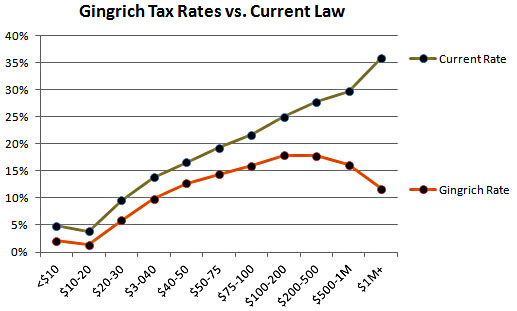
Everyone in the top 0.1 percent would be better off than under 2011 rates and they’d get an average tax cut of $1.9 million. Among those in the bottom 20 percent, only about one-quarter would be better off under the Gingrich plan. Overall, low-income households would get an average tax cut of $63. … Because the plan is so much more generous when compared to current law, the overall cost of the Gingrich plan is even greater. He’d reduce revenues in 2015 by nearly $1.3 trillion, or 35 percent of federal taxes that year. Talk about starving the beast!

It would also require destruction of vast swathes of government:

Gingrich’s plan would leave enough money to cover the cost of so-called mandatory spending, a category that includes Medicare, Medicaid and Social Security, along with part of the interest on the U.S. debt. Dedicating the money for those purposes wouldn’t leave any funds for defense spending or any other federal agency.

So unless the miraculous Lafferite effects take off like a rocket, Newt would have to zero out all defense. Chart from Kevin Drum, who comments:

In order to make sure that not a single person would even theoretically pay higher taxes under his plan, Newt uses the dodge pioneered by Rick Perry that allows taxpayers to choose between the current tax code and the Gingrich plan. However, he goes Perry one better by being even more brazenly pro-millionaire with an effective rate of 11.2% for anyone earning more than a million dollars per year.1 Take that, cowboy!