"[S]houldn’t we be relatively happy that there’s a show pointing to a better model for Muslims than extremism? Isn’t it a good thing that there’s a show celebrating the fact that you can love America and be a Muslim?" – Jonah Goldberg, NRO, on the "All-American Muslim" controversy.
Month: December 2011
What Is God? Ctd

I left the conversation hanging a while back, after my post about God being the most powerful force in the universe, rather than the anthropocentric notion of an old man with a gray beard in the sky. I left it because it felt like an impasse, with my view hovering in mid-air next to that of many readers, who insist that Christianity conform to what they think it must be (mythical piffle).
But my view is certainly orthodox Christianity, as long as you ascribe consciousness and caritas to the universal creative force. Anyway, that is a roundabout way of saying I read something this week that seemed more persuasive than my flawed efforts. It's in a review by James Wood of the essays of John Jeremiah Sullivan, recently published as "Pulphead." Here's the passage James quotes, with Sullivan (no relation) paraphrasing the theology of the early-nineteenth-century French explorer and botanist Constantine Samuel Rafinesque:
What’s true of us is true of nature. If we are conscious, as our species seems to have become, then nature is conscious. Nature became conscious in us, perhaps in order to observe itself. It may be holding us out and turning us around like a crab does its eyeball. Whatever the reason, that thing out there, with the black holes and the nebulae and whatnot, is conscious. One cannot look in the mirror and rationally deny this. It experiences love and desire, or thinks it does. The idea is enough to render the Judeo-Christian cosmos sort of quaint. . . . Rafinesque perfected his variant of this honorable philosophy while botanizing in the literal backyards of my childhood, examining ruderal plants I’ve known all my life, and so I have appropriated it from him, with minor tweaks.
It works perfectly as a religion. Others talk about God, and I feel we can sit together, that God is one of this thing’s masks, or that this thing is God.
“Full Unconcealed Panic” Ctd
TNR chronicles the mounting and widespread consternation over Newt's rise:
Charles Krauthammer: "Gingrich has his own vulnerabilities. The first is often overlooked because it is characterological rather than ideological: his own unreliability. Gingrich has a self-regard so immense that it rivals Obama’s—but, unlike Obama’s, is untamed by self-discipline.
Ross Douthat: "[Gingrich’s] candidacy isn’t a test of religious conservatives’ willingness to be good, forgiving Christians. It’s a test of their ability to see their cause through outsiders’ eyes, and to recognize what anointing a thrice-married adulterer as the champion of "family values" would say to the skeptical, the unconverted and above all to the young."
Joe Scarborough: "When [Gingrich] puts on his political helmet he is a terrible person. … Let me tell you something: the Republican establishment will never make peace with Newt Gingrich. They just won’t! They won’t. This is an important point. Because the Republicans I talk to say he cannot win the nomination at any cost. He will destroy the party. He will re-elect Barack Obama and we’ll be ruined. That’s going to happen. I mean Newt Gingrich would possibly win 100 electoral votes."
Even Jennifer Rubin thought Newt's rabid Likudnik stance on the Palestinians was de trop:
Playing historical one-upmanship may satisfy the candidate’s desire to be the smartest guy in the room, but it is not indicative of mature leadership. It’s certainly not comparable to Ronald Reagan’s predictive aspiration on the demise of the Soviet Union. (Our goal is not to eradicate Palestinian nationalism, as it was to end communism, and anyone who thinks Palestinian nationalism is going away is clearly delusional.) This sort of talk is not helpful in the least to Israel, to U.S.-Israel relations, or to the Republican Party and in fact concedes the entire ground of sensible pro-Israel policy to the other side. Yet the purportedly smart right-leaning punditocracy nods admiringly at Gingrich’s folly.
Talk-radio host Michael Savage puts his money where his mouth is, offering Gingrich $1 million to drop out of the race. All-caps alert:
HIS CONTINUED CANDIDACY SPELLS NOTHING BUT RUIN FOR CONSERVATIVES, REPUBLICANS, AND ALL TRUE AMERICAN PATRIOTS.
Along the same lines, John Cassidy is assembling responses to the question: "What is the nicest thing you can think of to say about Newt Gingrich?" I don't disagree with this line of argument, and Tomasky's idea that Obama might be handed a landslide is intriguing (although it's a huge stretch from a couple of polls in South Carolina and Florida). But there's a hell of a way to go before we can really assume any of this. Gingrich could explode (he doesn't implode); Paul could surprise; Romney could rally over the long haul.
But in many ways, this is all a simple result of the intellectual and ideological collapse of the Republican party. All they have, it seems, are some visceral reactions to social change – Latino immigrants, gay spouses, tolerant Millennials – and an argument that remains unchanged for thirty years, regardless of a hugely changed world.
So we have a Cold War mentality without the Soviet Union – and a crazy endorsement of pre-emptive war and torture as core elements of American exceptionalism! We have a myth of massive new regulations by the Obama administration. We have more tax cuts, as if Reagan's supply side policies have been vindicated in the long term. And we have more tax cuts, while revenue is at 50 year lows. Or we have truly utopian ideas like abolishing the Fed, bringing back child labor, and fracking our way out of climate change. The whole caboose is a sign of a party that has long since unmoored itself from the country it exists in. If one of the GOP's problems is that it has lost the last two generations, nominating a 68 year-old curmudgeon who told OWS to get a job and take a bath is not likely to help. Newt's still a boomer, with all that boomer baggage.
But here's what he'd do. He'd clarify dramatically the options in front of us. In refusing any tax hikes on the wealthy, and pledging to end Medicare as we have known it, and proposing a pre-emptive war on Iran as Israel's proxy, he'd help put the real GOP agenda on the table. To have that destroyed by Obama, and to have him handily re-elected would reform that party in a way nothing else would.
I always said it would get worse before it gets better. The hope now is that it will get much, much worse, and thereafter much, much better. But it's just a hope, not a prediction. Only a fool would predict anything at this point.
Quote For The Day II
"I think people recognize that I'm not a partisan Republican—that I'm someone who is moderate, and that my views are progressive," – Mitt Romney, 2002. Corn has the video.
Quote For The Day
"The outcome of the elections reflects the mood in Russia. Maybe there were some errors in several areas in Russia… but that is not different than what happens in Israel in various Arab and Druze villages," – Avigdor Lieberman, on the almost certainly rigged Russian elections.
The man is the foreign minister of Israel, defending Putin's corruption. And where has the neocon outrage been? Can you imagine if the foreign minister of France or Holland said such a thing. It's unimaginable because they share the core values of democratic life. Lieberman doesn't. And he represents the most powerful faction in Israel's politics: the neofascist right.
Why Pay For Channels You Don’t Watch? Ctd

A reader writes:
At last, someone is writing about this. But you are missing the elephant in the room. Cable bundling has enabled the corruption and radicalization of cable TV news. It the basis of Fox News' business model.
Here's how it works. Fox charges cable companies about 70 cents a subscriber. That fee provides about half their profits. So everyone who has Fox News on his or her cable system is compelled to pay Fox 70 cents a month. No matter how much I loathe Fox and what it has done to our political discourse, I have to pay them 70 cents a month. What this means is that Fox pays no economic price for stoking extremism. The opposite is true. It can cater to a mere three or four million Americans, 1 percent of the population, a ratings bonanza in the chopped up world of cable TV, while collecting a fee from tens of millions who detest the network. It boils down to this: I cannot stop paying Fox News no matter how much I hate it. I'm captive.
If Fox became a la carte, the results would be dramatic and immediate.
Tens of millions would drop the channel immediately. Black and Hispanic viewers would flee the network en mass. It would suffer crippling losses in the Northeast, West Coast and parts of the Midwest. The channel would be left with an overwhelmingly older, southern and evangelical viewership. Needless to say, the loss of such huge demographic swaths would cause many advertisers to jump ship.
In short, Fox would pay a heavy economic price for its lies and distortions. It would either reform or face becoming a niche network with much diminished power and influence. A la carte would have a similar, although less extreme impact on MSNBC. And that would be a good thing. We can never solve our problems if partisan media propagandize instead of inform. A la carte cable is key, perhaps the key, to reforming our politics and government.
(Screenshot via STFU Conservatives)
Newt Goes Negative
Joe Klein scores yesterday's Romney and Gingrich spat:
Gingrich is really good at this. He has been ever since he drove Tip O’Neill crazy in the early 1980s. When he can control his laser-mouth, it can be a powerful tool. He’s been controlling it so far. He may not be able to do so for long, but…do not underestimate the value of senior citizen hormones.
Dave Weigel dissects Gingrich's line of attack:
Shaming a businessman about the people he's "bankrupted" and "laid off" sounds like the work of an Occupier, not a private-enterprise loving conservative. Yes, it's true that Bain was not a job creation machine. Romney's being disengenuous when he says it was. But there's a perfectly respectable conservative ethos that defends what Bain did, arguing that the only responsibility of a corporation is to make money.
Adam Sorensen notes that Gingrich is counter-attacking, not attacking:
Gingrich is leading in a bunch of states now. He doesn’t need to tear down his opponents to win and a scorched earth campaign, which he probably doesn’t have money for anyway, could backfire. (The political science on that isn’t exactly settled). So his ability to counter-punch effectively whenever his opponents take a swing is a great asset for a front-runner. And for all the talk of Newt’s penchant for self-destructive bombast, he’s proved incredibly quick on his feet in this campaign.
Why Do Pit Bulls Get A Bad Rap? Ctd
A reader writes:
I have been following this discussion thread with interest and the comparison to guns by this reader leads me to wonder if anyone has brought up the role that gangs/criminals play in the perpetuation of the “pit bull myth”. Gang members, felons and parolees will often use pit bulls as replacements for actual weapons. Many have police records, obviously, and if they are caught with a gun or knife they’ll have to do time. So instead, they get themselves a pit bull. For them, it’s an ideal replacement. Walking around with a pit goes a long way to intimidate folks – and it’s legal.
Another:
Your reader says that the debate about pit bulls mirrors that about guns, which may be true, but he also says:
Yes, people opposed to them may show a certain irrational fear about them. But that’s only because when something goes wrong, it goes catastrophically wrong, and people end up dead, severely injured, or disfigured.
I doubt he or she is aware exactly how irrational that fear of pitbulls is. There are few statistics on the number of non-fatal dog bites attributed to specific breeds, but there was a CDC report published in 2000 which showed that 238 people were killed by dogs in the United States from 1979 to 1998.
(It also showed that pit bulls were disproportionately responsible to the tune of 32%, but enough has been said about the reliability and cause of those statistics by your readers. Suffice to say many people think the CDC study is flawed.) Generally, the number of deaths caused by dogs – all dogs, mind you – each year is between 20 and 30.
Meanwhile, in 2010 alone there were 8,775 gun-related murders in the US and even more suicides involved guns. And yet while some cities ban pitbulls, the Supreme Court thinks restricting gun ownership is unconstitutional. Anywhere from 2 to 4 million dogs (a disproportionate number of them pitbull-type dogs) are killed by shelters around the country each year. Can we please get real about the pit bull “problem”?
Another:
One of your readers
fact, they were highly symbolic. Many posters with them were made in the WWI era, before we joined the war and while people were getting nervous about it. These posters basically said that while this was not our fight, we could still totally win. Each nation was represented by a dog, and Team America was an American Pit Bull Terrier. It’s the American muscle dog.
I’ve enjoyed this thread, partly because my experience mirrors Bronwen Dickey’s. I thought pit bulls were mean and scary, met a couple of great ones, and then adopted one. When you go to the animal shelter, it seems like all pit bulls. We picked one, mostly at random, and she turned out to be a wonderful dog – affectionate, loyal, playful, and submissive. Because of our experience with her, we will probably always have a pit bull. Socializing is key, and it is important to us that ours be a good ambassador – the kind of pit bull that makes others rethink their ideas about the breed.
A note from Bronwen Dickey:
I’m pleased
there is such a gap between the data and common perceptions that I kind of fell into a rabbit-hole and couldn’t get out. Emotionalism runs so high on these issues that few people challenge why they think what they think, and that’s even worse when the subject is a companion animal.
So when a few of your readers posted negative responses to my story, I decided to use that as an excuse to pool all the information I’ve come across on pit bulls and aggression, to the tune of a 6,000 word “treatise.” If you think anyone might be interested in that, you can direct them here.
(Photo of Dickey’s dog, Nola)
Shopping Cart Psychology
Martin Lindstrom explores it:
[T]he bigger the cart, the more we buy. In fact, if the cart is double the size of our regular one, we buy an astounding 40 percent more than we usually do. It's not as if we need the extra items, but larger carts tap in to our primordial need to hoard food. We're still operating with our primitive brain and, ultimately, we're primed to guard against starvation. Evolutionary speaking, we're hardwired to store food in times of plenty. So, if our shopping cart looks half-empty, we'll fill it.
Should E-Cigs Be Banned?
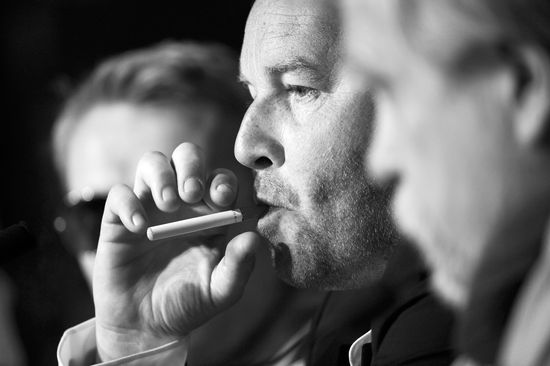
Cameron English finds the idea ridiculous:
[P]erhaps the hollowest argument leveled at e-cigs, as voiced by experts in Australia, is precisely what makes the devices so innovative: they're similar to the real thing. "Because e-cigarettes mimics [sic] smoking in both design and use, the ACT Health Directorate does not support [their use].'' The technically advanced rebuttal to this assertion goes like this: so what? If the goal is to prevent diseases and deaths associated with tobacco consumption, who cares if the alternatives emulate cigarettes? What's more, the evidence indicates that this is what makes e-cigs so effective. Part of breaking the addiction is addressing the behavioral aspect, the actual act of smoking a cigarette. In e-cigs we have an effective replacement.
(Photo: French director Xavier Beauvois smokes an electronic cigarette during the press conference of 'Des Hommes et des Dieux' (Of God and Men) presented in competition at the Cannes Film Festival on May 18, 2010 in Cannes. By Anne-Christine Poujoulat/AFP/Getty Images.)
 The Dish