Mitt’s Gold-Plated Achilles Heel?

Jonathan Chait notices that Romney has "cast himself as a middle-class champion, foreswearing at every turn any interest in benefiting the rich." Chait thinks this may be hurting him with GOP voters who want even more tax breaks for the financially successful:

Every additional episode that highlights Romney’s wealth merely increases the pressure he surely feels to avoid the vulnerabilities associated with championing the rich. Republicans have usually sought to avoid this problem by nominating candidates who can at least sell themselves as authentic representatives of the middle class. George W. Bush may have been handed enormous wealth by his patrician family, but he crafted an image of himself as a kind of Texas dirt farmer, with his modest “ranch” serving as the background. Nominating Romney, stripped of any such cover, raises the risk for Republicans that he may be a pacifist in the class war.
The Origins Of “Liberal Elite”

Tom Carson traces it back to Adlai Stevenson:

The most celebrated exchange of his two campaigns against Dwight D. Eisenhower went like this: "Governor, every thinking person will be voting for you," cried a woman at a rally. Ever humorous, the Democratic nominee twinkled. "Madam, that’s not enough," he said. "I need a majority." That quip was one of the most appalling things ever said in public by anyone running for president, because either you believe in democracy or you don’t. Yet to educated liberals at the time—confounded that Ike’s war-winning grin counted for more than their hero’s plummy savoir faire—it was balm. Almost 60 years later, the attitude has hardly vanished.

Cremation Goes Green

Natalie Wolchover investigates a final gesture of energy efficiency: 

In Durham, England, corpses will soon be used to generate electricity. A crematorium is installing turbines in its burners that will convert waste heat from the combustion of each corpse into as much as 150 kilowatt-hours of juice — enough to power 1,500 televisions for an hour. The facility plans to sell the electricity to local power companies.

Mitt Romney, Underdog

RomneyVsGingrich

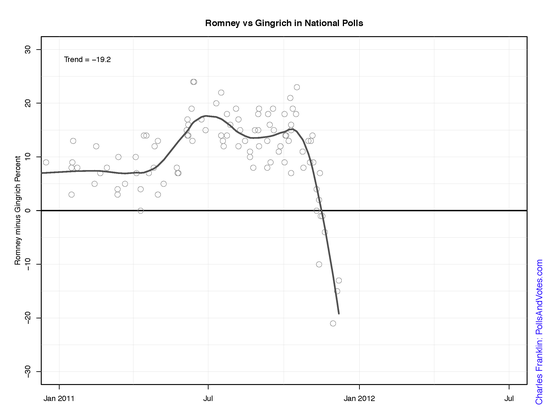
Charles Franklin, who remains somewhat skeptical of the Gingrich surge, points out that Newt's lead is relatively large: 

Gingrich has taken a significantly bigger lead over Romney than any of the previous three candidates were able to do. My trend estimate now puts that lead over 19 points. Perry briefly approached a 14 point lead while Cain was only briefly ahead slightly and Bachmann never was ahead.

Eric Kleefeld analyzes the early states:

Taking a step back from the various state polls, and looking at the flow of the calendar itself, something starts to become clear: If a person had sat down to write a primary calendar, designed around the goal of making things hard for Romney, they could not do much better than the current one.

Building A Better Classroom

Jordan Weissmann parses Roland Fryer's new findings on the importance of school culture: 

Fryer found that class size, per-pupil spending, and the number of teachers with certifications or advanced degrees had nothing to do with student test scores in language and math. In fact, schools that poured in more resources actually got worse results. What did make a difference?

The study measures correlation, not causation, so there are no clear answers. But there is a clear pattern. Schools that focused on teacher development, data-driven instruction, creating a culture focused on student achievement, and setting high academic expectations consistently fared better. … Fryer measured school culture in a way no academic before him had. He looked at the number of times teachers got feedback. The number of days students got tutored in small groups. The number of assessments for students. The number of hours students actually spent at their desks. Each correlated with higher student scores.

Would Gingrich Lose A Lincoln-Douglas Debate?

Probably:

[T]here's something odd about Mr Gingrich's specific proposal. The Lincoln-Douglas debates had a highly regimented format: an hour-long opening from one, a 90-minute rebuttal from the other, and a half-hour rejoinder to wrap it up. Unless Mr Gingrich has something different in mind, he's suggesting a format that favours Mr Obama's rhetorical strengths rather than his own.

Live-blogging for three hours? Seven times? Shoot me now. But on reflection, I'm not so sure it's a terrible idea. The primary debates have become reality show contests. Better to change the format entirely. And in so far as Gingrich really does have an expansive, distinctive and intermittently unhinged politics, I think a fleshing out of it would be helpful. One general rule is that the longer Gingrich speaks, the less people like him; another is that he's better at the put-down and come-back than the grand theory. So bring it on!

They should also unshackle the audience. If you are going to speak for an hour, then it's a real speech and works best with a real audience that cheers or boos and generally interacts. Let Obama start and end, with 90 minutes of Newt in the middle. The country does face a choice: between the pragmatic conservatism of the president and the radical reactionaryism of Gingrich. The clearer that distinction is, the better.

Face Of The Day

Drone_War_Photos

Spencer Ackerman interviewed a man documenting the drone war:

One resident of North Waziristan wants to expose the conflict. Noor Behram has spent years photographing the aftermath of drone strikes, often at personal risk. … [B]e aware that our sources came to us with an agenda: discrediting the drone war. "I want to show taxpayers in the Western world what their tax money is doing to people in another part of the world: killing civilians, innocent victims, children," Behram says. …Nevertheless, after careful consideration, we chose to publish some of these images because of the inherent journalistic value in depicting a largely unseen battlefield.

The above photo is of Dande Darpa Khel and was taken on August 21, 2009. The caption:

By the time Behram reached Bismullah Khan's mud house, partially destroyed in the strike, Khan's youngest son, Syed Wali Shah, had already died. Behram watched as the boy's body was laid out on a prayer rug, a "very small" one, in preparation for his funeral.

Greg Scoblete compares the graphic photographs to the administration's rhetoric:

Behram's images are not conclusive proof that the Obama administration was incorrect (or disingenuous) when it claimed that no civilians had been killed by U.S. drone strikes in Pakistan, but it's additional evidence that the claim was unfounded. It does beggar belief why such a claim was made in the first place.