The Two-Year-Old Sandwich

The Army is upgrading the Meal, Ready-to-Eat (MRE): 

[F]ood scientists started with ingredients like sugar (in jams or jellies for instance), salt, or honey that contain moisture but also retain it, keeping it out of contact with other ingredients. Think about a fresh tomato; on a sandwich, it will quickly cause the bread to become soggy as water from the tomato soaks into the bread. But jelly or honey on toast, though moist, doesn’t impart its moisture to the bread. Using ingredients that lock their moisture inside was key to the process. Perhaps more difficult is keeping oxygen away from the sandwich. To do so, each one is packed in an air-sealed package with an oxygen scavenger–a small packet of iron filings that pulls oxygen from the ambient air and locks it up in a layer of rust. This keeps oxygen away from things like bread, where it could feed a reaction resulting in mold and decay. Devoid of oxygen and water, a sandwich can last a long time–two years in this case. 

BBC report here

“A Talent For Contempt”

NEWT

Rick Hertzberg nails the core Gingrich appeal:

In 1990, when he was not yet Speaker, he pressed a memo on Republican candidates for office, instructing them to use certain words when talking about the Democratic enemy: “betray,” “bizarre,” “decay,” “anti-flag,” “anti-family,” “pathetic,” “lie,” “cheat,” “radical,” “sick,” “traitors,” and more. His own vocabulary of contempt has grown only more poisonously flowery. President Obama’s actions cannot be understood except as an expression of “Kenyan, anti-colonial behavior.” Liberals constitute a “secular-socialist machine” that is “as great a threat to America as Nazi Germany or the Soviet Union.” There is “a gay and secular fascism in this country that wants to impose its will on the rest of us” and “is prepared to use violence.”

In this campaign, Gingrich’s performances in televised debates have been widely deemed effective. But what has won him his most visceral cheers from the audiences in the halls—audiences shaped and coarsened by years of listening to talk radio and watching Fox News—is his sneering attacks on moderators, especially those representing the hated “liberal” media.

In March, at the Cornerstone Church, in San Antonio, Gingrich declared, “I am convinced that, if we do not decisively win the struggle over the nature of America,” his grandchildren will live “in a secular atheist country, potentially one dominated by radical Islamists and with no understanding of what it once meant to be an American.” Last spring, this was a kind of right-wing performance art. Now it is the language of the man leading in the Republican polls, a man who—in the real world, not the alt-world—could, not inconceivably, become President of the United States. Imagine that.

$10,000 Bet Debate Extra Reax

Michelle Cottle:

Up to now [Romney] had looked consistently solid in these forums: calm, cool, reasonable, informed, somewhat robotic, but on the whole believably presidential. Tonight, by contrast, it was as though he had prepped for the showdown by doing several lines of coke backstage. He was talking too fast. Blinking too fiercely. Fidgeting too much. Babbling. Cackling. On the whole looking, as Newt Gingrich might put it, fundamentally twitchy

Joe Klein:

Clearly, [Romney] is in trouble. I date that trouble to his late-November decision to jump into Iowa. It seemed a smart move at the time: Herman Cain was the front-runner, but that wasn’t going to last. Newt’s surge was just beginning; there was no way to tell how intense it would become. It seemed plausible that Romney might sneak a victory with his chronic 25% support level. Now it seems possible he might be clobbered there, finishing well behind Gingrich and Ron Paul, perhaps even slipping down to Rick Perry level (a level Romney attained, momentarily, by challenging Perry to that bet).

Steve Kornacki:

Gingrich’s poise was in sharp contrast to the botched attacks, missed opportunities, and general awkwardness that marred Cain’s and Perry’s performances earlier this fall and helped end their surges. And his response to Romney’s early attacks was the rule for the night. For every criticism from an opponent Gingrich was ready with a snappy, confident explanation. His answers amounted to gobbledygook at times — like his insistence that conservatives of the early ’90s had only proposed an individual mandate in an effort to stop Hillary Clinton’s healthcare reform plan — but Gingrich isunusually effective at selling gobbledygook. There was plenty in his performance Saturday night to reassure the hordes of new supporters who’ve flocked to his campaign in recent weeks.

Pete Spiliakos:

Gingrich just schooled Romney in their first clash.  Total Gingrich win.  Romney would do better to get it into his head that the salient difference between him and Gingrich has nothing to do with which one of them is a professional politician.  Romney has more recent experience of elected office and has been running for who-knows-how-long.  The salient difference is that Romney has experience of the private sector and Gingrich was a beneficiary of crony capitalism.

Jonathan Bernstein:

I think Romney’s strategy of going negative on Newt Gingrich at this point is a mistake (better to let Ron Paul and Michele Bachmann carry the ball on that one), and he was clearly thrown when George Stephanopolous demanded that he attack on cue early on, but if you’re going to attack, you need to do it well – and he very much didn’t. He didn’t have a lot of awful moments outside of challenging Rick Perry to a $10,000 bet (over something that Perry was basically correct about), but overall Romney probably gave his weakest performance.

Ed Morrissey:

Romney … made the gaffe of the evening when he attacked Rick Perry, of all people.  Until now, Romney has been very careful not to punch below his class, but Perry got under his skin and Romney ended up going after Perry on Gardasil all over again.  He didn’t do it well, either, and when Perry attacked Romney over statements in his book regarding health care, Romney tried to intimidate Perry by challenging him to bet $10,000 over the issue.  If Romney wanted to make himself look rich, arrogant, and clueless, he could hardly have done a better job.  When was the last time someone challenged you to a ridiculous bet in order to intimidate you out of an argument?  For me, I think it was junior-high school.

Nate Silver kept an eye on Intrade during the debate:

I checked the share prices for the seven major Republican contenders at 8:59 p.m. on Saturday, just before the debate began. Those prices represent estimates of the likelihood that the candidates will win their party’s nomination. At that point, Mr. Romney’s chances of winning the nomination were attributed to be 47.2 percent. They had declined to 44.4 percent, however, as of 12:27 a.m. on Sunday. Meanwhile, the share price for Newt Gingrich, who had a strong evening, rose significantly.

Dave Weigel:

It was the first time [Gingrich had] attacked another candidate on the debate stage, after months of attacking debate moderators for even trying to make the candidates fight…. Romney revealed that he really isn't as good at Gingrich at dishing this out. No one is—not in this field. No one thinks as quickly on his feet, and no one tosses up so many decoys to escape set traps.

Dan Drezner goes after Gingrich for questioning whether American will survive should Iran get the bomb:

Even a nuclear-armed Iran led by the current regime of nutball theocrats cannot threaten America's survival.  I get why the United States is concerned about Iran going nuclear, and I get why Israel is really concerned about Iran going nuclear.  The only way that developments in Iran could threaten America'ssurvival, however, would be if the US policy response was so hyperbolic that it ignited a general Middle East war that dragged in Russia and China.  Which… come to think of it, wouldn't be entirely out of the question under a President Gingrich. 

Daniel Larison focuses on Gingrich's Israel misinformation:

Gingrich’s remarks have nothing to do with telling the truth, and there’s certainly no courage required to make these statements. On the contrary, he is deliberately trying to deny an obvious reality to curry favor with hard-liners in his party. It’s a shame that the other candidates and the journalists at the debate allowed him to preserve the appearance of being someone interested in an accurate understanding of history.

John Cassidy:

In saying of the Palestinians, “These people are terrorists,”a statement blatantly aimed at the six out of ten Iowa Republicans who describe themselves as born-again or evangelical Christians, he answered Hunter Thompson’s famous question about President Nixon’s 1972 campaign: How low do you have to go to be President of this country? Newt, we now know—did we ever doubt it?—will dig all the way to China.

Earlier reax here. Live-blogging here.

How Do Animals See?

2277549976_59d13c2c0d_o

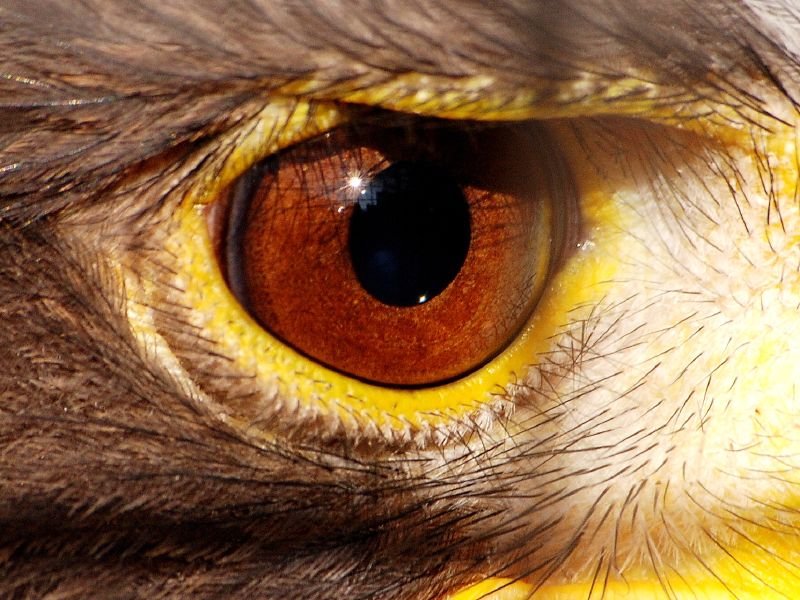
A primer explains how birds see better than dogs, cats and humans:

In general, birds have an additional ultraviolet pigment in their cones and many more cones than we have. Furthermore the visual pigments that would be similar to ours span different wavelengths. Their visual experience is richer than our own in ways impossible to describe or understand. … When a mouse is being hunted by a hawk, it will often urinate out of fear and to make itself as light as possible for escape. Mouse urine radiates ultraviolet and that actually helps the hawk follow the mouse trail. Fresher urine radiates more ultraviolet light. The ultraviolet arrow will point to lunch for the hawk.

(Photo by Flickr user Polandeze)

Everything You Never Wanted To Know About Fungus

Priscilla Long profiles the white button mushroom:

This common, commercially grown (and naturally growing) fungus, Agaricus bisporus, belongs to the kingdom of fungi, equal in status to the animal kingdom and the plant kingdom. Before genomics revealed true evolutionary relationships, fungi were considered first cousin to plants. The new Tree of Life puts them closer to animals. And, like us, they can’t synthesize sugars out of sunlight and must eat organic plant matter, such as dead wood and dried autumn leaves. Unlike us though, fungi grow toward their food. When they reach lunch, they excrete an enzyme that breaks it down outside their body. Only then do they ingest it. Digestion before ingestion.

When There Is No Spark

Owen Paciuszko takes on the belief that all successful first dates must create some special connection between the couple:

[First dates are] awkward and strange for the most part. It's two people finding their way around one another, trying to figure each other out, maybe you won't hit it out of the park on that first date, but unless you utterly despise one another should you discount a second date because there weren't any 'sparks'? Is life really too short to not give someone a second chance?

Ellen Waddell complicates the narrative:

Now I do believe there is such a thing that draws people together like an invisible magnet powered by the almighty waves of Neptune himself but I believe it is part of the process of evolution. We have all felt that intangible fire-o-loin’s lust with someone we don’t know all that well, just as we have all felt that sad damp squid-o-loin’s no lust with someone who we really want to fancy but just don’t and this could be because mother nature wants us all to have a powerful race of super babies.  

A Left-Handed Goodbye

In reviewing Rik Smits' The Puzzle of Left-handedness, David Yourdon examines an especially creepy theory:

Not only is left-handedness twice as common among twins as among regular siblings, but left-handers are twice as likely as right-handers to produce twins. This eerie link lies at the heart of another modern theory (and Smits’s favorite): that "being a monozygotic twin is a precondition of being left-handed." In other words, only someone who has had a twin in utero can be truly left-handed. The twins are mirror images of one another; one is left-handed, and the other right-handed. Of course, left-handedness doesn’t require that one ultimately be born with a twin. If only one fetus results at the end of term, that means the other died in the womb and was absorbed by the mother: a "vanishing twin."

What Happens If You Fall In Lava?

Contrary to cinematic opinion, you don't sink:

Golem, if you remember, dove into the lava of Mt. Doom after his previous ring was thrown in – he proceeds to sink into the lava and leaves the ring floating on the lava until it melts away. Guess what? Sinking into lava just will not happen if you’re a human (or remotely human). You’d need to be a Terminator to sink into molten rock/metal … and here’s why. Molten lava is nothing like water.

How Do Doctors Die? Ctd

Readers share more of their intimate experiences:

This string hits a deep chord.  My father died this fall at 81, after a steep decline in health over a couple of years.  As difficult as it was to watch, it was also the last example he gave us of what it meant to be a great doctor.  My dad essentially became his own last patient - paying fastidious and sustained attention to every detail in the care he was receiving.  He was as active a patient as any could be.  He knew exactly what was happening.   He fully understood the path his body would most likely take.  He used a lifetime of knowledge, skill, and instinct to make the best decisions he could on everything from what he ate at every meal, to whether to undergo procedures that his physicians offered as possibilities along the way. 

His goal throughout all of it was the same as it was with the thousands of patients he cared for in his very long career as a physician:  to extend life with the least amount of suffering. 

In the end, he died at home and in his sleep.  No end of life procedures, no tubes, no hospital administrators.  No one can say whether he would have lived longer had he undergone some of the procedures he had eschewed.  I doubt it.  But what we do know is that he was in control of those decisions until his last breath.  It was a great example for all of us.

A reader offers the other perspective on end-of-life care:

My mother-in-law died last Monday after a long bout with many illnesses. She had a rare form of cancer, but other health problems as well. It was so sad to see her go, so slowly and on so much morphine.

But for whatever reason, for years the doctors kept telling us she was going to die when she wasn't. Just as one example of many, a couple of years ago, a surgeon opened her up and was shocked at the state of her liver – cirrhosis, she's got months to live. But since no one gave up, it turned out after much consternation that she had had a virus as a child that had messed up most of her liver, but she'd been living with the bit that worked for over 60 years. Crisis averted. Just a month ago they took her off life support after a bad spell, but she kept on living! Went back home in a couple of days. I must have picked out clothes for my growing son to wear to her funeral six or seven times over a few years. I'm so glad that none of us gave up, because we had that extra time with her.

My mother-in-law and I used to say, every day we get is a blessing. And through a lot of effort, she made it until just after Thanksgiving. We all went to her home, a large family gathering, and everyone got to talk to her. My last sight of her alive was surrounded by her five great-grandchildren, all under 5, and my 7 year old, the last of the grandchildren. They were all reaching out to her, telling Mimi all about this and that, and she was reaching out for them, cooing over their stories.

I keep thinking of all the times we had to give up or go on, and I'm sure glad she went on as long as she possibly could. And despite feeling awful and wanting to be with her late husband, I know she was glad to hang on too – we talked about it often. "Every day is one more day," she said, and I noticed, she didn't mean good or bad necessarily, just another day given by God for His reasons, and she was going to embrace that.

Another doctor's loved one:

It was fascinating to read Hitchins' account of the indescribable, searing pain of his highly experimental treatment for esophagael cancer so soon after reading Ken Murray's "How Doctors Die." My husband, like the much older physician described in Murray's piece, died earlier this year of metastatic pancreatic cancer. It happens that clinical trials with proton therapy were being done for pancreatic tumors (albeit on the other end of the pancreas from that where my 51-year-old husband's appeared), but he chose not to seek out any kind of clinical trials once the medical verdict was in. Both of us knew as far back as when he was in medical school that we would both opt for being DNR in anything like the medical circumstances he faced at the end of his all-too-short life.

Last night I happened to give a talk to a large group of my physician husband's colleagues about how doctors treat doctors who are dying. An excerpt:

My husband, a doctor, went gently at a very young age. I think there is a vast difference between the doctor as patient and the doctors who treat a dying patient who is a physician.

At a Boston teaching hospital where my husband was not known and tended to be addressed as “Mr." not "Dr.," we could not help noticing the ethos was different: we were always being presented with high-action verbs, aggressive options, new things to try, new places to go. He didn’t want that. He wanted what was reasonable to try, and no more.

When his profession was known, he tended to be treated as a patient as if he already knew everything a medical expert in any field possibly could know. Doctors did not bother explaining things. And he almost always did know and immediately understand all of the medical and technical minutiae, and researched what he didn’t already know. It seems to me that to my husband as the patient, the most unfair part of this approach of assuming he knew everything as a physician was at least two-fold: first, it put him in the position of having to devote considerable time and energy to being the doctor explaining things to me, our children, and our non-medical family and friends. …

Second, treating him as a physician first seemed to me to impose on him a burden to do more on his own, to coordinate his care, even to remember to collect and transport discs with his scans—in short to be something more than a patient, when being a patient alone in such circumstances was more than most people could bear.

And with a very serious or terminal illness, both the word clouds flying between a physician patient and treating physician, and the things left unsaid because the patient is assumed to know them, can create additional problems. It’s overwhelmingly likely that in these cases eventually a non-medical family member like me will need to take over under a health care proxy, and needs to truly understand both the medical issues and the patient’s desires and make sure they’re carried out when he can’t. This requires being included in and led through some of these technical conversations. When having these conversations, doctors can be compassionate without giving false hope, and be realistic about options without being heartless.

Explain to patients that entering hospice isn’t giving up hope; it’s acknowledging the reality that your hope is no longer for a cure. Appreciate how much you know as physicians, explain things to family members who are likely to have no idea what the dying process is going to be like, and know how helpful it can be for your patients’ families, as they go on, to have been active participants in end-of-life-care for the people they love.