“I Have Never Been More Confident In The Revolution”

GT_TAHRIRFIREWORKS_111228

Karim Ennarah counters the pessimism of a post by Sandmonkey, a popular Egyptian blogger:

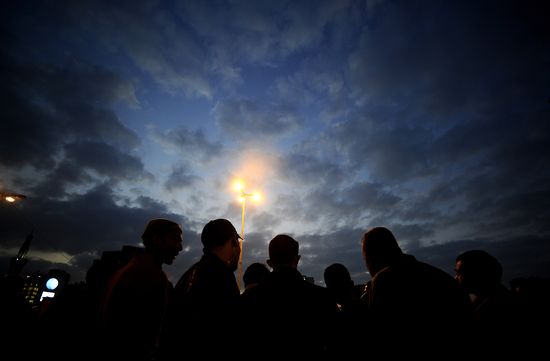
The army was quite confident in the first few months after Mubarak’s ouster that it could unleash extreme violence against protestors without losing the public’s trust. This calculation no longer holds. A growing number of protestors are willing to fight and die – even if this only inflicts small/negligible physical damage to the army. The army and SCAF have come to fear the protestors’ willingness to make the ultimate sacrifice. Even government prosecutors have come to fear the protestors’ bravery and power. In the aftermath of the November 19 demonstrations, prosecutors were systematically releasing activists who had been detained, fearful that, if they did otherwise, they could be on the wrong side of history. The prosecutors were right to have this concern. There are actually more cracks in the state apparatus now than on the day of Mubarak’s ouster.

(Photo: Egyptian protesters gather in Cairo's Tahrir Square on December 28, 2011. The murder trial of Egypt's former president Hosni Mubarak resumed after a three-month hiatus that saw the ousted strongman's fate eclipsed by deadly clashes and an Islamist election victory. By Filippo Monteforte/AFP/Getty Images.)

How Much Defense Cutting Is Too Much?

Michael O'Hanlon tries to find a sweet spot: 

Saving 8 to 10 percent in the annual peacetime defense budget of the United States—arguably the Pentagon’s fair share of a serious deficit-reduction effort—would be hard but not impossible under a shared-sacrifice philosophy. Over ten years, that would translate into $400 billion to $500 billion, to use the decennial accounting popular since the August 2011 debt deal between President Obama and Congress. These cuts would go beyond those already expected as part of a gradual reduction in the nation’s costs for waging war abroad.

… Such cuts, according to my calculations, would avoid going too far. We can avoid salary cuts for our troops and any display of weakening resolve toward East Asia or the Persian Gulf. We can modernize so that our most promising new technologies will adequately equip the forces most likely to fight in key regions. We can retain ground forces large enough, even after the Afghanistan campaign winds down, to carry out another war (heaven forbid) without having to let down our guard in every other part of the world by stealing forces from other theaters.

Today In Syria: America’s Next Steps

As the Arab League mission faces [NYT] heavy criticism over its shockingly blase attitude toward the violence, Josh Rogin reports on US plans for helping the opposition outside the Arab League mission:

After several weeks of having no top-level administration meetings to discuss the Syria crisis, the National Security Council (NSC) has begun an informal, quiet interagency process to create and collect options for aiding the Syrian opposition, two administration officials confirmed to The Cable. … The options that are under consideration include establishing a humanitarian corridor or safe zone for civilians in Syria along the Turkish border, extending humanitarian aid to the Syrian rebels, providing medical aid to Syrian clinics, engaging more with the external and internal opposition, forming an international contact group, or appointing a special coordinator for working with the Syrian opposition (as was done in Libya)…

Philip Gourevitch worries the international community won't be willing to get on board with tougher anti-Assad steps. Paul Wood writes a harrowing dispatch about his visit to Syria:

"Dignity" was a word I heard a great deal from Syrians explaining the revolution. Here, he was talking about Dera'a, the small southern town where the uprising had begun. In March, 15 school children were arrested for spraying anti-regime graffiti on a wall. Desperate families went to the local security headquarters. According to the widely circulated stories, the officer told them to forget about their children and that his men would rape the mothers to give them more. Two weeks later, the children were released. Some had had their fingernails pulled out. Neither the injuries, nor the insult, were forgotten.

Jordanian blogger Chubby writes a eulogy for Basel Sayed, a Homs resident who has been responsible for a number of videos from the beseiged Baba Amr neighborhood. Sayed filmed his own last moments – they're not graphic but still quite disturbing. In his honor, here's a video of a big protest in Homs:

These Homsis loudly boo Iran and Hezbollah during their protest:

These incredibly brave protestors in Idlib continue stand and, indeed, mass while being fired on by Assad's security forces:

The “Mainstream” And Ron Paul

Gallup finds him closer to the self-reported center than Obama, Bachmann, Gingrich, Perry, Santorum, and Cain. (Obama's outlying position comes entirely from Republicans, who seem to believe he really is the commie Fox News insists he is). So most Americans seem to disagree with the Beltway that Ron Paul is somehow an impermissible candidate for president. Why am I not surprised?

Meanwhile, Ron Paul has grasped the Iran question more aggressively as the voting nears. He is the only candidate who has taken military force off the table with respect to Iran's nuclear program. Obama is still threatening, with poor Leon Panetta being dragged back and forth in public by the Greater Israel lobby. Paul, in other words, is the only candidate we can be sure will not take us into a third war with a Muslim country in a decade. And he seems to believe this is a strength. No wonder Washington is still scratching its collective head.

The mindset that the world is our plaything remains entrenched. Only Paul has moved beyond that. If you ask me, that's the core of his appeal to the young.

Face Of The Day

136224018

A baby panda plays with New Year gifts provided by keepers at Ya'an Bifengxia Base of China Conservation and Research Centre for the Giant Panda on December 28, 2011 in Ya an, China. As the world's largest panda park, Bifengxia plays an important role in the protection and breeding programmes for an animal that remains one of the world's most endangered species. By ChinaFotoPress/Getty Images.

The Republican Revanchists

Mark Lilla insists that the "real news on the American right is the mainstreaming of political apocalypticism": 

People who know what kind of new world they want to create through revolution are trouble enough; those who only know what they want to destroy are a curse.

When I read the new reactionaries or hear them speak I’m reminded of Leo Naphta, the consumptive furloughed Jesuit in Thomas Mann’s The Magic Mountain, who prowls the corridors of a Swiss sanatorium, raging against the modern Enlightenment and looking for disciples. What infuriates Naphta is that history cannot be reversed, so he dreams of revenge against it. He speaks of a coming apocalypse, a period of cruelty and cleansing, after which man’s original ignorance will return and new forms of authority will be established. Mann did not model Naphta on Edmund Burke or Chateaubriand or Bismarck or any other figure on the traditional European right. He modeled him on George Lukács, the Hungarian Communist philosopher and onetime commissar who loathed liberals and conservatives alike. A man for our time.

The review of Corey Robin's essays is the best I've read. I found Robin's collection to be interesting in unearthing shards of reactionary rhetoric and impulses in conservatism's brief history. But the premise – that all conservatism means and can mean is suppression of the downtrodden and that all coservatives are the same underneath – is so crude it beggars belief:

[Robin] posits a class, isolates a characteristic of one of its members, and then ascribes that characteristic to every member of the class. Catholic reactionary Joseph de Maistre and George W. Bush are both on the right in Robin’s scheme; following his logic, since Maistre spoke flawless French, Bush must too. Which would be some national secret. Yet that’s exactly how Robin proceeds, until he has corralled everyone he doesn’t like into a pen and labeled them all conservatives and reactionaries and right-wingers, terms he fails to distinguish.

This is not an exaggeration.

Is Living At Home After College The New Normal?

Michael Rosenfeld questions the boomerang narrative: 

Census data show that what is really new about young adulthood is the percentage of young adults who live on their own. From 1880 to 1970 the percentage of U.S. born women in their twenties who lived on their own (not with parents and not with a husband) was always less than 15 percent. By 1980, the percentage of young adult women who lived on their own had risen to 27 percent, and to 33 percent in 1990, to 39 percent in 2000, and to 42 percent today.

The delay of marriage and the extension of singleness can make it appear as if young people are more likely to return to the parental nest. If one examines single people in their twenties, who are the people who have the option of living with their parents, the percentage who live with their parents is now about 45 percent. That may seem high but it isn't: in the past single people in their 20s nearly always lived with their parents. The Great Recession has actually had no effect whatsoever on the percentage of young adults living with their parents in the United States. This is not so surprising; the (even greater) Great Depression did not affect family structure much, and neither did the Industrial Revolution. Family structure changes slowly over time. Economic ups and downs have little effect on who lives with whom.