Mike Loukides disparages automatic sharing functions, such as an add-on that tells your friends every song you're listening to on Spotify:
If you want to tell me what you listen to, I care. But if it's just a feed in some social application that's constantly updated without your volition, why do I care? It's just another form of spam, particularly if I'm also receiving thousands of updates every day from hundreds of other friends.
Black may be the clouds about you And your future may seem grim, But don't let your nerve desert you; Keep yourself in fighting trim. If the worst is bound to happen, Spite of all that you can do, Running from it will not save you, See it through!
Here's the best profile of my college friend, Boris Johnson, Mayor of London and possible future PM. Money quote:
Since Petsy, his mistresses have included—but, let’s face it, are probably not limited to—Anna Fazackerley, a young journalist, and Helen Macintyre, a thirty-something art advisor whose young child, it is widely believed, is Boris’. (Boris has four children with Marina, two girls and two boys with the glorious names Cassia Peaches, Lara Lettice, Milo Arthur and Theodore Apollo.) In a testament to the unique position Boris occupies in public life, the BBC chose not to run with the story of his relationship with Helen Macintyre, which broke last year. "There was a feeling that it wasn’t a story," a BBC executive told Sonia Purnell, "it was just Boris."
Mara Zepeda explains why burn doctors hate noodle soups:
The sticky noodles cling to the skin, which leads to deeper, more severe burns, according to a study published in 2007. The study showed that hospital stays for upper body noodle-soup burns are more than twice as long as scalds from hot liquids alone.
Zepeda also reviews which brands of instant noodle soup are most likely to spill on you.
Alva Noë argues that neuroscience can't help us understand why we love certain works of art:
An account of how the brain constrains our ability to perceive has no greater claim to being an account of our ability to perceiveart than it has to being an account of how we perceive sports, or how we perceive the man across from us on the subway. … Some of us might wonder whether the relevant question is how we perceive works of art, anyway. What we ought to be asking is: Why do we value some works as art? Why do they move us?Why does art matter? And here again, the closest neural scientists or psychologists come to saying anything about this kind of aesthetic evaluation is to say something about preference. But the class of things we like, or that we prefer as compared to other things, is much wider than the class of things we value as art.
Why do I value Monet’s Impression Sunrise? For many reasons. Some art historical– its significance to the school of impressionism, its departures and influences. Some personal and indescribable– waves of feeling, a sudden mood. And some reasons, despite Noë’s overbearing negativity, stemming from recent offerings of perceptual neuroscience.
… [Margaret Livingstone’s Vision and Art] led me to some new questions I hadn’t really considered before in studying art history: Maybe some artists have intuitively, quite unconsciously, tapped into universal features of our neurobiology to induce widespread appreciation of their artistic output? Maybe it follows, then, that it could be interesting and useful to study these universal aspects of our biology of perception?
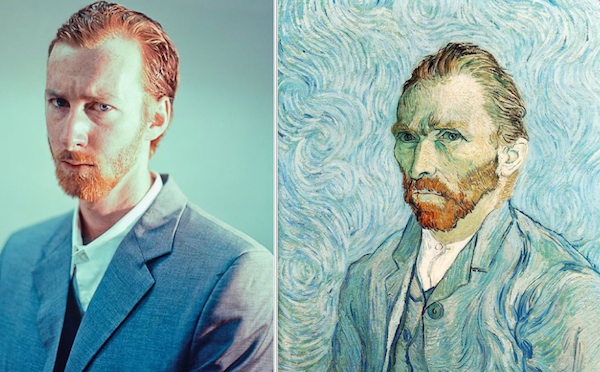
(Image: "Self Portrait 1889" by Vincent van Gogh and a remake by Seth Johnson from Booooooom!, a Vancouver-based art blog that asked photographers to remake classic works of art.)
Britain’s relationship with Europe has degenerated into, well, if not a full divorce yet, then a not so amicable separation. The Economist’s Charlemagne sees it as a French victory:
President Nicolas Sarkozy had long favoured the creation of a smaller, “core” euro zone, without the awkward British, Scandinavians and eastern Europeans that generally pursue more liberal, market-oriented policies. And he has wanted the core run on an inter-governmental basis, ie by leaders rather than by supranational European institutions. This would allow France, and Mr Sarkozy in particular, to maximise its impact. Mr Sarkozy made substantial progress on both fronts.
Johnnie Freedland explains it all very eloquently above. The Economist’s Bagehot columnist has a helpful guide to the Cameron-Merkel relationship, and how it foundered, despite some promise. I stick by my view that Cameron did what he had to do. Niall Ferguson and I – surprise! – agree on this one:
It is not that British policy has dramatically changed. The real historical turn is the one now being taken by the 17 euro zone members and the six non-euro states that have chosen to follow them. For there should be no doubt in anyone’s mind that what they have just agreed to do is to create a federal fiscal union. Moreover, it is a fundamentally flawed one.
The logic of the new agreement (not a treaty, because of Britain’s veto), is an increasingly centralized Europe, with national governments basically submitting their budgets to Berlin for approval. Britain did not fight two world wars to give Germany ultimate control of its internal finances. Britain’s recalcitrance will also – paradoxically – speed up the deal, because such an compact does not require as elaborate a system of agreement as a full-fledged universal treaty – you know, things like asking the people of various countries if they want to be run from Berlin via Brussels, or not. Whatever the EU is about, it is not grass roots democracy.
I have to say, though, that Cameron’s reason – protecting the City of London from meddling – is weak. The real reason is that his own party would have exploded had Cameron agreed to a new treaty, and in any referendum on it, the British people would almost certainly have said no anyway.
It's fair to say that most political nerds don't know what dubstep is. But last month libertarian sites like The Daily Paul and Lew Rockwell got geeked up about Porter Robinson's track "The State." The ominous dubstep number uses samples taken from economist Murray Rothbard's seminal For a New Liberty: The Libertarian Manifesto.
"How f'n awesome is that!?" wrote someone on The Daily Paul, which is, you guessed it, inspired by everyone's favorite gadfly presidential candidate Ron Paul. "…This is just further proof that the concept of liberty is being spread and becoming engrained in our culture, most obviously in younger generations."
The brief interview with Robinson may temper your excitement:
The most compelling anti-statist argument, I always found, is that taxation is armed robbery because — I'm getting really into it now– taxation is essentially armed robbery because every government action is backed by the threat of force.
Tim Murphy revisits Connie Bruck's 1995 New Yorker profile of Gingrich, where he reveals he was particularly influenced by James Clavell's novel Shogun, about a 17th-century Japanese samurai named Toranaga:
The book is a narrative of Toranaga's quest for the absolute power of shogun. Throughout the book, Toranaga, who confides in no one, violently repudiates the suggestion of his most loyal followers that he should seek to become shogun, even calling it "treason." Yet, through his study of individuals' psychology, his patience in listening, his system of punishment and reward, his establishment of an elaborate information network of spies, and his talent in projecting a wholly false self-image (he is an accomplished Noh actor), Toranaga is able to use, manipulate, and deceive all who come in contact with him; thus, in the end, he achieves his goal.
 The Dish