Face Of The Day

135378022

Indonesian widow Wanti Dodo, 93, whose husband Enap was killed during the 1947 massacre in Rawagede by Dutch troops, listens as Netherland's Ambassador Tjeerd de Zwaan delivers his formal apology to the Indonesian people in an emotional ceremony at the war memorial in the Rawagede, West Java province on December 9, 2011. By Romeo Gacad/AFP/Getty Images.

When Sodomy Saves The Day

A reader writes:

After reading your thread on why pitbulls get a bad rap, I feel obliged to share a recent story about one mauling another dog – and more importantly, what stopped the attack.

A group of us were having a picnic at the beach in San Francisco last month and a few people brought their dogs with them.  Among the dogs there were a small pit bull mix and a golden doodle puppy.  All the dogs were playing nicely until they weren't.  The pit latched on to the golden doodle's throat and locked down.  Hearing the awful screams, a bunch of ran over and tried to stop the attack.  I pulled the pit's hind legs (a friend with a pit said this was a good method to make them let go), but to no avail; someone else hit the pit over the head; and someone else used the handle to try and pry the dog's jaws open.  Nothing at all worked, and after what seemed like over a minute of this, I was sure the adorable little golden doodle was done for.  All of the sudden, the pit let go. 

As it turned out, another woman who we didn't know had come running across the beach upon hearing the screams.  As she told us afterwards, her dog had been attacked by a pit a few years ago and she had an idea what to expect.  She had run over, pulled the pit's tail flat against his back, and when that didn't work … she stuck her finger up the dog's ass.  No joke. Worked like a charm, and I've been telling people the story ever since, hoping that it saves some other dog or person in the future. 

The golden doodle is alright. The pit didn't get the neck straight on, which, in addition to our hero's finger, probably saved the dog's life.

The Liberal Reagan? Ctd

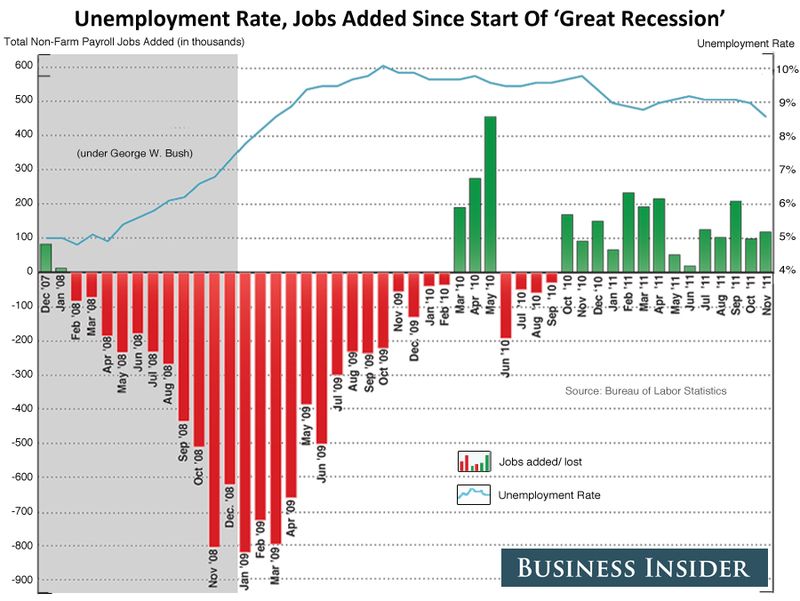
Chart of the day

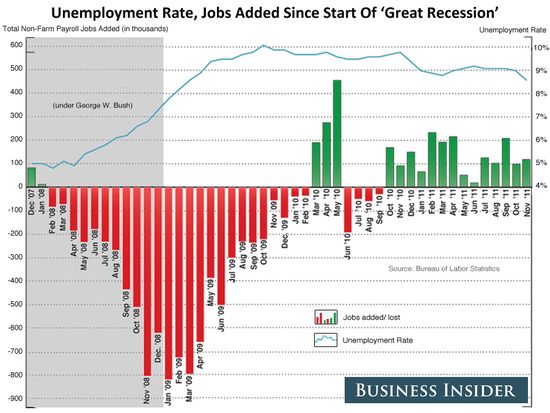
Jon Terbush backs up a reader's observation from last week: 

What the chart shows is that Obama inherited a bum economy but that, under his watch, things have begun to turn around. In the past year, the unemployment rate has dropped a full percentage point amid improving job growth. Assuming those trends continue, Obama will be able to say that, yes, the economy needs to be much stronger, but that it's currently heading in the right direction. That exact pitch helped Reagan win his 1984 reelection bid when he destroyed Walter Mondale —Mondale carried only his home state of Minnesota and Washington D.C. — despite an unemployment rate of 7.4% on election day. One year earlier, unemployment stood at 8.8%, higher than it is today, but it then steadily ticked down over the following months.

Why Is Medical Pricing So Opaque? Ctd

A reader writes:

Josh Barro is exactly right.  Take electrophysiology, for example.  When you get a pacemaker put in, you never learn the price of the device itself, or the other itemized costs of the procedure.  You just get a bill (or your insurer gets a bill) for the total cost.

Several years ago, I was among a team of big-firm lawyers representing a healthcare consulting company that worked with hospitals on their negotiations with medical device manufacturers.  The manufacturers all require their hospital customers to sign confidentiality agreements in order to keep the pricing of the devices secret.  One of the bigger device makers at the time sued my client for allegedly taking the pricing it learned from one hospital client to others so they could adequately negotiate with the manufacturer.  It was a slam-dunk win for the device manufacturer, and my former client is no longer in business.

Hate to say it (as a liberal Democrat), but Newt Gingrich of all people has been out in front trying to prevent this lack of transparency since at least 2006.

Another writes:

I'm thrilled to see you linking to the NRO post on this issue. 

My employer went to a "high-deductible" plan a few years ago and I've hated it for this very reason. First of all, there's very little "portability" in medical treatment – who wants to go to one doctor for a knee injury, then go to another for strep throat, and yet another for chronic headaches?  Secondly, just as Barro notes, you have no idea what any treatment is going to cost you until you leave the office.  The same goes for any prescriptions you may get. There may be five different medications that treat whatever ails you – not counting any generic versions of each – and the doctor's not going to give you a menu to choose your medication from.

These high-deductible plans exist for one reason – someone calculated that an average employee spends $2300 a year on medical treatment, and based on that, they set a deductible of $2500.  I hate it, but I have to be OK with the system because that's all that's available to me.  I'd rather my employer add the money they're paying in premiums for me back to my paycheck and be "taxed" $5000 a year for single-payer plan coverage. 

Also, I had to laugh at Barro saying that "we could legally obligate hospitals and medical practices to disclose their full price lists."  Imposing harsh new regulations on the medical industry?  Is this the same National Review than the one I'm familiar with??

Another:

Boy oh boy do I have an example for you. Last December I woke up with chest pains.  I am almost 50 and have had two brothers die before the age of 50 due to heart-related issues (high blood pressure and a botched bypass operation), so I drove myself to the emergency room.  It was around 3:00 AM when I walked into the Emergency entrance, checked in to Emergency, and was taken away by Emergency personnel.  After a couple of tests I was taken to a curtained-off bed in Emergency.  I stayed there in that bed for the next 12 hours, leaving only to be wheeled away for additional tests.  Fortunately, it was not heart related.  I checked out of Emergency and paid the clerk at the Emergency checkout the $150 co-pay the clerk stated my insurance required for Emergency care.  (Please note the excessive references to Emergency – it comes into play … or at least I believe it should.)

Two weeks later, I get a bill for $1,300+ from the hospital for my "Emergency" care.  Even though I checked into Emergency, remained in Emergency unless wheeled away for testing, checked out of Emergency while paying the $150 co-pay the Emergency checkout desk requested, I was billed for outpatient services.  At no time during my stay did any doctor or nurse ever tell me that I was being treated as an outpatient.  In fact, the doctor that spent the most time with me stated explicitly "we won't need to keep you for observation."  (By the way, my insurance has a $1,500 deductible on outpatient services …)

I've gone back and forth with their billing office numerous times in the past year, trying to get them to code the services appropriately as Emergency care.  My insurance company has told me that they will pay the amount owed if it is billed as Emergency services.  However, the hospital simply replies that it was outpatient service.

Since then, I have visited an Emergency room at a different hospital due to a late-night attack by a kidney stone.  I checked into Emergency, was treated by Emergency for almost six hours, and left the Emergency room paying my $150 Emergency co-pay.  The amazing thing is, the second hospital seems to actually believe I had Emergency services, and has been content with my payment.  Imagine.

One more:

I am a pediatric subspecialist at a major academic medical center in New York City.  Many times, patients call to find out the costs of procedures if we are outside of their network.  As ridiculous as it sounds, we are universally unable to tell them.  The prices are so opaque that no one at my institution will admit to being able to produce them.

For example, a pulmonary function test (really a group of tests) will involve a physician's fee and a technical fee.  The MD fee is generated from my practice and I have a list of fees that most patients are charged (though their insurances all pay different rates if they have insurance).  The hospital owns the technical fee.  A colleague of mine once spent three months trying to get an answer to the question of what the price is for a group of tests for a research grant she was planning.  No one could or would tell her.  Our practice manager acknowledges that this is a problem but can't access it.  Apparently many patients are charged different fees but no one seems to be able to know what they are.

The patient's don't believe it when we tell them we don't know.  Certainly any other business or service can tell you their fees.  With us you have to be billed to find out how much it will cost you.

When The Impossible Becomes Possible

Ezra Klein can't imagine a Gingrich win:

I think it’s more likely that this mobilization leads to a Romney win then a brokered convention or a new entrant. But I think it makes a Gingrich win almost impossible to imagine. And if something once considered so impossible begins to look likely, then correspondingly extraordinary events — again, like a brokered convention — will become likely, also.

Creepy Ad Watch

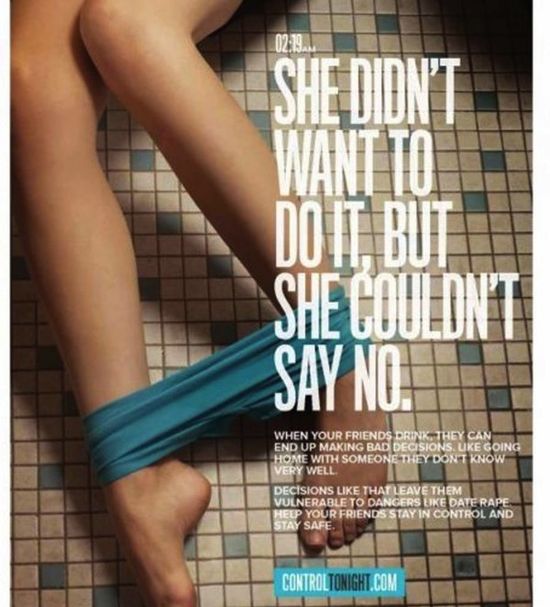
Many readers have been nominating this one:

PAdaterape

The small print reads:

When your friends drink, they can end up making bad decisions, like going home with someone they don't know very well. Decisions like that leave them vulnerable to dangers like date rape. Help your friends stay in control and stay safe.

Copyranter comments:

Rape. Not an easy thing to do an ad about. Right, France? Milwaukee? And when governments do rape ads, ho boy, heads up. Right, England? Well, the Pennsylvania Liquor Board got the urge to weigh in on teen date rape. This was the lead ad of their campaign. The victim blaming strategy didn't go over so well. They pulled all the ads Wednesday.

A commenter says of such criticism, "More over-reaction by the PC crowd."

The Key To A Happy Marriage?

A new report (pdf) looks at how to maintain happiness after the children arrive. Some advice from the authors:

[I]n today’s marriages both wives and husbands benefit when they embrace an ethic of marital generosity that puts the welfare of their spouse first. That is, both are happier in their marriages when they make a regular effort to serve their spouse in small ways — from making them a cup of coffee, to giving them a back rub after a long day, to going out of their way to be affectionate or forgiving. So the lesson here is not for wives now to throw off an other-centered ethic as a relic of an ancient era, but rather for contemporary husbands to embrace this ethic for themselves and their families.

Dreher nods:

I find from experience that this is deeply true. It’s a challenge, certainly, but it has its rewards. I’m really glad we live in a time in which it’s a normal thing for men to help with cooking, cleaning the kitchen, and so forth.

What Capital Punishment Isn’t

GT_DEATH_111209

Ari Kohen takes on the "imagine your family was murdered" argument for the death penalty:

I would argue that nothing will make me feel better about the loss of my loved ones. You could put the offender to death a hundred times and I still wouldn’t feel better … because the execution doesn’t make me whole, it doesn’t even things out. My family members are infinitely precious to me and the offender means nothing. When the execution is over, my house remains empty.

What we do, what our system does, is encourage victims and co-victims to believe that they will feel better after something bad is done to someone else. When it comes to the death penalty, we call it closure … as if watching someone die will put an end to the catastrophe that our lives have become as a result of violent crime. 

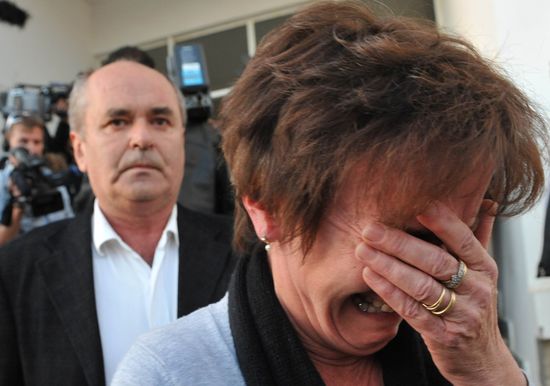
(Photo: Relatives of the victims of the April 28 bombing of an outdoor cafe in Marrakesh that left 17 dead, attend the final hearing on October 28, 2011 at the court in Sale. The anti-terrorism court in Sale, near the capital Rabat, delivered the death penalty verdict against Adil Al-Atmani and gave the life sentence to Hakim Dah, an AFP journalist reported. By Abdelhak Senna/AFP/Getty Images.)