The Daily Wrap


Today on the Dish, Jon Stewart marked the end of America, Andrew took stock of Perry's Christianism, and the Texas governor's campaign committed yet another amusing, unforced error. Gingrich embraced an anti-conservative and openly hostile foreign policy, he dangled John Bolton as secretary of state, and the GOP began to freak out. Some in the party elite prayed for a February surprise, Mitt Romney wanted to be a career politician, the big endorsements may not make a dent, and Fox News continued to deny the ascendancy of Ron Paul. The GOP championed wealth redistribution, the Republican primary resembled bad fiction, Rick Santorum inadvertently supported Obamacare, and GOP enthusiasm fizzled. In our AAA video, Andrew elaborated on "the successful and wealthy." 

There's evidence that the Syrian regime is cracking up, the opposition harbored hope, and the Arab spring suffered from bad timing. Obama pursued a creative policy in East Asia, and irregular warfare persisted

Retail clinics often do a better job, outward signs of aging can be misleading, and food drives are a waste. Readers dissected the Glenn Reynolds' student debt proposal, DOMA made things complicated in New York, and marijuana fueled the careers of accomplished actors and musicians. TNC reflected on race and the burden of the Civil War, Teddy Wayne enticed an overseas scam artist, and pit bulls are often misidentified. We studied the history of growing income inequality, and wondered about just war theory and cyberspace. Josh Barro called for medical pricing transparency, Ice Cube extolled the Eames, and Tebow's fans made their case. 

Tweet of the day here, quotes for the day here and here, money money TR quote here, MHB here, VFYW here, and FOTD here.

M.A. 

The Civil War In Black And White

4100347425_a8f847c425_b

Ta-Nehisi points out the shortcomings of the conventional histories of the war prevalent on both sides of the racial divide:

For realists, the true story of the Civil War illuminates the problem of ostensibly sober-minded compromise with powerful, and intractable, evil. For radicals, the wave of white terrorism that followed the war offers lessons on the price of revolutionary change. White Americans finding easy comfort in nonviolence and the radical love of the civil-rights movement must reckon with the unsettling fact that black people in this country achieved the rudi­ments of their freedom through the killing of whites.

And for black people, there is this—the burden of taking ownership of the Civil War as Our War. During my trips to battlefields, the near-total absence of African American visitors has been striking. Confronted with the realization that the Civil War is the genesis of modern America, in general, and of modern black America, in particular, we cannot just implore the Park Service and the custodians of history to do more outreach—we have to become custodians ourselves.

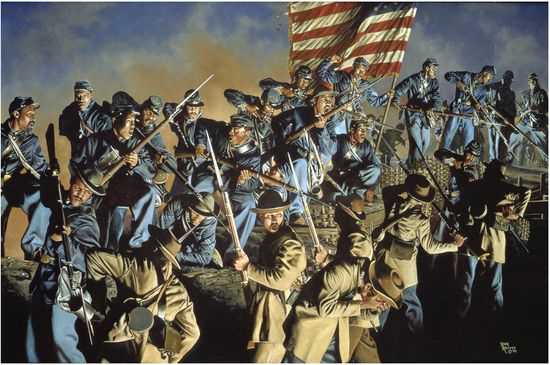
(Image of the 54th Massachusetts, the first black U.S. Army regiment, charging Fort Wagner from the "Heritage Painting" painting series. Via The National Guard.)

“How Far The Revolution Has Spread”

GT_SYRIAGREECE_111207

An anonymous dispatch from Syria touches on the mood in Damascus, the capital city:

[T]here is widespread feeling of amazement that the revolt has lasted this long – and that it continues—and touches so many. Older men chastise themselves for having silently put up with this regime for four decades until taught by their sons and daughters that enough was enough. "I’m embarassed," a middle-aged professional in Damascus confided. "We focussed on navigating our own lives and now our children are paying the price." One man told me he has not yet been to register his newly-born daughter with the authorities. "I am waiting for after—after—so I can call her Thawra, Arabic for revolution."

(Photo: Syrians living in Greece participate in a rally in central Athens to raise awareness of the situation in Syria on December 4, 2011. For almost nine months, Syria has been gripped by a crisis that now risks spiraling into all-out war. By Louisa Gouliamaki/AFP/Getty Images)

A February Surprise?

Rhodes Cook thinks that "another establishment Republican could enter the race in early February and still compete directly in states with at least 1,200 of the 2,282 or so GOP delegates." Bill Kristol salivates at the thought. Jonathan Tobin blows up his fantasy:

It’s fair to ask why if Paul Ryan or Marco Rubio or Mr. or Ms. Unknown chose not to run back in the summer when they could have entered every primary (the filing dates for many states has already passed), they would do so now? Let’s just say if they had really wanted to run, they already would have. … As crazy and unpredictable as this race has been, the idea of a Valentine’s Day surprise says more about the unfulfilled hopes of GOP activists for a better candidate with which to oppose President Obama than it does about the actual chances of another Republican getting into the race.

Healthcare On The Go

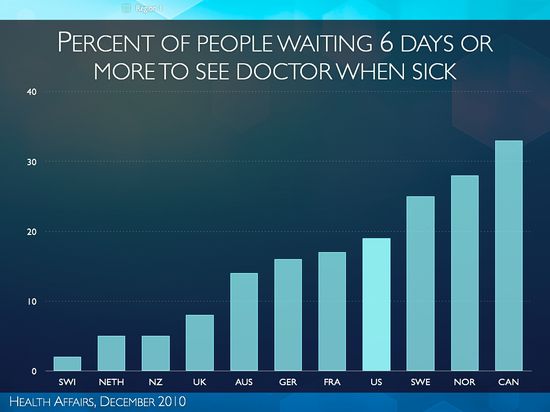
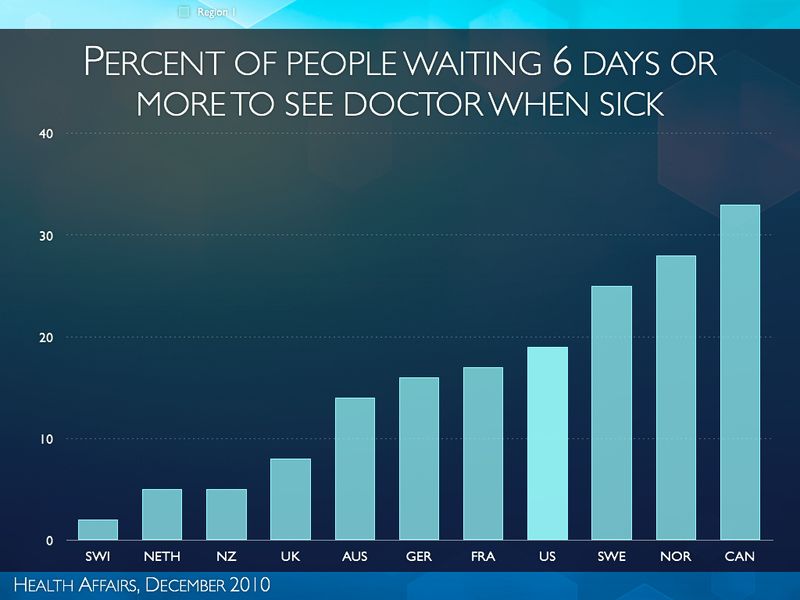
Waiting_To_See_Dr

Aaron Carroll defends Minute Clinics:

I don’t think retail clinics are good for everything. I think longitudinal care through a medical home is proper for primary care. But there are limits. There are times when you need to see a health care professional early in the morning, or later at night. Have you tried to get an appointment lately when you’re sick? It’s hard! That’s not all. You often have to wait a while

Why Pay For Channels You Don’t Watch? Ctd

A reader who worked at a consumer group writes:

As someone who spent about a year of my life on this issue, and many months buried in the FCC’s record, the former telecom attorney is right to an extent. ESPN watchers (about a third of the national cable audience) would probably be forced to pay around $30 for ESPN if it was only available on an a la carte basis. Some people see that as a reason why a la carte couldn’t work – that it was full of bugs. I saw it as a feature.

It puts the whole issue of exploding sports salaries and owners’ profits into the clearest possible view for consumers. Want to see voters vote down publicly financed stadiums? Remind them they’re paying $30 bucks a month to the team already (of course, that won’t be the price, as you will see as you read on).  It’s such a laughably high figure that they’d have to lower that price to attract subscribers – and in turn lower the prices they pay league owners, and in turn lower the astronomical salaries they pay athletes, which go hand in hand with huge ticket prices for games in publicly-financed arenas and stadiums. It would also reduce some of the obscene amounts of money paid to big college athletic programs in two sports – football and men’s basketball.

The LA Times has a story today noting how ESPN's programming costs have increased 50% in five years. Consumers are paying for it and have no way to discipline the market and reject the price increases  without dropping their entire cable package.

What no one has really said is that a la carte, or cable channel choice, or whatever, never had to be an all or nothing. DC’s telecom attorney industry did a great job of framing the issue that way, but they knew that it was a red herring. It was easier to defeat  it that way because of its perceived impact to minority and other niche channels. But some, even back in 2007, were willing to embrace a la carte because it would finally give them a tool to combat the programmers that the telecom attorney correctly identifies as the enemy of this choice. They're the ones who want to force you to pay for more channels.  

Cablevision, DISH Network, and smaller independent cable companies were fighting for the consumer’s interest — while TimeWarner Cable, Comcast, DirecTV and programmers of all kinds like Disney, Hollywood, sports leagues, etc. were strongly opposed. But now that TimeWarner Cable is independent of Warner Brothers and owns minimal programming properties, and now that DirecTV is free from Rupert’s holdings, you’re already seeing some new thinking by these companies. 

If you were to give cable operators the flexibility to offer programming and allow consumers more choices, I think you’d see some cable and satellite companies do some creative things – Pick 10 channels from this bucket for $5 bucks.  Pick 25 for $15.  Buy 10 from this bundle at $10. – Buy this bundle of sports channels that includes the NFL Network instead of making me pay a dollar a month you can watch the Scouting Combine in the summer. (As an example, check out Montreal’s cable company Videotron and don’t give me the line about Canada being a niche market – the point is it’s a proof of concept.)

Many (most?) would take the big package as it is today.  Some would buy individually.  But if cable operators had that freedom, you would certainly see consumers examining their options and many would take advantage of them.

Outside of the most expensive channels, most of them cost in the dime to quarter range.  Those dimes add up for the consumer – four different home improvement channels? – that the cable lineup looks a lot like drug companies in that when one programming format works, everyone else tries to copy it, resulting in more and more channels in the bundle. Except, in the drug market, competition can lower prices; in cable – without a consumer having the power to pick the winner and loser – competition for viewers results in a price increase to the consumer as each of the big programming conglomerates ties carriage of their weaker channels to carriage of their must-have programming.

And the secret to so many of these channels in upper-800-land on the lineup is that almost no one is watching.  Ratings are so low, they don’t publicize or qualify for Nielsen ratings; sometimes numbering in the thousands. How people argue that a network needs to survive – that it is critical to our entertainment or to our nation’s discourse with viewership in the thousands is beyond me.

What took me years to fully understand is why advertisers never caught on. Here they are buying millions of dollars of TV ads every year for clients on channels that people aren’t watching. There’s the old marketing adage – that only 50% of your marketing budget is actually effective, you just never know which half – well, here you have a chance to know who actually wants to see your client’s message, you can tell because people are choosing (or not choosing) those channels they want to get.

It de-clutters the dial so that your client’s message can break through! This should be what you and your clients want! Until it struck me that Madison Avenue has no interest in informing their clients that the cable emperor has no clothes – that their revenues are often a percentage of the client’s TV spend, and that it’s more important to get them to buy as much airtime on as many channels as possible – no matter how few people are actually receiving their message.  So even if Madison Avenue doesn’t want to hear this message, their clients, who are spending thousands on an ad that maybe a few thousand people will see, should.

One final thing, in the old days, cable operators were constrained by two things, limited channel capacity (a la carte was impossible in the analog cable days) and the economics of handing a consumer too high a bill. Channel capacity is now a non-issue (and digital boxes for cable and satellite make a la carte possible), and in the old days, operators would tell new independent programming companies (Quincy Jones’s New Urban TV comes to mind) that they wouldn’t offer customers a new channel serving that demographic because they already had a "black channel".  No matter that many African-Americans felt that BET didn’t serve them, one channel was all they would get. 

Fast forward, new African-American channels are on the lineup (like Centric, owned by BET; and TVOne owned by Comcast and DirecTV) that people claim wouldn’t survive if every customer wasn’t forced to get them – and there are only a small number of independent channels on the air in any significant distribution. First, because these niche channels are almost exclusively owned by the other conglomerates, they're getting preferential promotional value that would no doubt continue – and all channels would have an incentive to be as attractive (and low-priced) as possible.  One independent had a brilliant idea – offer your channel for free and you get included in every basic package.  After all, no better price discipline than free – and you’d get a lot more eyeballs among channel surfers being 1 channel among 100 than 1 among 800, which could increase the survivability of these channels.

Cable has time to figure this out, but it’s running short.  A programming market that serves consumers better serves cable better in the long run. Consumers are learning about internet streaming options but are (mostly) correctly judging it as too complicated. Right now, they’re not willing to leave cable for the complexities of streaming services and devices (no Hulu Plus on AppleTV, no E!’s The Soup anywhere other than iTunes/AppleTV, no way to get The A-List: Dallas except on their website) that no one has figured out how to merge in a user-friendly way.

Once someone figures this out – and they will – cable will be crushed. Cable (how most people get broadband) and telcos (the ones that sell TV and broadband over the same wire) both will have to make up lost TV revenue somehow.  These companies will have no choice but to force people to buy TV in order to get broadband and/or broadband prices will be even more onerous and objectionable than today. And when that happens, cable has just traded one headache for another.

Face Of The Day

135189167

A delegation of Tunisian Jews attend a ceremony at the Hall of Remembrance of the Yad Vashem Holocaust memorial in Jerusalem on December 7, 2011 to commemorate dozens of Jews killed by the Nazis during World War II. Deputy Israeli Prime Minister, Sylvan Shalom, called on Tunisian Jews to settle in Israel. By Menahem Kahana/AFP/Getty Images.

Containing China?

Joseph Nye explains Obama's pivot toward East Asia: 

American military forces do not aspire to "contain" China in Cold War fashion, but they can help to shape the environment in which future Chinese leaders make their choices. I stand by my testimony before the US Congress of 1995 in response to those who, even then, wanted a policy of containment rather than engagement: “Only China can contain China.” If China becomes a bully in the Asia-Pacific region, other countries will join the US to confront it. Indeed, that is why many of China’s neighbors have strengthened their ties with the US since 2008, when China’s foreign policy became more assertive. But the last thing the US wants is a Cold War II in Asia. Whatever the two sides’ competitive positions, Sino-American cooperation on issues like trade, financial stability, energy security, climate change, and pandemics will benefit both countries. The rest of the region stands to gain, too. The Obama administration’s pivot towards Asia signals recognition of the region’s great potential, not a clarion call for containment.

Related Dish coverage here

Should Colleges Be On The Hook For Student Loans? Ctd

A reader writes:

I agree with Glenn Reynolds on a number of points: college has become too expensive; this expense is burdensome when it no longer guarantees employment; college enrollment is too high; and the alternatives (like trade school) are undervalued and underfunded. But making colleges and universities bear some or all of the risk for the students' borrowing is not going to fix any of these problems. Reynold's plan would only result in the following:

– Admissions preference for the already-wealthy. Even if schools maintain a need-blind admissions process, reduced loan opportunities will still weed out poorer students

– Students who need loans will likely turn to private lenders, who offer loans with less forgiving terms. These loans place greater financial burden on students (and their parents) and simply displace the responsibility from schools back to individuals. 

– Schools don't become more "efficient" when budgets tighten. Instead, they will slash the auxiliary programs that can help students succeed in college and beyond (academic advising, mental health services, career services) and focus on that which brings in endowments and investments (sports, new buildings, etc.)

And colleges and universities aren't supposed to be job-placement agencies anyway. They're supposed to provide an education, an education which is still in demand by employers. That fewer graduates are getting those jobs isn't evidence that the education is devalued; it's evidence that there are fewer jobs and more candidates. 

If Reynolds thinks that students are graduating from university without possessing the traits he (and employers) value – self-discipline, delayed gratification, etc. – then he can push for higher accreditation standards and tie federal loan availability to those standards. If he simply thinks student loan debt is too high, we could restrict federal loans only to a certain dollar amount per year, or make them available only to schools whose tuition is below a certain amount.

None of these solutions is perfect, but they are less likely to turn universities into elite-only institutions. Though perhaps this is exactly what Reynolds wants.

Another reader takes the other side:

I love Glenn Reynold’s take on student debt.  That was my position this past Thanksgiving when I had to defend my support of OWS to my family members who opposed any sort of debt amnesty. I compared college education to motor vehicle Lemon Laws.  Say I purchased a four wheel drive pickup from Ford that promised 30 MPG and no maintenance for the first 50,000 miles and that oil changes were needed every 10,000 miles.  Now, let us say that the truck actually gets 20 MPG, needs maintenance almost immediately and actually requires oil changes every 2,000 miles.   I could sue Ford for breach of contract, fraud and on and on.

This brought up the questions, what exactly does a college education promise and who makes the promise.  I take the position that both society at large and colleges themselves have spend the last 30 or so years convincing the American public that unless you go to college, you are virtually worthless.  Become a plumber? Waiter? Fix cars for a living?  Having been born in 1982, I grew up in a society that looked down on those positions (never mind the fact that a master plumber, good mechanic or waiter at a high end restaurant can make a better living than some doctors or lawyers).  The momentum of society has always been towards higher education.  My generation, the Millennial Generation, has been indoctrinated to believe that if we don’t go to college we’ll all end up janitors and that that is a horrid fate.

And the colleges are quite happy to be complicit in the false notion that college is for everyone, that it's just about finding the right college.  They’ll take your money and let you get a degree in sociology (or as I call it, an excursion into the obvious). But once you get your degree, you are just a statistic, and another $200,000 towards some school’s endowment. 

Sadly, many schools have been caught fudging or out-and-out lying about their employment statistics, both in terms of percentage employed as well as starting and medial salaries.  If they were selling any other product it would be fraud.  But because education is amorphous and because tomorrow is promised to no one, we let them sell snake oil.  They promised education as a cure all to society’s ills, but instead it is stagnating the economy’s growth because so many young adults are saddled with so much debt.

The colleges should absolutely be the ones to pay back loans when students default through no fault of their own.  If they are willing to print a degree that says this person is competent and qualified to be a productive member of the college educated work force, they stand behind that promise.  Instead we apologize for them and say, the school did all they could … it must be the student’s fault.