Our Foreclosure Crisis

George Packer refocuses on it:

We should be long past the point of assigning blame, or worrying about creating moral hazard, let alone rewarding "losers." Foreclosure is a national tragedy and a relentless drag on economic growth. Jobs can’t be created until demand increases, and demand won’t increase until consumers get out of debt, and housing is the biggest obstacle. If we had healthy institutions, the White House, both parties in Congress, the leaders of the biggest banks, and consumer groups would have sat down together and worked out a solution that keeps millions of people in their homes without wiping their debts completely clean. But we don’t, and so the history of the past few years has been written by Rick Santelli and Occupy Wall Street.

Can Plants Think? Ctd

A reader writes:

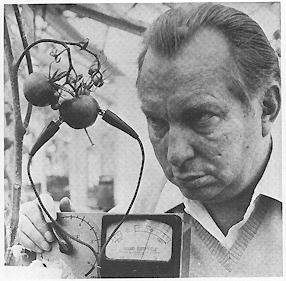
Almost surprised you Tomatomost hilarious photo of L. Ron Hubbard anywhere. Context here:

Hubbard's experiments soon came to the attention of Garden News, to which publication he revealed, gardener to gardener, his conviction that plants felt pain. He demonstrated by connecting an E-meter to a geranium with crocodile clips, tearing off its leaves and showing how the needle of the E-meter oscillated as he did so. The Garden News correspondent was enormously excited and wrote a story under the sensational headline 'PLANTS DO WORRY AND FEEL PAIN', describing Hubbard as a 'revolutionary horticultural scientist'.

It was not long before television and Fleet Street reporters were beating a path to Saint Hill Manor demanding to interview Hubbard about his novel theories. Always pleased to help the gentlemen of the press, he was memorably photographed looking compassionately at a tomato jabbed by probes attached to an E-meter – a picture that eventually found its way into Newsweek magazine, causing a good deal of harmless merriment at his expense. Alan Whicker, a well-known British television interviewer, did his best to make Hubbard look like a crank, but Hubbard contrived to come across as a rather likeable and confident personality. When Whicker moved in for the kill, sarcastically inquiring if rose pruning should be stopped lest it caused pain and anxiety, Hubbard neatly side-stopped the question and drew a parallel with an essential life-preserving medical operation on a human being. He might have whacky ideas, Whicker discovered, but he was certainly no fool.

Another reader:

In my view, plants do not have minds.  They are not intelligent.  That's not to say that they aren't absolutely amazing.  I studied them professionally for 15 years (PhD Harvard 2002), and I used think seriously and publish on exactly the sort of things Alva Noë seems pre-occupied with.  But "expressive of intelligence and mind?"  How much more anthropomorphic can you get?

Another links to YouTube:

Reminds me of the research on plants' feelings and empathy by Cleve Baxster.  Hell, Spock seems to agree.

How Liberals Enable Big Corporations, Ctd

A reader quotes Jason Brennan:

When you create complicated tax codes, complicated regulatory regimes, and complicated licensing rules, these regulations naturally select for larger and larger corporations. We told you that would happen. Of course, these increasingly large corporations then capture these rules, codes, and regulations to disadvantage their competitors and exploit the rest of us.

Yeah, that makes sense, because back in the day Standard Oil, US Steel, Southern Pacific Railroad, and J.P. Morgan were tiny companies that had no political influence and allowed free and open competition to flourish.

Another is more straightforward:

Mr. Brennan's open letter to the moderate left is an example of why libertarians are often referred to as "glibertarians."

Mr. Brennan's argument is that the moderate left caused today's "run-away corporatism" and "crony capitalism," in a process known to public choice economists as "regulatory capture". The idea is that state regulatory agencies are often "captured" by the industries they are formed to regulate, because the industries have a strong economic interest in controlling their own regulation. In such event, the argument goes, government regulation is worse than no regulation at all, because now the industry-controlled regulatory process has the force of law.

Mr. Brennan's innovation is to conclude that not only are regulatory agencies susceptible to capture by large corporations, but regulatory agencies actually create large corporations, because large corporations have a competitive advantage over smaller corporations when it comes to exploiting government regulation.

Mr. Brennan falsely claims that his conclusion is required by public choice economics. Although public choice economics has identified the regulatory capture problem, nothing about public choice economics requires the conclusion that the only alternative to regulatory capture (which public choice economics would consider a government failure) is no regulation at all.

Mr. Brennan's argument is also deeply ahistorical. For example, the Interstate Commerce Commission, which was formed in 1887 to regulate the railroads run by "robber barons", was (as Milton Friedman argued) soon captured by the very railroads that it was formed to regulate. However, it would be absurd to argue that the ICC created the robber barons.

In the end, Mr. Brennan's argument is just an expression of his libertarian bias, and does not follow from any serious modern theory of economics.

The Daily Wrap

GT_OBAMASPEECH_111207
Today on the Dish, Ron Paul threatened to weaken Ailes in Iowa, the Trump debate saga dragged on, and the Mormon factor lingered. Gingrich is the candidate of Republican outsiders (and Fox News), the GOP establishment did its best, and Newt cannot guarantee the Hispanic vote.  

Collaborative power spurred on the Arab spring, an Arab winter loomed, and Russia's democracy movement escalated. The killing in Syria continued, Andrew clarified his stance on Iran, and in our AAA video, he discussed US policy towards Cuba. Arab monarchies endured, drones may fight drones in the future, and Europe faced a choice between democracy and utopianism. 

We learned more about sexual objectification, reflected on the changing face of Superman, and spotlighted the shadow economy. A poised Iowan made the case for marriage equality, knights experienced PTSD, and sports fans flocked to gay sports bars. The brains of abused children resemble the brains of soldiers, doctors die gently, and sometimes nothing works. We contemplated the future of the local news, entertained an expanded definition of acting, and wondered about the minds of plants. Some pit bulls were bred to be extremely aggressive, on some level procreation is about survival, and climate change is accelerating. The movie quote is dead, and the cheeseburger is a modern miracle.

The practice of flip-flopping explained here, Malkin award nominee here, tweets of the day here and here, quote for the day here, MHB here, FOTD here, VFYW here, VFYW contest winner #79 here, and VFYW globe here

M.A. 

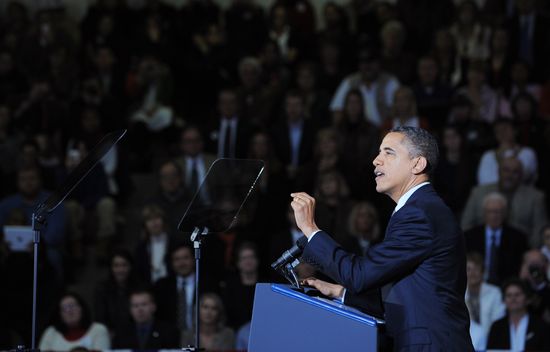
(Photo: President Barack Obama speaks about the economy at Osawatomie High School December 6, 2011 in Osawatomie, Kansas. Obama described the middle class struggles as the defining issue of our time in the speech. Photo by Julie Denesha/Getty Images.)
The Hispanic Vote Can’t Save Gingrich

Douthat dissects a talking point:

George W. Bush won a larger-than-average share of the Hispanic vote because he campaigned as a center-right figure in general, not because of his particular focus on amnesty for illegal immigrants. John McCain won a smaller-than-average share because the Republican brand was tarnished in 2008 in general, not because the failure of comprehensive immigration reform had poisoned the well with Hispanic voters. And in 2012, there’s no reason to think that a more polarizing candidate like Gingrich will be able to compensate for turning off swing voters by cleaning up among Hispanics: If he can’t win white independents and white conservative Democrats, he probably won’t be able to win Latino independents either.

A Moscow Spring?

GT_RUSSIAPOLICE_111206

Julia Ioffe thinks Putin may have sparked a renewed democracy movement by arresting Alexey Navalny, a key opposition leader, during anti-election fraud demonstrations. Jay Ulfelder wonders if Russians can capitalize on the momentum:

[M]y best guess is that Russia now is about where Egypt was in 2005. In national elections held that year, hopes were raised and then dashed that the Mubarak regime was ready to open the door a crack to real political competition. Led by the Kifaya movement, anti-government demonstrations remained modest in size but, for a time, became widespread. The regime soon quashed Kifaya, but the stirrings of popular activism helped to put the country on a trajectory toward the successful uprising of 2011.

I wouldn’t be surprised to see Russia follow a similar "sedimentary" path in which experiences, emotions, and organizations that arise from today’s protests and their repression lay a foundation for the popular challenge that will eventually but inevitably bring Putinism’s reign to an end.

Amy Knight reviews a new movie that she thinks sheds light on reasons behind popular anti-Putin sentiment.

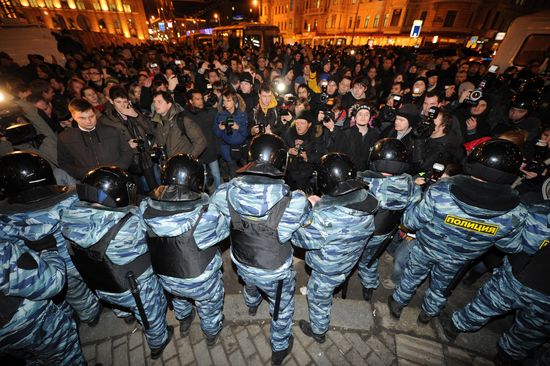
(Photo: Riot police cordon off on Triumfalnaya Square in central Moscow during an unauthorized rally late on December 6, 2011. Opposition leaders defied the Russian authorities today by organizing a second mass protest in two days against Vladimir Putin's 12-year rule, despite warnings of a police crackdown and the jailing of one of the organizers and some 250 protestors. By Kirill Kudryavtsev/AFP/Getty Images.)

How Do We Replace Local News?

Clay Shirky wrestles with how to best support reporters after the decline of newspapers. Alexis Madrigal reframes the debate:

To me, the real challenge for the future of news is *not* finding ways to support relatively tiny numbers of reporters to cover state legislatures and school board meetings. The problem seems to be in building an amplification apparatus that will reach a substantial percentage of the people in a given geography. There are some signs that this can be accomplished via a social news mechanism. Redditors, in particular, are getting good at pushing particular stories to popularity, like the video of a Texas judge hitting his daughter.

But social news efforts often draw on a national audience that's actually quite small in a given jurisdiction. 

The Shadow Economy

The man who sells candy on the D train is part of it:

Maurizio Bovi takes an in-depth look at unofficial commerce:

Traditionally, the presence of tax evasion has been associated with tax rates. But recently some authors (Johnson et al 1997 and Friedman et al 2000) have suggested that the shadow economy, taxation, and the institutional setting should be considered all together because they may be related in a very peculiar way. By inserting the institutional framework into the traditional analysis, they emphasise that the integrity and efficiency of the public sector is connected with the shadow economy because a more honest and proficient bureaucracy increases the probability of catching tax dodgers.

Other things being equal, this lowers the optimal size of the shadow economy. Furthermore, bad governments offer few and low-quality public services, a fact that may make people less willing to pay for public services and/or may give rise to alternative, irregular service networks. Finally, intrusive regulations are costly and another extra-taxation factor potentially stimulating firms to choose the ‘quit option’ (ie the decision to go underground). In sum, the presence of inept bureaucracy may be strongly associated with the shadow economy.

Face Of The Day

135098418

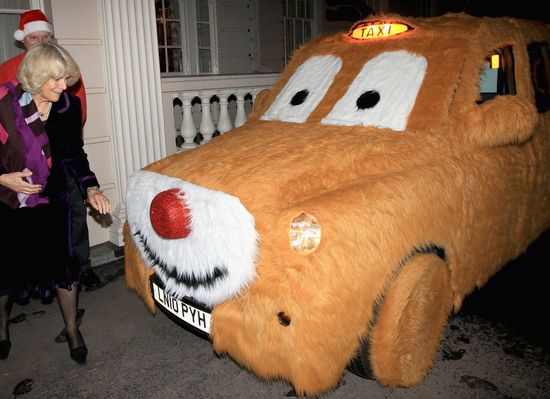
Camilla, Duchess of Cornwall, admires a taxi designed by driver Stephen Bell after they helped children from the Helen and Douglas House and London Taxi Driver's Fund for Underpriviledged Children decorate a Christmas tree in Clarence House on December 6, 2011 in London, England. By Chris Jackson WPA-Pool/Getty Images.

Update from a reader:

No reference to Dumb and Dumber and their dog car? Stephen Bell is a copy-cat.

In Defense Of Doing Nothing

Peter Bregman tries to check a basic human impulse:

In some situations, doing nothing – forever – is the right response. With my tendonitis, doing nothing helped. Sometimes, not trying to fix something is precisely what's needed to fix it. It's a hard strategy to follow because we have penchant for being proactive. If there's a problem, we feel better when we attack it aggressively. But consider the idea that we might spend a lot of time, effort, and money solving problems that can't, in fact, be solved with time, effort, and money.