A reader writes:
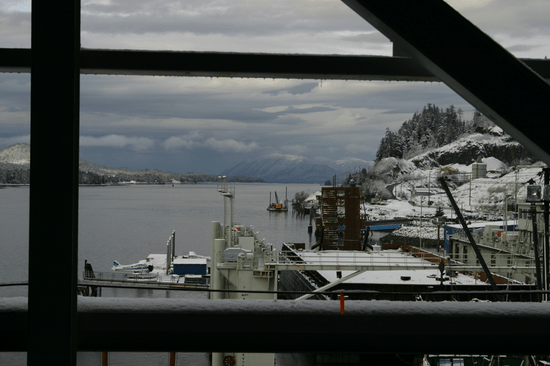
Grrrr! So many clues, but I could only go so far with them. The gray tower in the foreground with the depth markers reaching up to "45FT" indicated fresh water, a large hydro-engineering project (canal and/or lock?), as well as a location in Great Britain or the US. The mountain in the background and the snow and evergreen trees along the coastline indicated a northern climate. Thinking the Caledonian Canal through Scotland might match up well, I googled pics and found some topography similar to this view on the northwest coastline of Loch Lochy. This view is on the east coastline looking north/northwest. But that's as far as I could go.
Another writes:
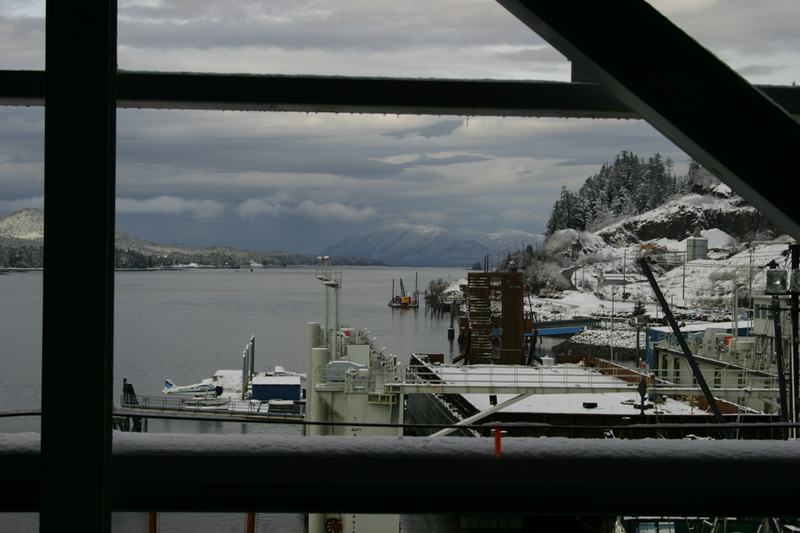
The picture mostly provides geographical clues, rather than cultural ones. I can see a single engine Beaver airplane – made in Canada – and the fjord looks like the long narrow inlet that Port Alberni is at the end of. Are these pictures supposed to be taken recently? I think it would be unusual to have snow here in early December, but not impossible.
They are usually taken recently, but not always. This photo was captured at 1.30 pm on November 17, 2011. Another reader:
St Barbe Ferry, Newfoundland, Canada? A guess from my self-described "sick and miserable" mother stuck at home in bed on a sunny Australian day. Specifically the ferry from St Barbe to Blanc Sablon, at the St Barbe ferry ramp. I'm glad my mother could provide you with this guess. The only way I'd get any of these "Name That Port" challenges is if the port in question came from the Douro Valley in Portugal.
Another:
Beautiful spot this week. My first impression was Nova Scotia or thereabouts, until I saw the "45FT", which takes metric Canada out of the running. Unless there's some international standard for those tanks. So I went south a bit, picked a small coastal town in Maine, hope it's within a hundred miles, call it a day. Hope it's not in Alaska.
Another:
The location screams Southeast Alaska, plus we got snow in the region two weeks ago (though the weather has since turned to rain and the photo would be less beautiful today). I thought that it looked like the Ketchikan area, so I started checking around for places where there was a dock that you could land a seaplane and the terrain matched. Past the community of Clover Pass is a little bay with a marina called Knudson Cove (latitude 55.473258, -131.795402). I checked the terrain on Google Earth it matches pretty well, so that's my answer.
If that's correct, then I'll have plenty of company as I've been impressed how your readers can find a specific window on a hut in Africa. I can only get the Alaska ones.
Another:
Oh man, I think I know this one! I took a glacier cruise on Prince William Sound back in aught six, and this looks exactly like the town that the cruise departed from. I don't have the chops to find the exact window, but it's got to be Seward, Alaska.
Another:
Prudhoe Bay, Alaska? Just a quick off-the-cuff guess. But man, do the mountains back in that photo make me miss living out west. It's a big world.
Another nails the right town:
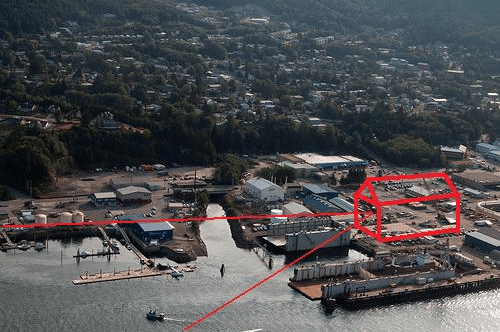
Finally a VFYW I know. I work for the forest service in southeast Alaska, so I'm in and out of Ketchikan on a regular basis. This is Tongass narrows looking to the north. What you are seeing is the Ketchikan waterfront (revilla Island) north of downtown on the right. On the left is the island where the airport is. The picture was taken from the new Ketchikan shipyards ship assembly facility. You should do the southeast Alaska tour on a cruise ship soon.
Another reader:
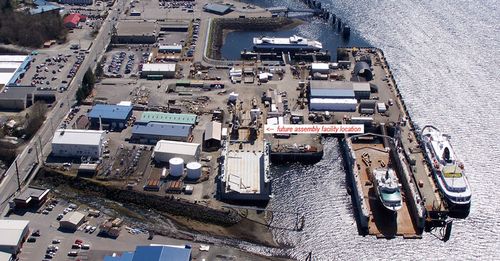
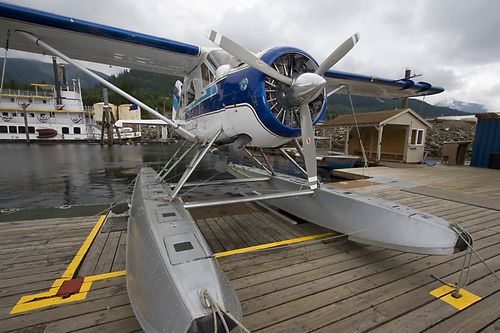
The combination of snow, mountains, and water suggested Alaska – as did the seaplane. A quick search of Alaskan seaplanes turned up an aircraft with similar blue markings. This turned out to be the livery of Taquan Air operating out of Ketchikan. From there, I looked up the location of the seaplane base, and found it to be right next to the Ketchikan Shipyard. Judging from the position of the drydock in the foreground of the photo, I figured that the photographer was somewhere on the grounds of the Alaska Ship and Drydock company, which operates the shipyard on behalf of the Alaska Industrial Development and Export Authority (AIDEA).
Another:
What gave this VFYW away were the two Taquan Air seaplanes on the left side. Taquan Air is a Ketchikan-based local carrier serving communities in the Southern part of the Alaska Panhandle. After scouring row after row of seaplane photo on Google, I finally stumbled upon one plane with the same tail marks. I now know the docks of every destination served by Taquan Air.
Another zooms in:
Another:
I'll bet the webmaster at Taquan Air Services in Ketchikan is wondering where all the hits came from.
Another:
I've only been to Ketchikan twice. Once when I was born and then some 50 years later. The first time I was there just a few days while the weather cleared enough for my mom to take me back to Annette Island after giving birth to me. The most recent trip was part of a birthday present I gave my mom when she turned 80. She lives in Bellingham and I flew down from Anchorage to meet her and take the Alaska State Ferry Matanuska up through the inside passage to Juneau and then Sitka. My dad worked for the FAA back then and we hopped around the state a fair amount. Annette Island was one station and the other was out of Sitka. As dawn broke, the ferry arrived in Ketchikan and it had been the first time I'd been back to the area since the mid '50s.
Another:
My wife and I flew a little Piper Seminole from San Francisco to Ketchikan (and back) two years ago, with many stops on the way. It was a gorgeous trip.  The Canadian customs folks were so relaxed and friendly, and their US equivalent so tight and brusque, it made us wonder. People in British Columbia are unbelievably nice.
When we took the ferry from the Ketchikan airport, which is on the left in the photo, on Gravina island, we commented to each other that it would really make sense to have a bridge here. We realized later on that this would be the infamous Bridge to Nowhere, which actually is not all that ridiculous (although $400M may be a bit steep) when you're in context. Like everyone else, I had made fun of this seemingly absurd idea of a bridge to an almost uninhabited island. This taught me that I should be careful before judging something like this. The bridge would probably handle 500,000 crossings/year to start with, and would allow Ketchikan to expand into Gravina island, which would lead to even more traffic.
It's always more complicated than you think, isn't it?
Another sent the above photo and writes:
The ferry that the bridge was slated to replace (from Ketchikan over to the airport on Gravina Island) is just barely in view. Aside from the obvious fiscal concerns with building a $398m bridge for a town of about 7,000, I always like riding the ferry to catch your plane. It’s not like driving to the other side would save a bunch of time or be much more convenient – the ferry takes under 5 minutes and goes every 15, so it is not hard to match the infrequent flights. The informality of the entire process is also what makes Alaska "different."
Another:
I had to ask what made Ketchikan the location this week. Here's my long-shot guess. Herman Cain announces the suspension of his campaign. Which, when you think about it, is a very Sarah Palin-like move. He quits without really quitting so he can remain relevant without taking the daily hits of campaigning and get back to his book tour. And, of course, when Palin first broke onto the national scene she bragged about saying no to funding for the famous "Bridge to Nowhere" which was located in Ketchikan. And a "Bridge to Nowhere" has always perfectly described Mr. Cain's campaign.
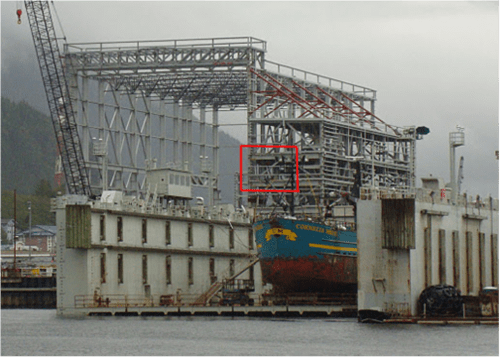
Another sends a visual guess:
Another:
There is a lot of federal money in this picture. That drydock, for instance – built at least in part with a federal grant to the Borough of Ketchikan (washed through the State? I can't remember…) of Department of Transportation Intermodal Surface Transportation Efficiency Act (Ice-Tea) money. Federal gas taxes, mostly from the Lower 48, paid for a drydock in Alaska that is leased to a private enterprise. The logic is that it supports the Alaska Marine Highway (ferries), and indeed the first vessel built in the facility was a rather unique craft serving as a ferry for a remote Southeast Alaska borough. The ferry, not visible, was built with funds from the Office of Naval Research (ONR).
The rugged, independent, Republicans of Alaska, with their emphasis on Personnel Responsibility, make me laugh. While it's a hard life in Alaska, no doubt, they are awash in subsidies of various kinds.
By the way, I think it's a stretch to call this view "from your window," as there is NO window present yet. The fact that Google Maps doesn't show this hall makes this one tricky, and unless you live in Ketchikan or are deeply involved in the marine trades (I am) you would not know about the assembly hall.
Another:
A cost/benefit analysis of proposed improvements to the Alaska Ship and Drydock Co. was done in 2009. This study states: "Once the shipyard improvement plan is fully implemented, shipbuilding and repair activity in Ketchikan will directly or indirectly account for 1,110 jobs throughout the U.S. These jobs will account for just under $50 million in annual payroll." Way to go, Alaska Ship and Drydock!
More than 50 readers correctly guessed Ketchikan, so we had to determine the one among them who has gotten the closest to victory in previous contests without clinching the prize. The winning entry, in visual form:
(Archive)


 The Dish