Will The GOP Establishment Veto Newt?

Chait is unconvinced:

Jonathan Bernstein has made the most confident version of this argument, though others have echoed it as well. Bernstein argues that Republicans understand how erratic and ineffective Gingrich is, and won’t let him get the nomination. I see a couple flaws in this assumption. First, insiders can’t always get their way. The party elite knew full well in 2010 that nominating candidates like Joe Miller in Alaska, Sharron Angle in Nevada, and Christine O’Donnell in Delaware was suicidal. They just couldn’t sway the voters not to nominate them in primaries. And presidential nominations are just a series of primaries. 

Nate Silver makes an important observation along these lines:

Republicans are sometimes thought of as the party of the establishment. But the party’s leadership has spent much of the last three decades cultivating distrust among its rank and file about the legitimacy of these institutions, particularly the government and the news media. This may have contributed to the party’s electoral successes. But it’s also possible that Republican elites have neutered their ability to influence how voters decide on a candidate. If so, they may end up with Mr. Gingrich rather than Mr. Romney.

Did Memes Kill The Movie Quote?

Clay Risen entertains the idea:

There was a time, not long ago, when every college male could be expected to have the same 20 or 30 videos in his dorm room (Godfather I and II, Swingers, Pulp Fiction); with the rise of online libraries and file sharing, who wants to watch the same old movie again and again? Who wants to even watch a movie at all, when YouTube clips, online TV, and multiplayer online games are equally entertaining? Of course, they’re not equally as rich in dialogue, and even if they were, they’re not equally shared by mainstream culture. Cue the gong: The movie quote is dead. …

It’s comforting to wax nostalgic for a day when everyone seemed on the same page, culturally, and seemed to stay there for months, even years, on end. Nowadays, a cultural meme is here and gone, gaining hold for a few moments, like a tenacious snowflake stuck, for a few seconds, on the window of a speeding jetliner.

(Video: The TV version of "these motherfucking snakes on this motherfucking plane" – a catchphrase that was originally "a cynical late addition, filmed and spliced into the film after an Internet parody suggested it.")

How Do Doctors Die?

Ken Murray investigates:

It’s not a frequent topic of discussion, but doctors die, too. And they don’t die like the rest of us. What’s unusual about them is not how much treatment they get compared to most Americans, but how little. For all the time they spend fending off the deaths of others, they tend to be fairly serene when faced with death themselves. They know exactly what is going to happen, they know the choices, and they generally have access to any sort of medical care they could want. But they go gently.

“Power With” vs “Power Over”

Screen-shot-2011-11-27-at-9.28.32-PM1

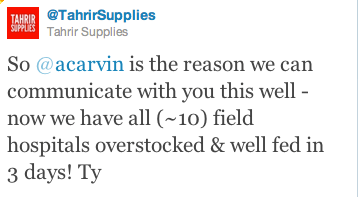
Alix Dunn spotlights Andy Carvin, the NPR social media guru who has served as an international clearinghouse for the Arab Spring:

As Carvin’s Twitter feed demonstrates, becoming an influencer on Twitter clearly makes it possible to broadcast information to large numbers, which, when coupled with smart tagging and grouping of needs and resources can also directly affect events on the ground. This week, despite all of the misinformation surrounding recent clashes in Cairo, Carvin’s attention to the @TahrirSupplies feed has made it possible for him steer information about needs and resources using his network of trusted Tweeps.

Anne-Marie Slaughter thinks people like Carvin are the harbingers of a new sort of power in world politics:

One familiar distinction is "power with" versus "power over." The power that interests [Joseph] Nye is the power that a person, group, or institution exercises over other people, groups, or institutions, getting them to do something they would not have done on their own. "Power with," on the other hand, is the power of multiple actors to get something done collaboratively. (I first heard this distinction from Harvard Law Professor Lani Guinier, but have since seen it in many places.) That certainly seems to capture the phenomenon we are witnessing in so many different places — the networked, horizontal surge and sustained application of collective will and resources.  I will call it collaborative power and define it as the power of many to do together what no one can do alone. Consider the power of water. Each drop is harmless; enough drops together create a tsunami that can level a landscape.

Moderate In Relation To What?

Razib Khan compares Islamists:

The Muslim Brotherhood is moderate in an Egyptian framework. But it is not moderate in, for example, a Tunisian context, let along a Turkish one. Egyptian American journalist Mona Eltahaway has pointed out that while the Tunisian Islamist party, Ennahda, has women in substantive positions (e.g., 42 or 46 women in the Tunisian legislature are members of Ennahda) the Muslim Brotherhood gives women only token representation, with no leadership role.

And, as I have observed before the Islamist prime minister of Turkey, Recep Tayyip Erdogan, was greeted with great anger by North African Islamists when he proposed the shocking idea (to them) that all religions be treated equally. My point is that what is moderate in Egypt is going to be very reactionary in North Africa, and what is moderate in North Africa is going to be very reactionary in Turkey. In fact, what is moderate in Turkey is going to be  very reactionary in the West. To a great extent, this common sense, but for some reason this sense is lacking from our broader discussion on these issues.

Why Do Pit Bulls Get A Bad Rap? Ctd

563304745_0ef56215de_b

Several readers counter the innocent portrayal put forth by Bronwen Dickey:

I work at a large trauma hospital in an inner city, in pediatrics. I can't tell you how many awful pit bull bites I've seen. The problem is that they have really strong jaws, and they bite down and don't let go. Many times it's been the family dog that's done the biting, out of the blue. I had no preconceived prejudice against these dogs, but I've just seen too many shredded kids. 

Another shares a similar perspective:

My wife is a surgeon in a major metropolitan area who regularly repairs facial trauma suffered by victims of attacks by dogs. 

Our city has a lot of dogs.  I'm sure a huge number of different breeds are represented, although I don't know their statistical distribution.  However, the kids/adults who need their faces put back together are almost exclusively pit bull attacks.  I can't even remember the last time that another breed was involved in an attack that made its way to my wife's operating room. 

Additionally, the dogs involved are usually the family pet (who everyone insists is very loving and never has done this kind of thing before), not some abused guard dog.  A recurring example is when a kid's friend is over playing, and they horse around or wrestle with one of the kids the dog is bonded to … and the dog flips out and attacks the friend to protect its master. .

Another:

Why do they get a "bad rap?"  First and foremost is the fact that a Pit Bull is physically capable of doing more damage than most other dog breeds.  You might be able to make a Yorkie as vicious as a Pit Bull by using the same methods, but little holes in your pants cuff don't compare to have large pieces of flesh torn from your body. Pit Bulls are bred to have unusually powerful jaws and a low center of gravity that makes them extremely formidable.  This makes them potentially dangerous, even if well trained and of good temperament.  All it takes is one misunderstanding like a tickle fight between a family member and a friend and the dog is capable of a disastrous response in a matter of seconds.

Another:

Defenders of pit bulls can be just as self-delusional as are people who want to demonize every single dog of the breed.  Unfortunately some pit bulls are descended from many generations that were bred to be extremely aggressive, and those traits won't disappear just because the pups are raised in a loving and benign environment.  I had a border collie bitch who was knocked up by the dog next door, which turned out to be a fighter pit owned by a man who was deeply involved in the ruthless illegal fighting circuit.  I kept one of the resulting pups, naively believing that generations of focused breeding specifically for the purpose of killing dogs in the ring could be nullified by cuddles and squeaky toys. 

By the age of three months, that pup had completely dominated her sweet but passive mother, and by the age of six months, when she'd turned on me several times to establish her alpha status, I realized that I had a dangerous problem on my hands that was way beyond my ability to cope.  I copped out by passing her onto someone else, and there's always been a worry in the back of my mind whether any of those eight half-pit/half-border collies or their descendants ended up viciously harming someone's child.

The above photo was captured by Flickr user This Year's Love. To be fair, the caption reads:

Judah and Israel have a bad habit of fighting right outside of my bedroom door because I'm ignoring them/on the computer. And I don't mean fighting like going-for-the-jugular, I mean wrestling and making snarly faces like this. Literally the "fight" just looks like one, it isn't actually one. They snap at each other's faces, then two seconds later they're licking each other and practically making out.

Medieval PTSD

New research sharpens our understanding of violence in the Middle Ages: 

"Modern military psychology enables us to read medieval texts in a new way – giving us insight into the perception of violence in the Middle Ages in the general population and the use of lethal violence by knights," says Thomas Heebøll-Holm of the SAXO Institute at the University of Copenhagen, who researches the perception of violence in the late Middle Ages. … 

[Heebøll-Holm] came across a book written by a knight who lived in the first half of the 14th century. "His name was Geoffroi de Charny, and he was one of the most respected knights of his age. The book, about the life of a knight, included the psychological consequences of being a knight – and they strongly resemble the symptoms of PTSD." In his book, de Charny advises knights on how to relate to the fact that they must kill people when they are at war. He also mentions some of the hardships knights face: poor sleep, hunger, and a feeling that even nature is going against them.

Extreme Makeover: Superman Edition

Screen shot 2011-12-01 at 6.05.19 PM

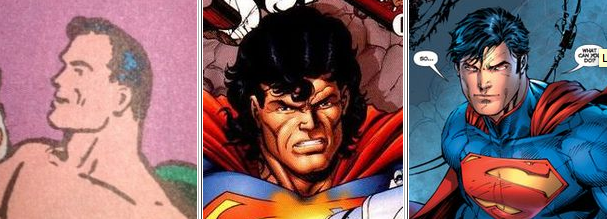
Glen Weldon tracks the hero's look over the past seven decades:

Over the years Superman has been our scrappy big brother, our concerned father, our compassionate uncle and, for an unfortunate stretch of time deep in the bowels of the benighted 90s, our mulleted hillbilly cousin. And the artists who've drawn him have continually iterated the character to suit to the time, and the role he plays in it. … The image that tops this post [on the right], by artist Jim Lee, was the reader's first look at the Man of Steel that, the company believes, is ideally suited to our modern age. He's younger, angrier and more introspective, we are told.

(Images by Joe Shuster; Tom Grummett; and Jim Lee of DC Comics)

Do We See People As Objects?

A new study (pdf) attempts to better understand sexual objectification. The conclusion:

[P]eople seen as bodies are not seen as mindless objects but, instead, as experiencers: someone more capable of pain, pleasure, desire, sensation, and emotion but lacking in agency. In other words, focusing on the body does not lead to de-mentalization but to a redistribution of mind.

Jonah Lehrer unpacks this:

If you’re a female applying for a job, the sexist tendency of men to focus on the body will unfairly diminish perceptions of agency and intelligence; you will be punished for having breasts. Although the woman won’t be literally objectified, the redistribution of mind will still make her much less likely to be hired.

The Daily Wrap

GT_GINGRICHTRUMP_111205
Today on the Dish, Romney experienced significant downturns in the four states that will vote next month, he fended off the mainstream media, and the GOP electorate exchanged anti-intellectualism for faux intellectualism. Newt is not a general election candidate, Pelosi hinted at even more Gingrich baggage, and Romney's campaign embraced a postmodern approach to truth. Gingrich's candidacy preyed on cultural nostalgia, his record on civil liberties is atrocious, but he did stand up for online indecency in 1996. More in the conservative media pivoted to Huntsman, Friedersdorf pleaded with the Republican base, and Douthat speculated wildly about a Palin endorsement. Ginger White described boring sex with Cain, Rove scoffed at the Trump debate (as did Huntsman), Fox News defied the GOP, and liberals stuck with Obama. In our AAA video, Andrew addressed his history with women. 

The war against Iran got less covert, the US gave Israel some tough love, and the peace process came to a well-orchestrated halt. We reflected on the deadliest month yet in Syria's possible civil war, Libya pushed for a massive bioengineering project in the Sahara, and Russia rebuked Putin. Merkozy called for a new EU Treaty, Ezra Klein issued a dispatch from Germany, and Belgium's soon-to-be prime minister is gay

We checked in on racial and ethnic integration, tracked the artificial ripening of bananas, and debated density and space. Jason Brennan blamed corporatism on the left, American plutocrats are ultimately invested in the US, and history contradicted the Laffer Curve. Jaswinder Bolina discussed race and poetic voice, female readers weighed in on the locker-room nudity question, and the DEA employed terror tactics. Brooklyn epitomized the "hourglass economy," the laff box may help, and dogs are East Asian. Pit bulls suffer from a tragic feedback loop, and teen promiscuity may make sex safer.

MHB here, FOTD here, VFYW here, and Andrew's race and intelligence wrap here

M.A. 

(Photo: Republican presidential candidate and former Speaker of the House Newt Gingrich speaks to the media as Donald Trump listens at Trump Tower following a meeting between the two on December 5, 2011 in New York City. Photo by Spencer Platt/Getty Images.)