Have We Hit Peak Lawyer? Ctd

Some need to moonlight as rappers, apparently:

A reader writes:

About the decline of "law" as an industry: I'd guess that the advent of computer technologies hit law offices harder than most.  In college I worked at a law firm that handled paper-intensive asbestos litigation.  The firm of 60 attorneys employed over 150 paralegals and file clerks, most of whom simply handled the daily deluge of paperwork.  Now it's all digitized and they employ a quarter of the support personnel they used to. That says nothing of the weekly transatlantic flights 10-15 people had to make in order to meet with the Lloyds folks before videoconferencing.  I'm not surprised they're not throwing around the same amount of money as before.

I agree with everything Campos says about the industry and am SO thankful I didn't take the job they offered me after college or go to law school.  Still, I wonder how strictly Campos defines "Legal Services?"  Does it include only people who pass the bar and/or work at law firms?  I'd bet if he included all those legislators, lobbyists, and executives who hold a JD but don't practice, we'd get a number a bit higher than 1.3% – and certainly that particular triad influences a lot of money.

Another reader reinforces the first point:

As a lawyer, my job is to get ideas articulated and exchanged as quickly as possible.  I started work as a law student in 1960.  With fax and copy machines, then computer and Internet, including e-mail, I can accomplish in hours what may have taken weeks. Of course it represents a lesser proportion of GDP.

Update from a reader:

Regardless of whether we've hit peak lawyer, there is at least one lawyer who has a legitimate rap career.  David Kelly, an associate in the corporate department at a big Chicago law firm, is also the artist known as Capital D.  Here's a CBS news profile on Cap D.  Chicago Tribune music critic Greg Kot describes him as "criminally" under-rated on the national scene and declared Cap D's album PolyMath the best local indie record of 2010.
The Politics Of Police Overkill

Radley Balko explains why SWAT team deployment has skyrocketed. A major factor:

The amount of force the government uses to uphold a given law is no longer determined only by the threat to public safety posed by the suspect. Now, it appears to give an indication of how serious the government is about the law being enforced.

The DEA sends SWAT teams barreling into the offices of doctors accused of over-prescribing painkillers not because the doctors pose any real threat of violence, but because prescription drug abuse is a hot issue right now. The feds sent SWAT teams into marijuana dispensaries not because medicinal pot merchants are inherently dangerous people, but because officials believe the dispensaries are openly defying federal law. It is, to put it bluntly, a terror tactic. Sending a couple cops with a clipboard to hand out fines and shut down a dispensary doesn't convey a strong message. Sending a bunch of cops dressed like soldiers to point guns at dispensary owners and their customers certainly does.

Romney’s Tenuous Relationship With The Truth

Here's how a Romney operative explains a recent Romney ad, which took Obama's words completely out of context:

"First of all, ads are propaganda by definition. We are in the persuasion business, the propaganda business … Ads are agitprop … Ads are about hyperbole, they are about editing. It’s ludicrous for them to say that an ad is taking something out of context … All ads do that. They are manipulative pieces of persuasive art."

Chait dissects this statement:

This new justification is a frank embrace of the postmodern approach to truth. The assumption here is that, since a campaign’s arguments are designed to persuade the audience of a predetermined conclusion, they do not need to uphold any standards of truth whatsoever.

What Issue Will Shape Arab Democracy?

GT_TUNISIA_111202

Daniel Serwer thinks it's the rule of law:

Islamists think Sharia should be the basis of law in Muslim countries, as in fact it nominally was even under supposedly secular autocrats.  The question is one of degree and interpretation.  If Europe and the United States want the 2011 Arab spring to result in democratic regimes that respect human rights and see eye to eye with the West, they are going to need to engage seriously on rule of law issues.  This would mean helping the judiciaries of these countries to rid themselves of corruption and enabling them to establish the kind of independence from executive authority and moderate interpretations of Sharia that might lead to legitimacy in the eyes of the people.

James Traub points to the Islamist relationship with current military/monarchical rulers:

The most pressing question is not about their intentions, pious or otherwise, but about whether they will be permitted to rule at all. In Tunisia, where there is no entrenched rival force, the answer is almost certainly yes. In Morocco, King Mohammed VI promulgated a new constitution to give some authority to the feeble parliament, but he has kept virtually all real power for himself. Last week's election aroused nothing like the enthusiasm of Tunisia's or Egypt's, with turnout a relatively modest 45 percent and large numbers of voters turning in intentionally spoiled ballots. In Egypt, of course, the interim military government, known as the Supreme Council of the Armed Forces (SCAF), has said that it plans to rule until a president is elected, apparently in mid-2012; but Egyptians are increasingly worried that the SCAF will not withdraw even then.

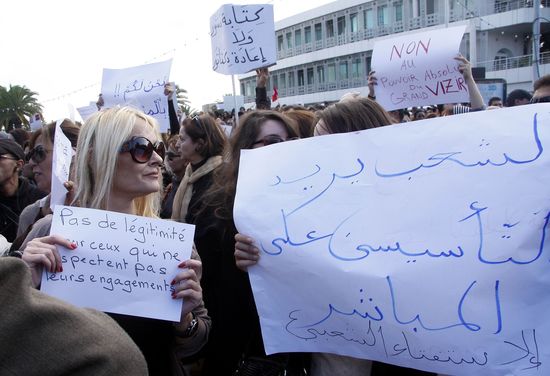
(Photo: People demonstrate outside the Tunisian assembly during the first week of session of the elected constituent assembly in Tunis on November 30, 2011 demanding that Tunisia's Islamist movement Ennahdha respect the rights of women. Tunisia's three main parties formalised a power-sharing agreement following October 23 elections for the constituent assembly with Ennahda party leader Hamadi Jebali as prime minister. Placard on right reads ' Debates should be transmitted live on television(s).' By Salah Habibi/AFP/Getty Images.)

A Short Cut Back To 1750?

Clare Heyward thinks through the implications of Libya's proposal at the climate change conference in Durban to reverse global warming by turning the Sahara into a massive wind and solar farm. Here's the somewhat Qaddafi-like proposal for

dozens of enormous greenhouse-like structures up to 15km in diameter built across the Sahara and Arabian deserts. Each would suck in air, that would be heated and then escape at high speed through large venting towers.

This “conversion of daylight into steady winds” would, he said, power rings of wind turbines that would, with the help of a huge global network of electricity connectors, generate enough power to end the world’s reliance on traditional fossil fuels.

Plausible in any way?

It is not obviously an attempt at removing carbon dioxide from the atmosphere (carbon dioxide removal, or CDR),  nor a method which seeks to hold global temperatures steady regardless of increases in atmospheric GHGs, known as solar radiation management (SRM).  It is mitigation, the reduction of carbon dioxide emissions, but on an almost unimaginably vast scale – planetary engineering, if you like.

My own view is that some kind of massive bio-engineering like this will likely be humankind's ultimate way of grappling with the stress our mass consumerism is placing on the planet. But like Heyward, I remain utterly unable to judge if something on this scale is possible.

What Liberal Revolt?

Yzgzhum0feu4w3ixyuylmw

Rakim Brooks doesn't believe Obama's base is deserting him:

Liberals are not the president’s problem. When Democratic presidents or nominees lose elections, it is because of independents and centrist voters. President Obama’s problem is no different. When he was inaugurated 62 percent of independents and 41 percent of Republicans approved of the president. Today, support rests at 39 percent and 10 percent from those respective groups, whereas core constituencies, like women and African Americans, have stuck with the president. African-American women are near universal in their approval of Obama.

(Chart by Gallup)

Why Is Fox Attacking Republicans?

Gabriel Sherman thinks "the network plans to tack toward the center for the general election":

While CNN has slipped again to third-place in the cable ratings race, Fox recognizes that the network still poses the biggest threat if it gets its act together.

During the 2008 election, Anderson Cooper and Wolf Blitzer surged to the top the ratings for their respective time-slots and CNN scored wins on big news events. Since then, CNN has flailed and ratings have dived. But CNN's brand remains powerful at big news-making moments — and Presidential elections are about as big as they get. Which partly explains why Fox wants to distance itself from the overt championing of Tea Party politics that defined its post-2008 coverage of Obama. Dominating as much of the election as possible means appealing to viewers beyond the conservative base and being perceived as a credible news outfit.

Density’s Manifest Destiny

Dfw

Joel Kotkin questions it: 

[A]ny analysis of the 2010 U.S. Census would make perfectly clear that rather than heading for density, Americans are voting with their feet in the opposite direction: toward the outer sections of the metropolis and to smaller, less dense cities. … The top ten population gainers among metropolitan areas — growing by 20%, twice the national average, or more — are the low-density Las Vegas, Raleigh, Austin, Charlotte, Riverside–San Bernardino, Orlando, Phoenix, Houston, San Antonio and Atlanta. By contrast, many of the densest metropolitan areas — including San Francisco, Los Angeles, Philadelphia, Boston and New York — grew at rates half the national average or less. It turns out that while urban land owners, planners and pundits love density, people for the most part continue to prefer space, if they can afford it. No amount of spinmeistering can change that basic fact, at least according to trends of past decade.

Reihan isn't so sure:

Are people choosing low-density metropolitan areas — or did rising prices in high-density metropolitan areas drive the population shift? “Urban land owners, planners, and pundits” might love density, but have dense cities allowed enough new construction to meet existing demand to live in dense, amenity-rich cities and regions? Ryan Avent’s The Gated City offers an alternate hypothesis that strikes me as more convincing. If regions like New York and the Bay Area allowed more construction, more people would choose to live in them. Density isn’t deterring potential migrants and encouraging emigration: high prices driven by constrained supply are to blame.  

(Image from Flickr user skys the limit2)

The Stateless Elite

Felix Salmon observes that many of the global 1% have "broken the bounds of national identity, and have basically created a stateless stratospheric sovereignty of their very own":

In a way it’s reassuring that America’s billionaires are still so civic-minded that they buy laws and political parties: it’s a sign that they’re invested in the country and are here for the foreseeable. And the one law they’re not going to repeal any time soon is the most important one — the one which says that US citizens have to pay US federal taxes on their global income, no matter where they live. (Or at least demonstrate that they’ve paid at least that much in taxes elsewhere.) American plutocrats, almost uniquely, are tied to their home country in a way that other members of the global elite can barely imagine.

Chrystia Freeland covered similar ground in her Atlantic cover story last year. Dish coverage here, here, here and here.