America’s Israel Headache

It doesn’t seem to be getting any better, and it isn’t helped by the super-cynical interventions of the GOP. The US Ambassador just remarked that

“A distinction should be made between traditional anti-Semitism, which should be condemned and Muslim hatred for Jews, which stems from the ongoing conflict between Israel and the Palestinians.”

It is simply a fact that Israel’s recent actions in Gaza and long-standing settlement policy on the West Bank have isolated Israel from Western publics and fanned the flames of anti-Semitism in the region. Yes, the old bigotries endure and are indefensible; but one way of isolating and stigmatizing them is to remove legitimate reasons for criticism, like the de facto annexation of the West Bank and refusal to halt settlement construction. There’s no excuse for anti-Semitism of any kind, but is it not obvious that the current Israeli government is going out of its way to alienate otherwise friendly observers and friends?

If you run a government that increasingly allows women’s rights to be restricted, passes laws that restrict foreign funding for left-wing NGOs, drafts bill making it easier to sue journalists, and broadcasts ads warning citizens not to marry Americans, then it is perfectly appropriate for the US secretary of state to call you on it. If you have damaged US interests in the region by intransigence and needless antagonism of vital regional allies, like Turkey, and by threats of unilateral action, without any warning, towards Iran’s nuclear threat, then you deserve some tough love from the US defense secretary.

Do fanatics like Jennifer Rubin really believe that Hillary Clinton, Joe Biden, David Petraeus, Robert Gates and Leon Panetta are all anti-Semites? What would it take for these neocons to wake up to the threat Israel is posing to itself?

Mitt’s Media Problem

Dylan Byers wonders if Romney’s strict avoidance of the mainstream media is backfiring: 

The Romney team’s M.O. has been to pursue softball coverage in lieu of potentially dangerous interviews. He agreed to interviews with soft-lens magazines like Parade and People, but not with newsmagazines or websites, or even with the Boston Globe reporters who are writing a biography of the candidate. He has avoided The New York Times as well, and his only policy-oriented interview — foreign policy, exclusively — with The Washington Post was granted to blogger Jennifer Rubin, who holds similar views. Romney also avoids reporters’ questions on the trail. When confronted by a Times reporter about this, he countered that he had press avails “almost every day” — a preposterous stretch of the word “almost.” (In fact, the reporter noted, Romney’s most recent press avail had been nearly a week earlier.)

Meanwhile, as Greg Sargent notes, a Romney adviser is now defending the campaign’s deliberately misleading attack ad on Obama by explaining that “by definition all all political ads are ‘manipulative’ and  ‘propaganda.'” Tom Edsall has more

How Liberals Enable Big Corporations

Jason Brennan unloads on the left:

You complain, perhaps rightly, that corporations are just too big. Well, yeah, we told you that would happen. When you create complicated tax codes, complicated regulatory regimes, and complicated licensing rules, these regulations naturally select for larger and larger corporations. We told you that would happen. Of course, these increasingly large corporations then capture these rules, codes, and regulations to disadvantage their competitors and exploit the rest of us. We told you that would happen.

It’s not rocket science. It’s public choice economics. 

How Do The Germans See The Euro Crisis?

Ezra Klein is in country. He says the Germans "seem serenely confident that it will all work out, and this will end in a stronger, more united, Europe." How they view austerity:

The German embrace of austerity raises an obvious question: If Southern Europe is to cut and tax, how will they grow? The German answer, put simply, is, "like we did."

Ten years ago, the Germans are quick to note, unemployment in Germany was 10 percent and structural deficits were large. Germany was called "the sick man of Europe." They attribute their subsequent success to a series of painful reforms they made to their unemployment insurance system, their health-care sector, and other pieces of their social safety net. Many figure that if they could do it, so too can Southern Europe. In truth, it's probably not that easy — Southern Europe doesn't have the industrial strength that Germany does, and no longer even controls its own currency levels — but it makes sense to the man on the street.

Time For The GOP To Grow Up At Last?

132621480

Jim Pethokoukis joins George Will

Huntsman a conservative? As governor, he massively cut income and sales taxes — instituting a 5 percent flat income tax — while expanding the state’s “rainy day” reserve fund. His approach to healthcare reform relied on markets rather than mandates. As the Club for Growth describes it, “Utah’s main health reform contained no individual mandate, no employer mandate, and has very limited regulatory authority. … It empowers individuals to take ownership of their own health insurance and to choose coverage that works for them.” If elected president, Huntsman says he would like to slash tax rates to their lowest levels since before America entered World War One and eliminate taxes on capital gains and dividends. … He’s also pro-life, a dedicated free trader and  – at least as evidenced by his sweeping bank reform plan — an ardent anti-crony capitalist.

Conn Carroll compiles more evidence "from the conservative media, both establishment and insurgent," that Huntsman may get a real second look. I'm a little stunned that Erick Erickson is on board:

His record as a Governor is more conservative than Newt Gingrich and Mitt Romney combined. He is more pro-life than either of them. He is more economically wedded to the free market than either of them. He has better foreign policy experience than either of them. Huntsman should be a conservative hero in this race.

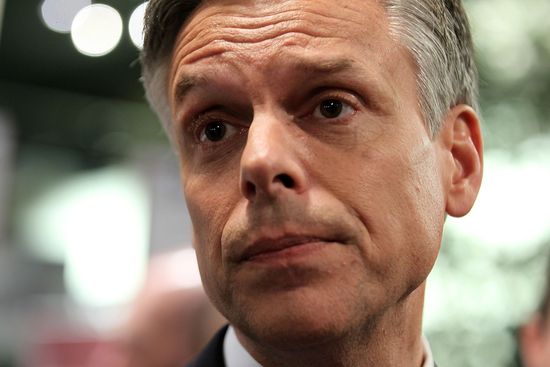
(Photo: Republican presidential candidate and former Governor of Utah Jon Huntsman speaks to members of the media after a presidential debate at Wofford College November 12, 2011 in Spartanburg, South Carolina. The debate was focused on national security and foreign policy. By Alex Wong/Getty Images.)

Race And Intelligence: A Wrap

The most recent Dish thread on race and IQ can be read in chronological order here, here, here, here, here, here and here. Final exchange with Ta-Nehisi here and here. We didn't have room to accommodate the flood of dissents and counter-dissents from the in-tray, many of which have been aired in the past, but we did provide an unfiltered forum over at our Facebook page, which has over 100 entries so far. For readers whose emails didn't get posted on the Dish, we encourage you to copy-and-paste parts of them on the FB page to get your voices heard.

For a comprehensive look back at coverage on the Dish over the years, follow the links below.

Basic pros and cons of the IQ issue here. Debate sparked by James Watson's 2007 controversial comments here, here, here and here. Another sparked by a May 2010 email from a Harvard Law student here, here, here, here, here and here. On the Jewish connection here. Some data from Science Times here. An array of commentary from bloggers and readers here, here, here, here, here, here and here.

I think the marginal returns of continuing to wrangle over this on the Dish have rapidly diminished and I think TNC's and my resolution should conclude this discussion. But one of the cool things about our newly energized Facebook page (thanks, Chris) is that you can carry on the debate if you so wish. (You can even comment on why we don't have a comments section.)