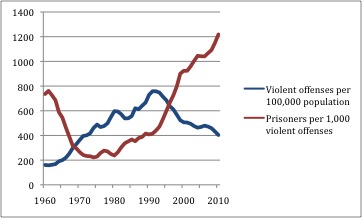
Charles Murray points to a higher rate of incarceration as the reason we've seen such a big drop in crime over the past two decades:
Suppose we had maintained imprisonment for violent crime at the rate that applied in 1974. In that case, we would have had 276,769 state and federal prisoners in 2010 instead of the 1,518,104 we actually had. Suppose tomorrow we freed 1.2 million inmates from state and federal prisons. Do we really think violent crime would continue to drop at a somewhat slower pace?
Pete Wehner thinks the answer is far more complicated:
I tend to be skeptical of mono-causal explanations when it comes to social phenomena and behavioral trends. These tend to be the result of a complex, and sometimes mysterious, interplay of events. For examples, since the early-to-mid-1990s, out-of-wedlock births have increased from less than 30 percent of all births to more than 40 percent of all births today. Yet during that period almost every other social indicator — including crime, drug use, welfare, education test scores, teen suicides, divorce, and abortion –improved. In some areas, like crime and welfare, the progress has the dimensions of a sea change. This is a remarkable, unexpected and encouraging development. It also reaffirms the conservative belief that modesty and caveats are in order when it comes to our ability to understand, let alone predict, social trends and human behavior.
 The Dish