Sasha Issenberg assembles evidence:
Under some circumstances, they can motivate people to vote. Before New York City’s 2005 mayoral election, Fordham University professor Costas Panagopoulos decided to take his curiosity about the effectiveness of signs to the streets. In the only known randomized academic experiment on the subject, Panagopoulos matched 14 pairs of Manhattan voting locations with similar turnout levels in previous elections. In each pair, he randomly designated one location as a control and the other as an experimental treatment: a small group of volunteers were dispatched to a nearby intersection, where they stood for 11 hours on election eve with white 2-foot -by-3-foot signs with "VOTE TOMORROW" written in blue. Once the polls had closed, Panagopoulos checked the numbers of votes cast in each of the 28 districts, and found that the ones visited by his sign-wavers had 37 percent turnout, nearly four points higher than those that didn’t.
Panagopoulos attributed that boost to the value of a quick reminder and speculated that seeing one’s neighbors publicly promoting the cause might instill a sense of social pressure to vote. That’s why Panagopoulos designed his experiment to measure if signs could change behavior on the boulevard, rather than just inspiring an already convivial small-town Main Street. “Detecting environmental effects in New York City, the epitome of urban anomie, would produce more convincing evidence,” Panagopoulos wrote.
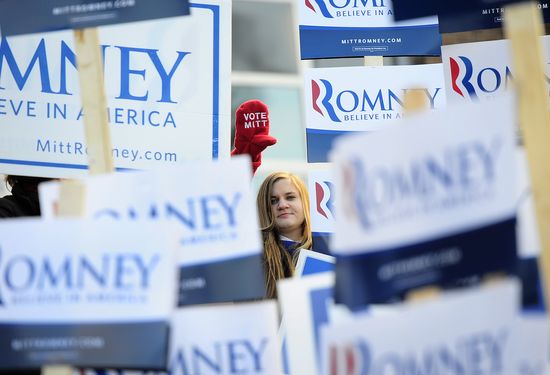
(A Republican presidential hopeful Mitt Romney supporter expresses her opinion outside a polling station at Webster School in Manchester, New Hampshire, on January 10, 2012. By Emmanuel Dunand/AFP/Getty Images)
 The Dish