Surowiecki fears the long-term consequences of stock market volatility:
[W]hile crazy volatility may be great for traders (who live for the chance to make two per cent a day), it’s lousy for the rest of us, and for the economy as a whole. It isn’t just that volatility costs ordinary investors money.
It also makes them more likely to give up on the stock market entirely: over the past three years, investors have pulled almost two hundred and fifty billion dollars out of equity funds, even though stock prices have almost doubled since the lowest point of the crash. And, while some of that money has gone into exchange-traded funds, most of it has just left the market. This flight from stocks is probably not a good thing for people’s retirement accounts—after all, in a capitalist country owning some capital is usually a smart way to make money. But it may well be a good thing for investors’ psychological well-being. In effect, they’ve decided that, in a market as volatile as this one, the only way to win the game is simply not to play.
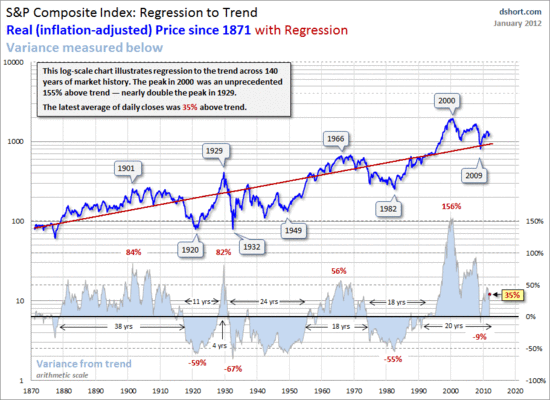
Chart (click to enlarge) from Doug Short, who comments:
The peak in 2000 marked an unprecedented 156% overshooting of the trend — nearly double the overshoot in 1929. The index had been above trend for two decades, with once exception: it dipped about 9% below trend briefly in March of 2009. But at the beginning of January 2012, it is 35% above trend. In sharp contrast, the major troughs of the past saw declines in excess of 50% below the trend. If the current S&P 500 were sitting squarely on the regression, it would be around the 923 level. If the index should decline over the next few years to a level comparable to previous major bottoms, it would fall to the mid 400s.
 The Dish
