Ian Leslie hopes not:
In 1952 a French sociologist called Paul-Henry Chombart de Lauwe asked a student to keep a journal of her daily movements. When he mapped her paths onto a map of Paris he saw the emergence of a triangle, with vertices at her apartment, her university and the home of her piano teacher. Her movements, he said, illustrated "the narrowness of the real Paris in which each individual lives".
To some degree, the hopes of the internet’s pioneers [to foster serendipity] have been fulfilled. You type "squid" into a search engine, you land on the Wikipedia page about squid, and in no time you are reading about Jules Verne and Pliny. But most of us use the web in the manner of that Parisian student. We have our paths, our bookmarks and our feeds, and we stick closely to them. We no longer "surf" the information superhighway, as it has become too vast to cruise without a map. And as it has evolved, it has become better and better at ensuring we need never stray from our virtual triangles.
Along similar lines, Farhad Manjoo chides Google for incorporating social media into its search engine:
While my friends are thoughtful and knowledgeable people, their views on the tens of thousands of large and small inquiries that I bring to Google every year are almost always irrelevant. When I’ve got a clogged toilet, I want advice from an expert—a plumber, preferably, but I’ll even take the stranger who wrote this eHow post. What I don’t want to know is which link my boss consulted when his toilet was clogged.
Earlier coverage of the "filter bubble" here and here.
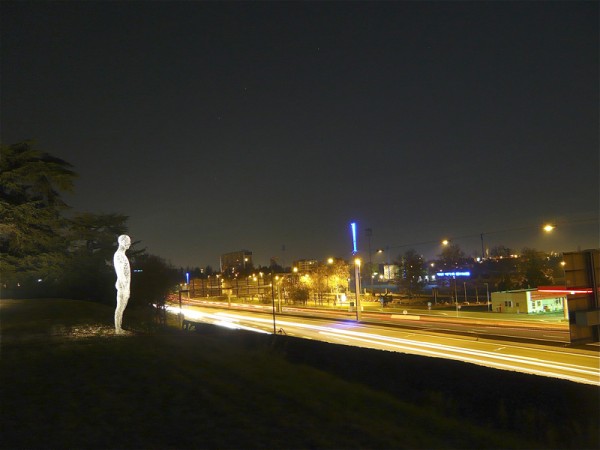
(Image: Les Voyageurs by Cedric Le Borgne)
 The Dish