Is Equality The Answer To Education?

Anu Partanen spotlights the curious example of Finland, where there are no private schools: 

Education has been seen first and foremost not as a way to produce star performers, but as an instrument to even out social inequality. … Finland offers all pupils free school meals, easy access to health care, psychological counseling, and individualized student guidance. In fact, since academic excellence wasn't a particular priority on the Finnish to-do list, when Finland's students scored so high on the first PISA survey in 2001, many Finns thought the results must be a mistake. But subsequent PISA tests confirmed that Finland — unlike, say, very similar countries such as Norway — was producing academic excellence through its particular policy focus on equity.

But for all the talk of equity and non-competitiveness in Partanen's piece, this key sentence is skipped over rather quickly: "A master's degree is required to enter the profession, and teacher training programs are among the most selective professional schools in the country."

New Defense Strategy Reax

Spencer Ackerman:

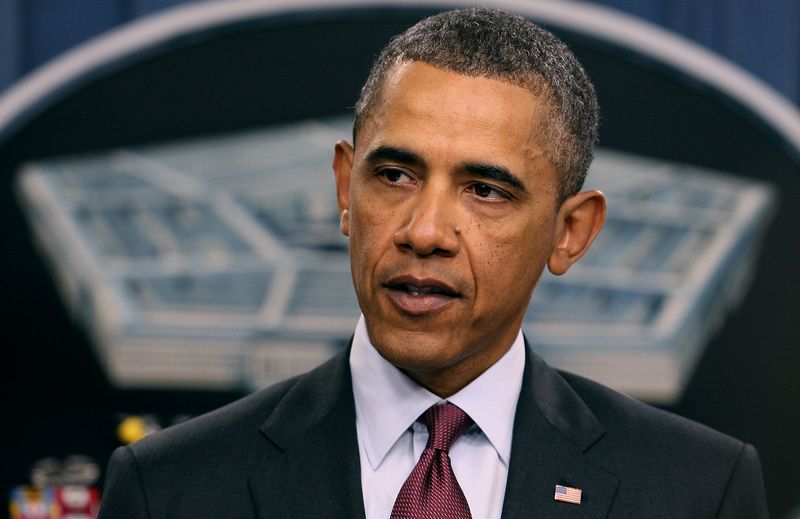
Many of the key points in President Obama’s new blueprint for the next decade of U.S. defense strategy are straightforward. More spy gear; more special forces; fewer land wars; Asia, Asia, Asia. Whatever you think of the merits of those points, at least they’re internally consistent. Others… not so much. Sometimes the analysis in the strategy suggests a policy choice that the strategy actually disavows. Sometimes it walks back controversial points. Sometimes it makes pledges that sound sensible at first blush — but don’t actually make sense the more you think about them. 

Gulliver:

One particular line from the document is getting a lot of attention: U.S. forces will no longer be sized to conduct large-scale, prolonged stability operations. COIN is dead, or something like that. (Spencer writes "kiss big counterinsurgencies goodbye.") Bollocks…What this document is saying is not that such operations will no longer be considered, but rather that the steady-state, "peacetime" U.S. military will not be manned as if we expect to engage in them next month. Manned. Sized. Structured. You know, like the U.S. military in 1938 wasn't sized to simultaneously conduct major combat operations against the world's two most capable military powers in geographically distant theaters. That doesn't mean we couldn't do it; it just means we weren't allocating our national resources as if that was a preferred or expected course of action in the near term.

Jonathan Rue:

I fear that I’ll be lumped in with the libertarian set, or worse, Ron Paul, but this so-called strategy and the idea of significantly reducing the growth of the Department of Defense is meaningless unless we’re prepared to revisit our assumptions on the utility of military force. Moreover, we have to rethink what constitutes “vital American interests” when considering military action.

Jacob Stokes:

The strategy does not call for less everywhere. In fact, it explicitly calls for a “pivot” that would increase resources in Asia while still retaining a large presence in the Middle East. That shift would highlight naval and airpower over ground forces. Given the scarcity of resources, changes will likely include a redeployment of about a third of U.S. forces currently stationed in Europe. Broadly, the shift toward Asia shows an understanding that the center of gravity in global politics has shifted towards the Western Pacific. 

Gary Schmitt:

It’s a declinist strategy for a declinist president. And a key question is whether, when the administration submits its defense budget in a month, the Congress will step up to the plate and reverse course.

Andrew Exum:

I spent the months before Christmas meeting with some U.S. allies in the Gulf, who expressed their concern that a U.S. shift to East Asia would mean the United States was abandoning its security commitments to the Gulf. The president, the secretary and the guidance explicitly pushed back against that worry. So our Gulf allies should rest easier tonight. (One rare specific offered by Sec. Panetta during the press conference was the scenario whereby the United States fights a land war in Korea and also keeps the Straits of Hormuz open.) But I wonder how this will change if the behavior of U.S. allies make continued cooperation more difficult. If Bahrain continues its brutal crackdown on democracy activists into 2012, the United States will have a huge political problem on its hands — as well as a potentially huge engineering problem as it considers other basing options for the Fifth Fleet.

Bryan McGrath:

While the President believes we can “assume more risk” in Europe by cutting back our commitments there, he ignores potential tinder boxes all along Europe’s southern and eastern flanks.  Tunisia, Libya, Egypt, Syria—much of the Mediterranean littoral is governed (or under-governed) by questionable and hostile regimes.  Additionally, our steadfast ally in the region—Israel—is increasingly surrounded by regimes newly dedicated to its instability, even as we cut back both our military and our naval presence in the region.

Steve Saideman:

China is not going to attack Pearl Harbor anytime soon, and it does lack some basic capacities to dominate the Pacific.  War is not likely soon or in the medium term.  However, being prepared is one of the better ways to avoid war.  Further, it is a matter of priorities and threats.  Is the Pacific a more uncertain, less institutionalized environment than the Atlantic and the Mediterranean?  Yes.  No doubt.  Europe has its problems, including an increasingly authoritarian Hungary (oh my!), but we have a much more stable status quo there.  The fears are about whether Germany will exert enough leadership, not whether various actors within Europe will drop out of NATO and start attacking others (well, except for the constant Greece-Turkey thing). In Asia, there is China, making threats to its neighbors, North Korean being North Korea, lots of other hotspots, and, oh by the way, India is in PACOM's area of responsibility.  Plus Europe is closer and has much more infrastructure so the US could surge there more quickly and more effectively.  Again, less resources (less than previously planned/dreamed) means prioritizing, and the Pacific is simply of greater concern

Fred Kaplan:

This new defense guidance was driven by the fiscal crisis above all. The budget agreement struck last year requires the Pentagon to cut its plans by $487 billion over the next 10 years—and $263 billion of that over the next five years. (This does not include the hundreds of billions saved by the fact that the Iraq war is over and the Afghanistan war is winding down.)

Kori Schake:

There is also a crucial guns versus butter issue Panetta fails to take up, at least so far. As Arnold Punaro from the Defense Business Board puts it, unless major changes are made to DOD medical and retirement programs, "If we allow the current trend to continue, we're going to turn the Department of Defense into a benefits company that occasionally kills a terrorist." The same growth of medical and retirement programs that is the principal driver of our federal debt is also crowding out other spending within the DOD budget. I expect that is where Panetta will focus the second tranche of cuts.

Travis Sharp:

The Obama administration's new strategic guidance assumes that the Department of Defense (DOD) will absorb $487 billion in cuts to its budget over the next decade. Yet that assumption does not match the current law of the land, sequestration, which will roughly double the amount of cuts. If sequestration occurs, DOD will not be able to execute this new guidance. In that scenario, DOD will likely further reduce capabilities that provide insurance against uncertainty while preserving capabilities that provide protection against the most pressing threats facing the nation. The new guidance seems to identify ground forces and nuclear weapons as two 'insurance' capabilities that DOD might cut further if Congress doesn't undo sequestration.

Jason Fritz:

If we look back on those days we will see that the President(s) insisted on limited actions of influence. George H.W. Bush did not seek victory (in the sense that his son did) against Iraq. Ditto Clinton in Somalia or Iraq again (Operation DESERT FOX). The U.S. had limited objectives to influence and bend our adversaries to our will, not defeat them in the way we've sought against our enemies past and (delusionally) present. There will be no more "win" or "victory". There will be no more mission statements to defeat our enemies. Barring some existential threat to the U.S., I don't see how any military objectives after Afghanistan can have any end states other than very specific policy or political goal that doesn't include the eradication of our adversary. The next 10 years of austerity should be the death knell for victory as we've known it.

If You Liked Dubya, You’ll Love Santorum

James Poulos calls Santorum "Zombie Bush," and blames his sudden rise on the candidates' "awkward conspiracy of silence surrounding the Bush years." Larison reminds us that Santorum was one of two senators to vote against Bob Gates' confirmation after Rumsfeld resigned in 2006: 

He was intensifying his hawkishness at the same time that even the Bush administration was beginning to pull back from some of the ideological enthusiasms and mistakes of its first five years. Santorum’s foreign policy might actually be more aggressive than that of Bush’s first term … Romney represents a return to Bush-era policies, and that’s bad enough, but Santorum would represent a full-blown revival of the worst elements of the Bush administration’s policies and mentality during its early years.

David Boaz has more.

Chart Of The Day

Romney_Tax_Plan

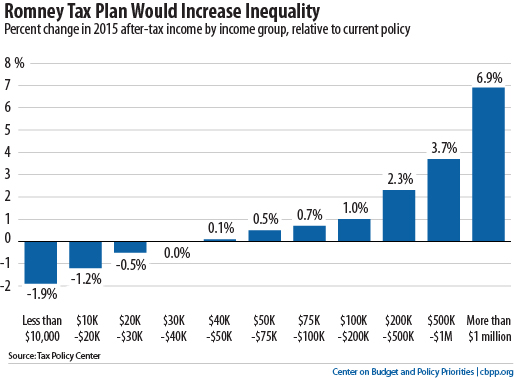
Romney's tax plan would mostly benefit the rich:

The Romney plan would provide massive tax cuts at the top of the income scale.  In fact, more than half of its total tax cuts would go to the top 1 percent of households (that is, people with incomes over $630,000), according to TPC. The average millionaire would receive a tax cut of $146,000 in 2015, in addition to the $141,000 he or she would receive from an extension of the Bush tax cuts. By contrast, the plan would hurt poor Americans by not extending some recently enacted tax policies aimed at low- and moderate-income families. 

Kevin Drum and Jonathan Chait both see major problems with Romney's plan.

Is Libertarianism Fundamentally Racist? Ctd

Readers join the thread:

Your response to Chait and Smith was good, but missed something.  There are two layers of government in the US, of course, and I believe it is the responsibility of the Feds to compel non-discrimination when a state’s laws are discriminatory or designed to foster discrimination.  The 14th Amendment saw to that, and nicely so, although examples such as DOMA, which overule state governments' attempt to give equal rights to their gay citizens, demonstrate that the Feds are just as willing to impose discrimination.

Another writes:

I think you almost entirely dodged the thrust of Chait's argument, but I want to focus on the part in which you write, "And that is the core difference between power exerted by the state and power exerted by non-state actors: the former is ultimately backed by physical force deployed by the government."

Let's accept the claim that this should be the "core difference" for a moment. In what sense is, say, the State of Alabama not a "state" which is able to exert power backed by physical force? Do police batons and fire hoses count? Why, in the United States, do libertarians so often seek to limit the power of the Federal state so as to clear the way for a return to unchecked State violations of human rights and civil liberties? If we accept libertarian values, what does this accomplish? (And don't tell me "you can move if you don't like Alabama." You can move if you don't like the U.S., too. That's no argument at all.)

A real libertarian should be just as concerned about a State government's infringement of individual liberty as the Federal government's. There should be no distinction. Period. Instead, for some strange reason, American libertarians always rail against Federal power and champion the cause of unfettered State power. Why do you think American libertarians historically champion the cause of unfettered State power in the name of "individual liberty"?

My reader is right. I don't support unfettered state power to ignore, say, equal protection. I'd favor more libertarian policies in every state. The point is that you are more free the more accountable your government is, and states are closer to their own voters than the federal government. Again, the struggle between freedom and justice is a real trade-off at times, and it would be helpful if both sides acknowledged that. Another quotes me:

The social power of homophobia and hetero-sexism in a free culture is crushing. I oppose it; and recognize it. I have spent a great deal of my life pushing back culturally and intellectually and morally against it. But I do not want to compel it into submission. I want to persuade it into toleration. 

There's a fundamental problem here.  You propose to use reasonable persuasion to combat hatred.  But hatred is not reasonable.  The hatred of bigotry is based upon fear and ignorance, and those who cling to bigotry are impervious to facts or to reasonable argument.

Really? This is where contemporary liberalism is actually illiberal. Twenty five years ago, the gay left told me exactly the same: don't even bother making arguments; they all hate us. And in one generation of active persuasion, we moved the needle faster than any civil rights movement in history. Forgive me for thinking that reason and ideas matter in a free society; and that they should be our first tools for change. Another:

You wrote, "Because I believe in civil equality as guaranteed by the Constitution, I insist on absolute neutrality by the government, which is supposed to represent all citizens, but I would allow for private hostility, bigotry, hatred and even discrimination in civil society." Does that mean you don't like Title II of the Civil Rights Act of 1964, which prohibited discrimination based on race, color, religion, or national origin in PRIVATE places of public accommodation like hotels, restaurants, etc.? Is it really your view that those places should be able to refuse service to blacks, muslims, or whomever without consequence?

Public accommodation is different than private association – and should be coereced not to discriminate. But I wholeheartedly support the right of, say, the Boy Scouts to discriminate against gays, or the Saint Patrick's Parade to do so, as long as they do not rely on government funding or facilities. One more reader:

As a 24-year-old I've been a Ron Paul supporter since my college days. I'm hispanic, so I would think this racist stuff should bother me in a country where racism is mostly aimed at blacks and hispanics. But that stuff doesn't bother me because I've learned that most people have and continue to battle prejudices within ourselves, and I'm much more comfortable with a presidential candidate that recognizes his past failures and current prejudices, actively changing his behavior and beliefs because he loves others enough to change himself to improve the world for everyone around him.

And Paul's track record proves that his changed behavior is sincere and not just a scheme for votes. He's always been sincere and honest except for how he handled the racist newsletter stuff. I can look past that moment because it must be rather embarrassing to deal with the same stupid mistake for the entirety of your career.  It's old news that has always been and always will be an issue for Paul. More importantly, he recognizes EVERYONE's rights despite the fact that his upbringing, or whatever, taught him differently.
Has Obama Kept His Promises?

Jonathan Bernstein checks in:

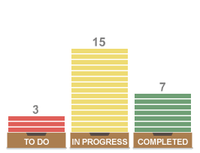
According to Politifact’s "Obameter," Obama made 508 separate promises during the campaign. Of these, he has fulfilled, by the Obameter’s count, 158, or just under a third—everything from ordering the troop surge in Afghanistan to removing don’t ask, don’t tell to reforming health care to reducing strategic nuclear weapons. He has broken, again according to Politifact’s count, fifty-four promises, just over 10 percent. But even on these, such as failing to end the Bush tax rates for upper-income taxpayers and passing "card check” for unions, generally the story is that Obama wound up placing a low priority on some items and was defeated on them.

What I think is most telling is that of the original 508 promises, only two—two!—are "not yet rated," implying that there’s been no action at all. What the Obameter is reallyScreen shot 2012-01-06 at 1.02.30 AM telling us is the same thing that political scientists have found: presidents certainly try to carry out their campaign promises, and they succeed in many cases, although they’ll push harder on some things than on others, and they are sometimes defeated or forced to compromise. Campaign promises set the presidential agenda, even when they don’t tell you which items will pan out and which won’t.
(Image from the WaPo's own feature of "key promises" from  Obama's first campaign)

The Syrians’ Need To Be Heard

Issandr El Amrani reflects on the above video:

This video really highlights the isolation of the Syrians — because the situation is confusing, because most media have a tough time covering the conflict, because there is an "Arab Spring weariness" in much of the world, because the consequences of the uprising there are regionally daunting. What's so moving about this scene is the protestors' need to be noticed, for the world to take note, to have an audience for their chants and slogans.

Shit Santorum Says

A list. Dish faves:

“Many of the Christian faith have said, well, that’s okay, contraception is okay. It’s not okay. It’s a license to do things in a sexual realm that is counter to how things are supposed to be.”

"I believe Obamacare will rob America, the best way I can put it is, rob America of its soul.”

It's also important to note that Santorum is a cafeteria Catholic. Opposing any sacrifice from the very wealthy in cutting the debt, while slashing healthcare for seniors is not orthodox Catholicism. Nor is support for torture; or pre-emptive war. The Vatican doesn't really care as long as he keeps up the war on gays, privacy and contraception. But he is a dissident in the church – from the fringe right.

Has Romney Already Won?

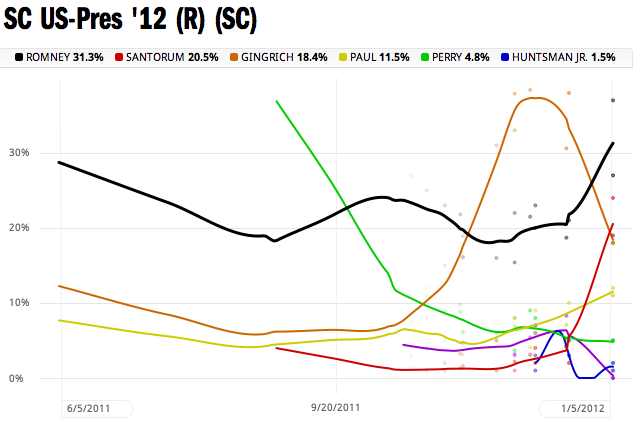
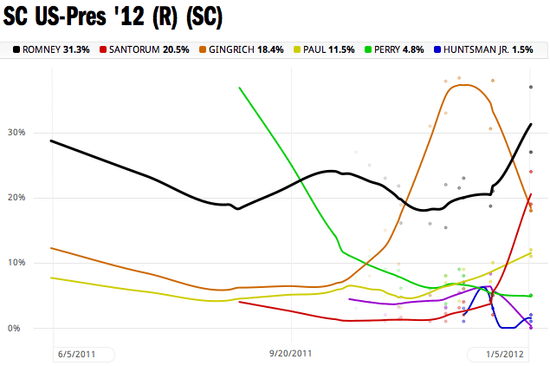
SC_Poll_Polls

Josh Marshall begins to think so:

Public Policy Polling is currently in the field in [South Carolina]. And they’ve just tweeted a few polling morsels from there first night of polling. And the first night shows Mitt Romney ahead by 10 points in the state, with Gingrich and Santorum battling for second. It seems very likely that Romney will win convincingly in New Hampshire. If he then goes on to score a clear win in South Carolina, that would likely be pretty much it in terms of a real battle for the nomination.

A new CNN poll has Romney at 37%, Santorum at 19%, and Gingrich at 18% in South Carolina:

Romney is getting his share of born-again Christians (35%), Tea Party supporters (32%) and self-described conservatives (37%). This is, however, South Carolina, notoriously one of the nastiest political battlefields in the U.S., and the anonymous backstabbing, radio spots, Church fliers and Super PAC attack ads have yet to saturate the state. And a 49% plurality of likely voters said they are still open to changing their minds.  A New Hampshire surprise could tilt expectations. Santorum might just need more time. But for now, everything’s coming up Romney.

Rassmussen's new poll has Romney at 27%, Santorum at 24% and Gingrich at 18% in South Carolina. Ed Morrissey analyzes:

The news has to be encouraging to both Romney and Santorum.  Romney was not expected to do well in South Carolina, but his numbers have improved quite a bit over the last three weeks, and two-thirds of voters in this poll expect him to win the nomination, while 45% believe he’s the strongest candidate to beat Obama in the fall.  Only 16% believe that of Santorum, which means his support outstrips his perceived viability.  A second-place finish in New Hampshire might improve that number and perhaps add more to his support, but that may come at the expense of other conservatives in the race rather than Romney.

(South Carolina poll of polls from TPM.)