Dear David

My friend David Brooks writes the following:

I’m to Rick Santorum’s left on most social issues, like same-sex marriage and abortion.

No, no, no. David is to Santorum's right on both issues, if left and right retain any meaning. Same-sex marriage is arguably the most successful socially conservative reform ever, as Conor Friedersdorf notes.

It has brought families together; it has strengthened mutual responsibility; it has integrated a minority much more healthily into the majority; it has added an insitution designed to mitigate the chaos of love and sex, and help guide them to more lasting, stable forms. On abortion, the settled law of the land is pro-choice. Roe was a ghastly over-reach, but criminalizing all abortion would be a huge disruption to the social order as it now is, and would require a massive increase in the power of government over women's lives.

Santorum is a radical, not a conservative, on these issues. David should not surrender his conservative credentials so easily. I found the rest of the column, by the way, surpassingly sane.

Why Ron Paul Is Right And Barack Obama Is Wrong About Iran

One of the key things that Ron Paul has contributed to our discourse is the notion that we should try and look at conflict from the point of view of our foe. You'd think this would be obvious if we are attempting to influence, say, Iran's behavior, to understand their fears, their baseline interests and their ideology. So far, all we hear about is their ideology. But let's broaden our moral imagination in ways not allowed in the Washington Post.

Imagine that three scientists working on the US nuclear arsenal were assassinated in the streets of Chicago or Washington or Los Angeles by agents of Iran. Now imagine that an explosion took place at one of our nuclear facilities – also engineered by Iran. Also imagine that Iran was capable of blockading US ports to cripple the US economy. Imagine the dollar collapsing because of this and a new depression initiated. What do you think Mitt Romney would be saying? I suspect he would be saying that Iran has already declared war on the US.

But all these things have happened in Iran, probably by the hands of Israeli intelligence, perhaps by the US, or some combo of the two. Is it surprising that the Iranians are throwing rhetoric around, even if much of it is empty? Of course not. Vali Nasr argues that Iran is already on a war-footing because of this:

Iran has interpreted sanctions that hurt its oil exports, which account for about half of government revenue, as acts of war.

Who alone among the presidential candidates gets this? Only Ron Paul. Bob Wright has a must-read on the potential president's lonely sanity on this question. Jon Rauch also notes that the debate we're having about Iran is very very similar to the debate we once had about China's nuclear capacity:

Fifty years ago, [China] was the Iran of its day, a rising regional power that was radical, ideological, boldly antagonistic. It fought the U.S. in Korea, attacked India and Taiwan, supported violent insurgencies and more. Its leader, Mao Zedong, mused that killing half of mankind might be a price worth paying to make the world socialist. Understandably alarmed, some of President Eisenhower’s advisers urged a pre-emptive nuclear attack. (Ike wisely forbore.) President Kennedy said a nuclear China would dominate Southeast Asia and "so upset the world political scene" as to be "intolerable."

Notice the classic Kennedy recklessness in foreign policy (he was George W Bush avant la lettre), and the characteristic Eisenhower sanity. Now look at the history. Since China's adoption of nuclear status, it has actually behaved more responsibly abroad, not less. Jon makes a very persuasive case that nuclear weapons really don't give countries much of an edge, and, if anything, tend to calm them down, especially if they are in a region where they have foes who do have such weapons.

The Obama administration has foolishly decreed that it will never allow a nuclear-armed Iran. It's foolish because at some point, Iran will get one, and the US will therefore have to go to war either to stop it or to punish Iran for it. The obvious option – containment – is foregone.

Obama also argues that he opposes Iran's nukes because of proliferation in the region. At which point one must loudly cough "Ahem." Only one country in the region has illegally, in defiance of internatinal law and the NPT and US policy, has nuclear weapons and it's Israel, not any Arab state. More absurdly, the US government has a formal policy of never acknowledging this fact. At one point in the not-so-distant past, the US government was committed to the view that Iraq had nukes but Israel didn't.

When will the US evolve a sane policy in the Middle East? One that advances our interests, avoids a catastrophic global religious war, and bases it judgment on history and statecraft rather than religion and a US-Israel alliance that, since the end of the Cold War, has become increasingly unhealthy to both parties? Less Kennedy, more Eisenhower, please.

The End Of Republican Fusionism?

Screen shot 2012-01-06 at 11.17.56 AM

Today, the Boston Globe endorsed Jon Huntsman, a mixed blessing for New Hampshire Republicans, but surely a net plus for him. And if he had run a decent campaign and emerged strongly in the debates, you can see how, in an alternative universe, and one I hoped for last summer, this could have been a tipping point. But, sadly, it probably isn't. In the last few polls, Huntsman's support has actually been slipping slightly, and he's being overtaken by Santorum.

What's notable about New Hampshire is Gingrich's collapse over the last month, which wasn't caused in New Hampshire by the Bain Super-PAC. And what's more striking to me is that two candidates have been making steady gains there for the last month at Newt's expense: Romney and Paul. Santorum is soaring, after Iowa, but he still has only half of Paul's support in this libertarian-minded state. Remember also that all these events are currently proportional – so Paul's third and second places add up, especially if you have mastered the caucus process and, unlike some others, actually got on the ballot in every state.

What we're seeing, I think, is Romney as the last, dying gasp of Republican fusionism. The old alliance – free market capitalism, social conservatism and anti-Communism – has morphed into a new one – libertarianism, Christianism and anti-Jihadism. Each faction has become more extreme as they have marinated in their own media complex, and responded to their fantasies about president Obama. And there is therefore no fusion possible between them. Maybe a charismatic figure like Reagan could somehow bind them together again; but such a figure comes along rarely.

Romney's problem is that he understands he has to unite all these strands, but so obviously sees each of them as merely marketing tools for Romney Inc. that he inspires real confidence from none of them. They may get over it. But this feels like a loaf that won't rise in the oven. The fusionist yeast has disappeared. And Obama, far from uniting them all, seems only, in his inimitable way, to drive them into suicidal distraction.

Newt: “I’m Not Rich”

In these straitened times, it's probably a good idea for politicians not to appear too comfortable. But Gingrich has gone from bragging about $60,000 speeches and $1.8 million from Freddie Mac to pleading a "not-rich income" of $2.6 million in 2010. Meanwhile, Romney has joked that he is unemployed. Unemployed with an annual salary of $26 million from Bain for doing nothing.

Rick Santorum Meets The Next Generation

Not pretty:

David Corn reports on the exchange:

Santorum has been in this spot before, and he easily adopted a here-we-go-again stance, and, in a somewhat condescending manner, struck back with…logic. Or what he claimed to be logic. He asked the students to justify gay marriage. When one said, "How about the idea that all men are created equal and [have] the right to happiness and liberty," Santorum asked, Are you saying that everyone should have the right to marry anyone?

The student said yes. And Santorum quickly retorted. "So anyone can marry several people?"

No, the student said.

But what if someone can only be happy if he or she was married to five people? Santorum asked her.

Others in the crowd starting jeering him. "That's not the point," one shouted.

But Santorum, who kept cutting off the students, stuck to this argument. When the students talked about equal rights, he repeatedly interrupted, "What about three men?"

That Santorum has regurgitated the polygamy point reveals, it seems to me, the weakness of his thinking on this issue. Gay people are not seeking the right to marry anyone. They are seeking the right merely to marry someone. Currently we are denied that basic civil right that every heterosexual takes completely for granted, in most states. The issue of polygamy is completely different and separate. Currently, no straight people have a right to a three-way marriage, let alone gay ones. I think there are very good social reasons for that, although it's certainly worth debating. But it's another debate. The only way Santorum's argument works is with the premise that gays denied any right to marry are denied no right at all. They are not in the same category as heterosexuals, and their relationships, and the benefits they bring, are inherently inferior, indeed morally repugnant.

That's Santorum's view. It's his view that private gay sex can and should be regulated by the government to prevent the evil of sodomy from destroying society. And sodomy, remember, means any non-procreative sex act: oral sex, masturbation and, worst of all, contraception: a deliberate flouting of natural law. If this is the position of the GOP, it is essentially turning itself into an irrelevance for the vast majority of those under 40, and hefty proportion of everyone above.

The boos are a harbinger. But they may turn to cheers, of course, in South Carolina.

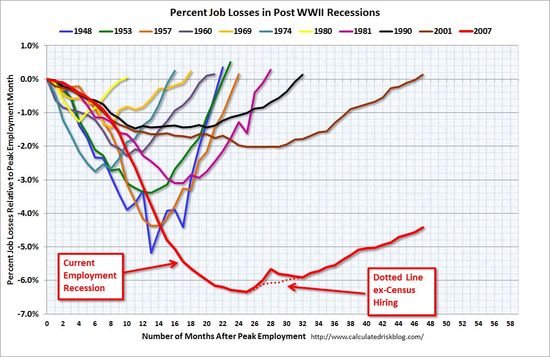
Jobs Report Reax: Getting Better, Slowly

Jobs_Chart

Felix Salmon calls the jobs report "unmitigated good news":

Is this a fantastic report? No: as Betsey Stevenson says, an economy on fire could and would add 400,000 jobs a month, rather than 200,000. But no one’s kidding themselves that this economy is on fire. The main thing is that it’s growing, that things are moving in the right direction, and that we’re well above stall speed. If we stall, remember, there’s no safety net: the chances of any kind of fiscal stimulus in 2012 are exactly zero. So we’re on our own, here. And, happily, we seem to be doing OK.

Calculated Risk is more reserved:

This was a decent report compared to expectations, but it was still weak compared to the number of people unemployed and the high level of unemployment. There were 200,000 payroll jobs added in December. This included 212,000 private sector jobs added, and 12,000 government jobs lost. The unemployment rate fell to 8.5% from a revised 8.7% in November (revised from 8.6%). U-6, an alternate measure of labor underutilization that includes part time workers and marginally attached workers, declined to 15.2% – this remains very high. U-6 was in the 8% range in 2007.

Karl Smith digs into the internals. Ezra Klein:

[T]here’s work to be done. And we have the tools with which to do it. As I wrote inWonkbook this morning, an expanded payroll tax cut, a major effort to encourage refinancing in the housing market, infrastructure investment, and much more could be leveraged to accelerate the recovery. If we are adding jobs more slowly than we need to be, that is, in large part, the fault of Republicans and some Democrats in Congress who refuse to sign onto tried-and-tested methods of creating jobs in recovering economies.

Yglesias:

One key issue going forward is whether the state and local layoffs will cease. This 200,000 number is good by the standards of post-2007 America, but hardly a torrid boom. If instead of subtracting 12,000 government workers from the 212,000 private ones we'd added a few thousand to keep up with population growth, then the headline number would look a lot better. 

Mataconis:

Politically, this obviously is going to make the Obama White House, and the re-election team in Chicago, smile just a little bit. Today’s numbers are first of ten employment reports we will see before the November 8th election (the October report will come out the Friday after the election). A consistent stretch of good news will quite obviously inuure to the President’s benefit, through Republicans will try to spin it another way. This is why it’s far too early for anyone to count the President out of this. 

Chait:

Mitt Romney has made the state of the economy his central theme against Obama. The entire premise of his campaign is that the economy is bad because Obama's economic program has failed. If voters think the economy is improving, Romney has no ammunition left. That is still the smart play for Romney, because if the economy feels strong, he probably can't win anyway, so he needs to plan for the scenario that gives him a chance to win. A few months ago, that scenario was looking almost certain. Now it's looking far less likely.

Jared Bernstein:

Securing, sustaining, and building on these gains, particularly in the face of economic risk factors–Europe, oil, fading stimulus–must become the top goal of policy makers who have heretofore been way too cavalier about this primary responsibility.

(Chart from Calculated Risk)